Tag: Website Strategy

  • How to Attract & Convert Customers with Smart Website Redesign Goals

    How to Attract & Convert Customers with Smart Website Redesign Goals

    If you’re a marketing or business leader, you’re no stranger to setting website redesign goals—or just the challenge of a website redesign (sans the “goal” part). But what if you could do more than make things look better this time—what if you could magically create 10x growth?

    You can, but there’s a hitch: without a plan and solid goals for your website redesign, it might only end up as a costly makeover that ends in frustration and disappointment. 

    You’ve been around the block, so you know your brand’s online presence is worth investing in.

    But with everyone expecting top-notch digital experiences (not to mention the competition breathing down your neck), a botched redesign could mean confused customers, a drop in revenue, and missed opportunities. 

    Let’s not do that, okay? 

    So here’s the solution: your redesign must tackle specific goals to create predictable results.

    Goals like, “I just don’t like how our website looks,” or “Someone in my networking group said we need to switch website platforms” aren’t specific enough.

    In other words, they’re ideas to consider but not good enough reasons to redesign your website.

    The best place to start a website redesign is with a plan. 

    It all begins by changing how you look at the redesign: from a surface-level change to a strategic effort that improves every business function.

    In simpler terms, it’s not about how it looks—it’s about how it works.

    When you start with a plan and clear goals, you can reverse engineer growth. Once your goals, vision, brand, budget, and team align, your website redesign will create tangible, long-term results.

    Get a FREE Customized Digital Growth Plan

    Take our 10-minute Digital Maturity Assessment and receive a FREE, personalized digital growth score that uncovers gaps and drives your business forward.

    Take the Free Assessment →

    What are good reasons to redesign a website?

    Another way of saying this is “why” are you redesigning your website?

    When considering a redesign, you should have a good reason. Often, these reasons coincide with a change or growth in the business that triggers the need for a redesign.

    Website Redesign Team Brainstorming Goals

    For most marketing managers and business owners looking to redesign their websites, the reason often falls into one or more of these five triggers.   

    1. When your brand changes

    If you’ve tweaked your brand’s look or message, your website should reflect those changes.

    It’s about ensuring your online image matches what you stand for now.

    2. When you launch a new product or service

    Your website can be a powerful tool for gearing up to introduce something new and exciting.

    It can help you spotlight your fresh offerings and get potential customers interested.

    3. When it’s been more than two years since your website launch

    Think of your website like a car – it needs regular maintenance.

    If it’s been more than two years since you last spruced it up, chances are it’s not performing as well as it could.

    4. When your industry changes

    In the fast-paced business world, industries change.

    Your website should keep pace if your industry evolves due to new trends or technology. It’s all about staying relevant.

    5. When the business gets bought or sold

    When new owners step in, they might have different plans for the business. That often means the website needs a makeover to match the new vision.

    In short, consider website redesign as a way to stay current, showcase your latest offerings, and reflect any changes in your business journey.

    It’s a strategic initiative to keep your online presence in sync with your evolving goals.

    Get a FREE Customized Digital Growth Plan

    Take our 10-minute Digital Maturity Assessment and receive a FREE, personalized digital growth score that uncovers gaps and drives your business forward.

    Take the Free Assessment →

    What is your site for?

    No matter what you want your website to achieve, remember this: your website is your company’s most crucial tool.

    It’s always open, often where customers connect and order from you.

    It’s even more valuable than a fancy office, a big sign, or updated vehicle wraps. Your website is all those things all the time.

    Marketing Team Meeting for Website Redesign Objectives

    You might remember when things were different if you’ve been around for a while. But now, especially in the digital age, your website is your most important investment. It’s time to update your thinking to get the most out of it. 

    To do that, let’s clarify what your website isn’t.

    1. Your website isn’t a digital brochure; it’s an ecommerce platform.

    It’s time to let go of the old-style brochure websites.

    Remember when customers used to call for price quotes? Those days are long gone, and an essential webpage isn’t enough.

    Websites have a new role now. They’re not just about sharing information; they’re a two-way street, which is excellent for you! If you sell products directly or through dealers, your website must be more than just a digital pamphlet.

    If you sell things, your website must act like an online store. An online store is where people browse and buy and where you earn money.

    This isn’t just a passing trend; it’s a significant change in how people want to buy from you. They want it to be easy and quick. An online shopping experience isn’t just nice—it’s essential!

    Turning your website into an online store can be the key to keeping customers and making sales. People who can’t buy from your website might go to your competition instead. So, it’s time to upgrade!

    2. Your website isn’t just a pretty face; it’s how customers experience every aspect of your brand.

    Looks are important, but your website does way more than look good.

    It’s where people find you, talk to you, and buy from you. What we call the “Flywheel,” your website makes your business work in the digital age.

    • It’s the primary way people see your brand.
    • It’s often the first thing customers see.
    • It’s where folks learn about you.
    • People use it to talk to you.
    • It’s where they shop for your stuff.
    • And it does even more!

    So, remember, your website is not just about looks.

    It’s about making things happen – like transactions, sharing info, engaging customers, and gathering data. To make it work for you, think beyond the visuals. It’s a powerful tool for your whole business.

    3. Your website is not an announcement board; it’s a storefront

    As a business owner or marketing manager, treating your website like a giant news billboard is tempting.

    You might want to shout about your achievements from the mountaintop.

    Celebrating your successes is important, but there’s a better way than plastering them all over your website’s front page.

    Your website should be more about your customers and what they need. It’s not just a place to brag. 

    So, while showcasing your accomplishments is great, remember to keep your website focused on what matters most to your visitors—helping them find what they’re looking for and making it easy for them to do business with you.

    Elevate Your Website Game

    Snag your complimentary Structure Website Design Planner now and start crafting a website strategy that leads to undeniable project success!

    Website redesign goals impact more than marketing

    When most people think of “website goals,” they immediately think of traffic, leads, and sales.

    Those are great goals—in fact, they’re vitally important! But if your website only provides traffic, leads, and sales to your business, you’re missing out on its full potential.

    Business Leaders Discussing Website Redesign Strategies

    The truth is that your website can improve all business functions, from marketing to HR.

    Here’s a short list of the different business functions that your website can impact—and how it affects them.

    1. Strategy and Administrative

    Your website can be pivotal in shaping your overall business strategy.

    It can serve as a platform to communicate your mission, vision, and goals to internal and external stakeholders. 

    Internally, it can streamline administrative processes by providing a centralized hub for communication, document sharing, and project management. 

    Externally, it can showcase your strategic priorities and initiatives, helping investors, partners, and customers understand your direction and values.

    2. Sales and Marketing

    This is the more traditional website role, but it remains crucial.

    Your website is often the first point of contact for potential customers. It should generate leads and sales and serve as a powerful marketing tool. 

    It can also provide valuable content, demonstrate your expertise, and create a positive brand image—and utilizing analytics and user data helps refine marketing strategies and effectively target the right audience.

    3. Finance and Human Resources

    Your website can streamline financial operations and human resource management.

    For example, it can serve as a platform for online billing and payment processing, simplifying financial transactions. 

    Regarding HR, it can assist in recruiting talent by showcasing job openings, detailing company culture, and offering an easy application process. Additionally, it can be a resource for existing employees by providing access to essential documents, training materials, and benefits information.

    4. Information Technology

    From an IT perspective, your website must be secure, scalable, and well-maintained.

    It is your organization’s backbone for many digital tools and platforms. 

    Properly managing your website ensures it remains a reliable and efficient resource for all other IT-related functions. Regular updates, security measures, and technical maintenance are essential for a smooth operation.

    5. Operations and Manufacturing

    Even for businesses involved in operations and manufacturing, a website can have a significant impact.

    It can be a customer portal for placing orders, tracking shipments, and managing accounts. 

    It can also act as a knowledge base, providing technical information, troubleshooting guides, and customer support resources. Your website can improve efficiency and customer satisfaction in these operational areas by offering self-service options.

    Supercharge Your Website Strategy

    Get your hands on the Structure Website Design Planner absolutely FREE and supercharge your website strategy for guaranteed project success!

    How to set goals for your website redesign

    There are many approaches to setting goals for your website redesign.

    While many of them are helpful, at Structure, we’ve found that using your Customer Journey as a guide is most beneficial.

    Team Collaboration for Successful Website Project

    Planning based on your customer journey is the most natural and logical way to think critically about the goals you need your website to accomplish for your customers and your business.

    Here’s how to go about it:

    1. Start with the End – What Do You Want Your Customers to Do?

    It’s crucial to clarify your primary objective.

    Consider what final action you want your website visitors (customers) to take on your website. Let’s call this your “ultimate goal.”

    This ultimate goal can include:

    • Buy a Product: If you’re an e-commerce business, your goal may be to increase product sales directly through your website.
    • Request a Quote: Obtaining quote requests from potential clients can be crucial for service-based industries.
    • Schedule a Call: If your business relies on consultations or appointments, encouraging visitors to schedule a call or meeting is essential.
    • Consume Content: Some websites aim to provide valuable content, so the goal might be to increase content consumption, such as blog post views or video watching.
    • Visit a Location: If you have physical locations, guiding visitors to find and visit those locations can be a goal.
    • Share Content/Product: Social sharing and referrals can be important for spreading the word about your products or content.
    • Donate: Non-profit organizations often aim to increase donations through their websites.
    • Register for an Event: Encouraging registrations is a goal if you host events or webinars.
    • Other: Depending on your unique business model, there may be other specific actions you want visitors to take.

    2. Know Where It Starts – How Do Customers Find Your Website?

    Next, you need to understand how customers find your website.

    Think of this like a map’s “you are here” arrow. 

    Consider the various possible entry points:

    • Paid Search: Do visitors visit your site through paid search campaigns on search engines like Google?
    • Paid Ads: Are online advertisements, such as display or social media ads, driving traffic?
    • Blog Posts: Is your blog a significant traffic source, attracting users through organic search or referrals?
    • Podcast: If you run a podcast, are listeners coming to your site through podcast-related content?
    • Referral Marketing – Influencer/Affiliate: Are influencers or affiliates driving visitors to your site?

    Now, you know where you are and where you want to go. All that’s left to do is fill in the gaps.

    3. Steps Along the Way – What’s the Next Action?

    Once visitors arrive at your website, consider the steps they need to take to fulfill your ultimate goal.

    This may involve navigating various pages, interacting with specific elements, or filling out forms. 

    Pro tip: using the AIDA Framework for this step is helpful. 

    Use the AIDA framework to document action steps

    The AIDA framework is a widely used marketing and advertising model that outlines a potential customer’s stages when interacting with a product or service.

    AIDA stands for:

    Attention 

    This is the stage where you grab the audience’s attention.

    You must create awareness and pique their interest in your product or service.

    This can be achieved through compelling headlines, eye-catching visuals, or engaging content.

    Interest 

    Once you have their attention, you must generate interest in your offering.

    This stage involves providing more information about the product or service, highlighting its features and benefits, and addressing the audience’s needs or pain points.

    Desire 

    You aim to create a strong desire or craving for your product or service at this stage.

    This is often achieved by showcasing how it can fulfill the audience’s desires, solve their problems, or improve their lives.

    Customer testimonials, reviews, and success stories can be powerful tools in building desire.

    Action 

    The ultimate goal of the AIDA framework is to prompt the audience to take action.

    This action could be purchasing, requesting more information, signing up for a newsletter, or any other desired outcome.

    Clear and compelling calls to action (CTAs) facilitate movement.

    At each stage, ask yourself two questions

    At each action stage in the AIDA framework, you need to ask yourself the following:

    1. What content is needed to communicate value at this action step?
    2. What is the following action step our customers need to take to proceed toward the ultimate goal?

    Take the time to document each action step at each stage in the AIDA framework. I know this sounds like a lot of work. And it is, but it’s how you set great goals for your website.

    3. Set SMART website redesign Goals

    Now that you have full context and aren’t shooting in the dark, it’s time to determine your website redesign goals.

    Do this in two steps.

    1. Benchmark your current metrics so you can measure success

    As you set goals, it’s essential to understand where you currently stand.

    That way, you can measure success. This involves conducting a comprehensive assessment of your website’s existing performance metrics. These metrics may include:

    • Website Traffic: Analyze the volume of visitors to your site. This includes overall traffic and specific traffic sources, such as organic search, social media, or paid advertising.
    • Conversion Rates: Examine how effectively your website converts visitors into customers or achieves other desired actions. This might involve tracking form submissions, purchases, or sign-ups.
    • Bounce Rates: Assess how many visitors leave your website shortly after arriving. High bounce rates can indicate issues with user experience or content relevance.
    • Average Session Duration: Measure how long users typically spend on your website. Longer sessions can indicate engagement and interest.
    • Page Load Times: Page speed is crucial for user experience and SEO. Evaluate how quickly your pages load and identify any slow-loading elements.
    • Traffic Sources: Understand where your website traffic is coming from. Are visitors finding you through search engines, referrals, social media, or other channels?
    • Keyword Rankings: If SEO is a focus, track the rankings of important keywords to assess your visibility in search engine results.
    • Conversion Funnel Metrics: If applicable, analyze users’ steps from initial interaction to conversion. Identify drop-off points in the funnel.

    Benchmarking these metrics provides a baseline for assessing the impact of your website redesign. It allows you to identify areas that need improvement and sets the stage for defining specific goals.

    2. Set SMART goals so you know you’ve succeeded

    As an intelligent leader, SMART goals may already be second nature to you.

    If so, great! You can skip down to the bullet points below.

    However, if you’re new to SMART goals, SMART is an acronym for Specific, Measurable, Achievable, Relevant, and Time-Bound.

    Setting SMART goals is crucial in ensuring your website redesign project is well-defined and aligned with your business objectives. Here’s a breakdown of each element:

    • Specific: Goals should be clear and precise. Avoid vague objectives and instead articulate precisely what you want to achieve. For example, instead of a broad goal like “increase website traffic,” a specific goal might be “increase organic website traffic by 20% in the next six months.”
    • Measurable: Goals should be quantifiable. You need to be able to measure progress and determine when you’ve achieved the goal. This might involve using metrics like percentages, numbers, or other quantifiable units.
    • Achievable: Goals should be realistic and attainable. While it’s good to aim high, setting unattainable goals can lead to frustration. Consider your available resources, constraints, and historical performance when setting goals.
    • Relevant: Goals should be relevant to your business objectives and the overall mission of your website. Ensure that achieving the goal contributes meaningfully to your organization’s success.
    • Time-Bound: Goals should have a clear time frame or deadline. This creates a sense of urgency and helps with project planning. For example, “increase newsletter sign-ups by 15% within three months.”

    By setting SMART goals, you’ll have clear targets that guide decision-making, resource allocation, and progress tracking throughout the redesign process. 

    3 website redesign goals you should focus on in 2024

    So, you’re probably wondering about the critical goals for your website redesign in 2024.

    Well, the thing is, your website goals should always sync up with what your company aims to achieve, what’s happening in your industry, and what your audience expects.

    Now, let’s dive into the top three website goals that should be on your radar for 2024:

    1. Mobile and performance optimization

    This one’s been around for a while but is more critical than ever.

    Why? Because the number of folks using smartphones and tablets to access websites keeps increasing. So, having a website that looks great and works smoothly on mobile devices is non-negotiable, regardless of your industry or what you offer.

    It’s all about delivering a top-notch customer experience.

    Let’s say you run an online health supplement retail store.

    Mobile optimization ensures customers can effortlessly browse and shop for supplements using smartphones while waiting for a bus or during lunch breaks. Fast-loading pages and a smooth checkout process enhance the user experience, leading to more completed purchases.

    Optimizing for mobile and performance doesn’t just meet user expectations; it’s a competitive advantage.

    It reduces bounce rates, increases user engagement, improves SEO rankings, and leads to higher conversions and customer satisfaction.

    2. Create human, original content

    You’ve probably noticed that artificial intelligence (AI) is making waves in our world.

    It’s everywhere, and with it comes a flood of generic, machine-generated content taking over the internet. The thing is, some of your competitors might be going all-in on this robotic content, and it can make your customers feel, well, a little weird.

    But here’s the exciting part: amidst this AI revolution, you have a golden opportunity.

    It’s all about staying human in this increasingly artificial landscape. That means finding genuine ways to connect with your customers, to make them feel heard and valued, and to provide an authentic experience that stands out in a sea of automated content.

    If you manage a healthcare blog, original content might include in-depth articles written by medical experts, real patient stories, and interviews with healthcare professionals.

    This content provides valuable information and establishes your site as a trusted and credible resource in the industry.

    Human, original content builds trust, loyalty, and brand authenticity.

    It also helps with rankings, as search engines prefer unique and valuable content. Moreover, it creates a lasting impression on your audience, making them more likely to engage with and advocate for your brand.

    3. Personalization

    Your customers want your website to understand their needs and preferences.

    It’s almost like having a friendly, knowledgeable guide. 

    Personalization is not just a trend; it’s becoming a standard for successful websites. It’s about showing your customers that you truly know them and care about their journey on your site.

    Let’s say you run an e-commerce website selling outdoor gear. Through personalization, you can show hiking enthusiasts content related to their interests, recommend hiking equipment based on past purchases, and even alert them to nearby local hiking events or trails.

    This not only enhances their user experience but also drives more targeted sales. In 2024, personalization is the key to making each visitor feel like your website was tailor-made just for them.

    In this way, personalization can significantly impact your bottom line. It improves user engagement, increases conversion rates, and boosts customer retention. When customers feel understood and catered to, they’re more likely to stay, purchase, and become loyal advocates for your brand.

    10 more website redesign goals to consider for 2024

    Your company can have one or various goals for their websites, depending on their industry, target audience, and overall business objectives. 

    I intend for these examples below to inspire your planning and illustrate how specific website redesign goals can impact your business, from growth and revenue to reputation and community-building.

    1. Brand Awareness

    • Goal: Elevate your brand’s online presence.
    • Why: A website revamp can boost your brand’s online visibility, making it easier for potential customers to find and recognize your business.
    • Example: After a website redesign, your Consulting company’s improved branding and content strategy resulted in a 30% increase in organic search traffic.

    2. Lead Generation

    • Goal: Capture more high-quality leads.
    • Why: A redesigned website with optimized lead generation forms can increase your pool of potential customers, providing your sales and marketing teams with valuable prospects.
    • Example: Your Software Company’s website redesign led to a 25% rise in lead conversions, thanks to strategically placed lead capture forms and compelling content offers.

    3. Sales and E-commerce

    • Goal: Drive more online sales.
    • Why: An e-commerce website overhaul can enhance the online shopping experience, increasing revenue through more successful online transactions.
    • Example: Your E-Commerce company saw a 40% surge in online sales within six months of the website redesign, thanks to a user-friendly interface and a streamlined checkout process.

    4. Educational Content

    • Goal: Establish your company as an industry authority.
    • Why: By showcasing thought leadership content such as insightful blogs, whitepapers, and webinars on your website, you can position your brand as a trusted industry expert.
    • Example: Your Coaching company website redesign featured comprehensive blog and industry reports and solidified your position as a thought leader, resulting in a 50% increase in event speaking invitations. Hooray!

    5. Information Dissemination

    • Goal: Keep stakeholders informed with timely updates.
    • Why: A well-designed information hub on your website ensures that clients, partners, and stakeholders stay informed, fostering transparency and trust.
    • Example: Your Private Equity Firm’s revamped website included a dedicated news section that saw a 20% increase in media coverage and positive public perception.

    6. User Engagement

    • Goal: Foster a vibrant online community.
    • Why: Websites encouraging user engagement through interactive content, discussions, and social sharing features create a loyal and active customer community.
    • Example: Your Travel Company’s website redesign included a forum for travel enthusiasts, resulting in a 15% increase in user-generated content and user retention.

    7. Customer Support

    • Goal: Provide efficient customer support.
    • Why: Redesigned customer support sections with FAQs, live chat, and knowledge bases to reduce support ticket volume and enhance overall customer satisfaction.
    • Example: Your EdTech Company’s website redesign, featuring a simple help center, led to a 30% reduction in support tickets and faster issue resolution.

    8. Event Promotion

    • Goal: Promote events effectively.
    • Why: Event-focused website enhancements ensure potential attendees can easily access event details, boosting registrations and attendance.
    • Example: Your Non-Profit website redesign included a user-friendly event calendar and registration system, resulting in a sold-out conference within weeks.

    9. Portfolio Showcase

    • Goal: Showcase your company’s standout work.
    • Why: A portfolio-rich website builds trust with potential clients by showcasing your track record of successful projects.
    • Example: Your redesigned Real Estate website highlighted case studies, resulting in a 40% increase in inquiries from high-profile clients.

    10. Recruitment and Careers

    • Goal: Attract top talent and showcase company culture.
    • Why: A revamped career page attracts skilled job seekers and provides insights into your organization’s values and work environment.
    • Example: Your Manufacturing Company career page redesign featuring employee testimonials led to a 35% increase in applications from top-tier candidates.

    These are just a few examples of the diverse range of website goals that companies might have. Each goal is tailored to the company’s needs, target audience, and overall business strategy.

    Common questions about setting website redesign goals

    ​​What is a website redesign goal?

    Website goals are the specific things your website aims to do. 

    Why are website goals important? Well, they give you a roadmap for how your website should look, what content it should have, and how you market it online. 

    These goals can be diverse for marketing managers and business leaders like you. It could be about getting your brand out there, attracting potential customers, boosting sales, sharing valuable info, getting folks engaged, or achieving specific business targets like making more money or gaining more customers.

    But here’s the kicker: keeping an eye on these goals is crucial. It’s how you measure if your website is doing its job and contributing to your overall success. 

    So, in a nutshell, website goals are the key to a successful website redesign.

    What is an example of a SMART goal for a website redesign?

    In summary, a SMART goal focuses on a specific aspect of website performance (organic traffic), is measurable, achievable, relevant to the organization, and has a defined time frame for completion.

    It provides a clear and actionable target for website improvement.

    Here’s an example of a common SMART goal for a website:

    • Specific: Increase organic website traffic by 20% over six months.
    • Measurable: This goal is measurable because you can track website traffic using tools like Google Analytics. You can quickly determine whether you’ve achieved a 20% increase in traffic.
    • Achievable: The goal is realistic and possible based on historical data and industry benchmarks. A 20% increase in organic traffic is challenging but feasible with the right strategies.
    • Relevant: Increasing website traffic aligns with the organization’s broader marketing and business objectives. It’s appropriate to expand the online presence and attract potential customers.
    • Time-Bound: The goal has a specific timeframe of six months, providing a clear deadline for achieving the 20% increase in organic traffic.

    Many companies are looking to increase web traffic. Maybe you want to steal this SMART goal for your website! 

    How do you measure the success of a website redesign?

    This is a fantastic question.

    Most results will give you a list of generic performance indicators to evaluate your website redesign performance. Or, someone will tell you it’s based on how you feel it looks at the end of the project.

    Throw out that generic list and pretty brand. Instead, create SMART goals for your website redesign. SMART goals are measurable, so your success metrics are already built in. That’s it! 

    Measure the success of your website redesign based on how you achieve your goals.

    What should be included in a website redesign?

    Goals! That’s always a great starting point.

    However, it can be tough to pull goals out of thin air.

    That’s why we recommend using your unique customer’s buying journey as an easy way to walk through everything that your website must do well to make a sale.

    We call this “creating a customer.”

    Therefore, your website redesign should include everything necessary to create a customer (and keep them around). Often, this runs the gamut from blog posts to a help center—and everything in between.

    What is the main goal of a website redesign?

    Great question! Some would say: “sales.” Others would say, “lead generation.”

    They’re both right! And you’ll talk to plenty of folks who will say the main goal of a website is “to look impressive.”

    Ultimately, every website exists to help a company produce a profit. So, in short, that’s the point. However, other goals are often at play, tailored to the unique needs and objectives of the company it represents. 

    What’s important is that you take the time to define clear and measurable goals for your website to ensure that it effectively serves its intended purpose—whatever that may be!

    What are the best tools and resources for setting website redesign goals?

    Setting website redesign goals requires careful planning and consideration of various factors.

    While there are many tools available to help you with different aspects of goal-setting and website redesign, here are some of the best tools and resources:

    1. Google Analytics: It almost goes without saying, but Google Analytics is essential for benchmarking your website performance. It provides insights into your website’s traffic, user behavior, and conversion rates, helping you identify improvement areas.
    2. Google Search Console: This tool helps you monitor your website’s presence in Google search results. It provides data on how your site appears in searches, which keywords drive traffic, and any issues affecting your site’s visibility.
    3. Heatmap and User Recording Tools: We use Hotjar to provide heatmaps and session recordings that visualize user interactions on the websites we manage. This often helps identify areas of interest and pain points our website visitors are experiencing.
    4. SEO Tools: Our favorite SEO platform is Ahrefs. It can assist in keyword research, competitive analysis, and SEO performance tracking. Setting SEO-related goals is crucial for website redesign. Note there are many great options with different price points and features like Moz, SEMrush, and Ubersuggest.
    5. User Survey and Feedback Tools: It’s worth getting feedback from your website users with a pay-per-test tool like Userfeel. This economic feedback loop can provide valuable insights into user preferences and issues.
    6. Website Performance Monitoring: We use PageSpeed Insights daily to look under the hood at a website’s performance, including page load times and uptime. Ensuring your website loads quickly is essential for user satisfaction and is a goal worth considering.
    7. Customer Relationship Management (CRM) Systems: CRM platforms like Salesforce or HubSpot can help you set and track goals related to customer engagement, lead generation, and sales.
    8. Competitor Analysis Tools: Tools like SimilarWeb can help you analyze competitor websites to identify areas for improvement and set competitive goals.
    9. User Persona and Journey Mapping Tools: Tools like Whimsical can make creating user personas easy and mapping out the customer journey, which is crucial for setting user-centric goals. If you’re savvy and want to take your website planning a step further, check out Slickplan.

    As with all tools, there are dozens to choose from. We recommend selecting tools that align with your website redesign goals and requirements. A combination of any of these tools can help you plan, execute, and measure the success of your website redesign project effectively.


  • Manufacturing Success Online: Leveraging Strategic Website Design for Business Growth

    Manufacturing Success Online: Leveraging Strategic Website Design for Business Growth

    In today’s digital age, your company’s online presence is often the first impression you make. Strategic website design for business growth transforms your website into a powerful tool by driving lead generation, boosting customer engagement, and accelerating long-term success.

    In this blog, we will delve into the journey of one of Structure’s manufacturing clients, who sought to leverage strategic web design to achieve their growth goals.

    We will explore the goals, pain points, and critical decision criteria for finding the right strategic web designer for the job.

    Website Design Transformation

    Not long ago, one of our manufacturing clients recognized the need to revamp their website to stay competitive in the ever-evolving digital landscape.

    Their existing website was outdated and no longer aligned with its strategic objectives or the needs of its target audience.

    Here are the exact steps we recommended they take in business.

    Define Goals: The Path to Strategic Growth

    The company’s primary objective was to catalyze growth, and its marketing team understood that a revamped website was central to this mission.

    Let’s take a closer look at their goals:

    1. Modernize the Online Presence

    The first goal was to modernize the online presence.

    An outdated website can deter potential customers and partners, making it crucial to create a sleek, contemporary design that leaves a lasting impression.

    2. Increase Lead Generation

    The organization aimed to transform the website into a lead-generation powerhouse.

    The new website needed to attract more visitors, engage them effectively, and convert them into leads, as generating a steady stream of high-quality leads was a key driver of business growth.

    3. Enhance Customer Experience

    A positive customer experience was essential.

    The website needed to serve as a platform where customers could easily find information, answer their questions, and feel confident in their interactions with the organization.

    4. Align with Business Strategy

    The website had to reflect the organization’s strategic goals, messaging, and branding, communicating the value proposition clearly and aligning with the broader business strategy.

    Pain Points: Navigating Strategic Website Design for Business Growth Challenges

    As the organization set out to achieve these ambitious goals, it encountered several pain points that made the strategic website design for business growth journey challenging:

    1. Lack of In-House Expertise

    The internal team lacked the technical skills to design and develop a modern, user-friendly website. This skills gap meant external expertise was needed to bring the vision to life.

    2. Tight Timelines

    There was significant pressure to expedite the project without compromising quality. The leadership team was eager to see results quickly, setting tight timelines for the website overhaul.

    3. Budget Constraints

    Like many organizations, there were budget constraints to contend with.

    A priority was to find a cost-effective solution that could deliver the desired results within the allocated budget.

    4. Ensuring Alignment with Strategy

    The website redesign had to be more than just a cosmetic change.

    It needed to align with the organization’s strategic goals and resonate with its target audience. Straying from this path could result in missed opportunities.

    Decision Criteria: Finding the Right Web Designer

    To navigate these challenges and transform the organization’s online presence into a strategic asset, it sought the expertise of a skilled web designer. However, not just any designer would suffice. The organization needed a strategic web designer who could meet specific criteria to ensure the project’s success:

    1. Expertise

    The organization sought a web designer with a proven track record of success.

    They wanted someone who had designed websites for businesses in similar industries and could demonstrate expertise in creating responsive, SEO-friendly websites.

    2. Understanding of Business Goals

    A crucial criterion was finding a web designer who could grasp the organization’s business objectives. The designer needed to understand the company’s strategic goals, unique value proposition, and target audience.

    3. Creative Problem-Solving

    In web design, innovation, and creativity can set a website apart from the competition. The organization valued creative thinking and wanted a designer who could create innovative solutions to address their unique challenges.

    4. Project Management Skills

    Given the tight timelines and budget constraints, the organization needed a designer to manage the project effectively. This meant meeting deadlines, staying within budget, and ensuring the project progressed smoothly.

    5. Communication Skills

    Clear communication was non-negotiable. The web designer had to be able to explain technical concepts in a way that the organization’s team could understand. Effective collaboration and a shared understanding of the project were essential for success.

    6. References and Reviews

    The organization wasn’t willing to take chances with such a critical project. They considered recommendations and references from previous clients to ensure that the designer had a track record of delivering high-quality work on time.

    7. Cost-Effectiveness

    While quality was a priority, the organization also needed to ensure that the chosen web designer offered competitive pricing. Balancing quality and cost was essential to meet the budget constraints.

    The Search for the Perfect Web Designer

    Armed with these decision criteria, the organization searched for the ideal web designer. They understood that finding the right partner was pivotal to the success of their mission. Here’s how they navigated the process:

    1. Market Research

    The organization started by conducting extensive market research, looking into web design agencies and freelancers with a strong track record in designing websites for organizations in their industry.

    2. Portfolio Assessment

    One of the first things they examined was potential designers’ portfolios. They wanted to see examples of their previous work to assess their design style, creativity, and whether they had experience with similar projects.

    3. Client References

    The organization contacted the designers’ previous clients, asking about their experiences working with them, the quality of the work delivered, and whether the projects were completed within budget and on time.

    4. Initial Interviews

    After narrowing down their options, the organization interviewed a select few designers. During these interviews, they gauged the designers’ understanding of the organization’s goals and ability to offer creative solutions to address their challenges.

    5. Cost and Contract Negotiation

    The organization carefully reviewed the proposals they received from the designers, comparing cost estimates, project timelines, and the scope of work included in each. They also engaged in negotiations to ensure that the project remained within budget.

    6. Collaboration and Communication

    Open and clear communication remained a priority throughout the selection process. The organization wanted to ensure the chosen designer could collaborate effectively with their team, understanding their needs and providing regular project updates.

    Making the Right Choice for Growth

    After carefully considering and thoroughly evaluating potential candidates, the organization finally decided.

    They chose Structure because of our stellar manufacturing web design portfolio—and because we demonstrated a deep understanding of their business goals and target audience.

    Lastly, our creative problem-solving skills and a track record of delivering projects on time and within budget sealed the deal.

    The Online Transformation Begins

    With the Structure on board, the organization began revamping its online presence.

    The website’s transformation was not just about aesthetics but about creating a strategic asset that would drive business growth.

    • The new website was designed with a modern, user-friendly interface that resonated with the target audience.
    • It incorporated SEO best practices to improve search engine rankings and attract organic traffic.
    • Lead generation forms and clear calls to action were strategically placed throughout the site to convert visitors into leads.

    Throughout the project, the Structure maintained open lines of communication with the organization’s team. Regular updates and feedback sessions ensured that the project stayed on track despite tight timelines.

    Measuring Success

    As the new website went live, the organization turned its attention to measuring the impact of the transformation.

    Here are some key metrics that they tracked:

    1. Lead Generation

    They monitored the increase in leads generated through the website. The new design and user experience improvements had a noticeable impact on lead quality and quantity.

    2. Website Traffic

    They analyzed website traffic to ensure that the redesign was attracting more visitors. An uptick in organic and referral traffic indicated that the website was reaching a broader audience.

    3. Conversion Rates

    Conversion rates on key landing pages and lead generation forms were closely monitored. Optimizations were made based on this data to improve results continually.

    4. Customer Feedback

    The organization actively sought feedback from customers and partners about their experience with the new website. Positive responses and constructive criticism were used to fine-tune the user experience.

    5. Alignment with Business Goals

    Above all, the organization ensured the website aligned with its strategic goals. Regular meetings with the executive team helped maintain this alignment and adjust the website’s focus.

    The Results

    The results of the organization’s strategic web design initiative were nothing short of remarkable.

    • Within a few months of the website’s launch, they experienced a significant increase in lead generation.
    • The website was attracting more traffic, and the conversion rates were higher.
    • Customers and partners praised the improved user experience, noting that finding information and engaging with the organization was easier.

    Ultimately, the website had become a true reflection of the organization’s commitment to innovation and customer satisfaction.

    Conclusion: Strategic Website Design For Business Growth

    This manufacturing client’s journey highlights the transformative power of strategic web design.

    By setting clear goals, addressing pain points, and employing rigorous decision criteria, organizations can find the perfect web designer to lead their online transformation.

    The results speak for themselves: increased lead generation, improved website traffic, higher conversion rates, and enhanced customer satisfaction.

    The website no longer serves as a mere online presence but has become a strategic asset that drives business growth.

    As the digital landscape evolves, your organization must recognize its website’s critical role in achieving overall growth and success.

    As demonstrated in this journey, prioritizing strategic web design as a fundamental driver of growth can set them on the path to unleashing online success.

  • Free Web Strategy Template: A Simple 10-Step Plan to Make Your Website Work

    Free Web Strategy Template: A Simple 10-Step Plan to Make Your Website Work

    The value of web strategy is this: the most beautiful, best performing, and highly profitable websites powering fast-growing companies weren’t built overnight—they were carefully planned. That’s why we created a web strategy template to help you think through every key decision before you ever write a line of code or choose a design.

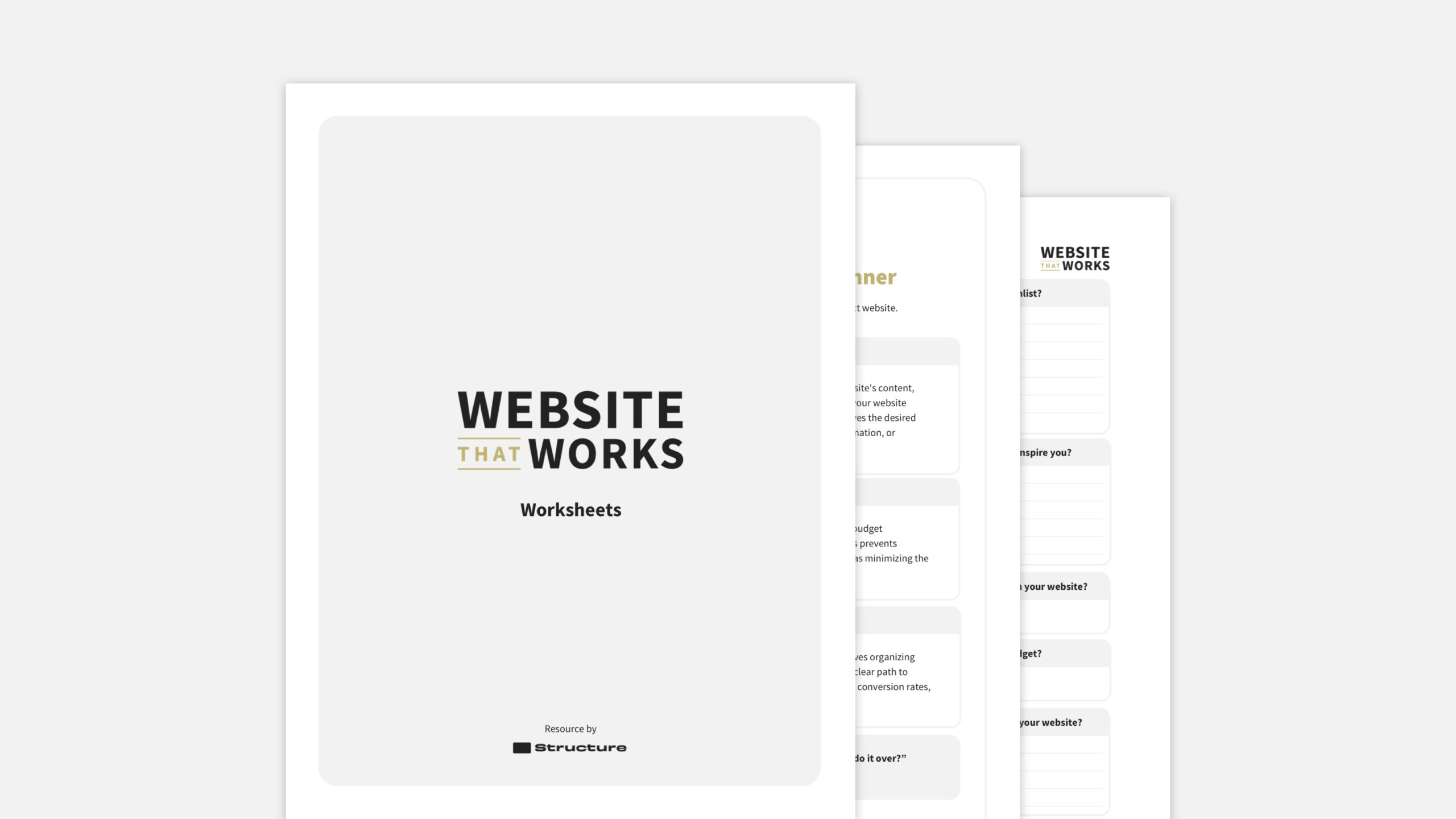
    If I showed you two websites—one that got rave design reviews and another that made millions of dollars yearly—which would you choose? If you’re like most of our clients, you’d say, “Duh, show me the money.”

    The thing is that because many websites look fantastic and showcase the latest design trends, you think they’re producing incredible results. Yet, the reality is they fail to meet the expectations of their owners and users. You’d never know it, but they’re challenging to manage in the background, yield terrible ROI, and are just a pretty liability.

    Your website should work like an engine that helps you get where you want to go

    If you’re working on a new website, you likely want your website to be a strategic asset contributing to your organization’s growth, supporting your marketing efforts, and delivering a seamless customer experience.

    Free Web Strategy Template

    Download the Structure Website Design Planner to create a web strategy that makes your project successful!

    Similarly, your customers want your website to provide readily available solutions to their problems. This happens by providing resources, products, or services that improve their life and offer quick and practical solutions to their concerns.

    If you’re considering what you want for your website, this short list of expectations from multiple sources will likely stop you in your tracks! If you didn’t already know it, you might be starting to see that building a website is much more complex than choosing the right colors, fonts, and layouts.

    Web design is not just an art. It’s a science. You see, designing and creating a website starts with a web strategy—which involves making a plan, aligning with your team, and putting it into motion.

    The good news is that you don’t have to figure it out yourself! Using our Website Strategy Template and following the advice and proven 10-step plan in this article, you can plan a beautifully designed website that produces incredible results.

    Team Brainstorming Website Tactics

    What is a website strategy?

    At face value, “Website strategy” is a scary word. It sounds serious,  intimidating, and hard to create. The word “strategy” must make it feel this way. Whatever it is, it feels like it’s something you don’t want to mess up.

    But don’t worry; it’s not so bad after all. If it helps to know, the most significant way you can “mess it up” is by not doing it. More on what happens when you fail to plan your website later.

    Here’s the skinny: a website strategy is simply a strategic plan for your website. That’s it—just a plan for what you want, what customers want, and how you will satisfy those expectations.

    Typically, a website strategy includes specific details about the company, website goals, brand direction, buyer journey, technology, budget, and more. We’ll outline the particular parts of the perfect website strategy in our ten steps below, but those are the basics.

    Get a FREE Customized Digital Growth Plan

    Take our 10-minute Digital Maturity Assessment and receive a FREE, personalized digital growth score that uncovers gaps and drives your business forward.

    Take the Free Assessment →

    Why do you need a website strategy?

    If you’re delving into website strategy, you’re likely tackling a website project, either creating a new site or redesigning an existing one. Here are the scenarios you might be in:

    • Launching a new product or business
    • Outgrowing your current website, hindering your team
    • Rebranding with fresh design changes
    • Migrating to a more suitable platform

    Don’t underestimate the significance of the situation. Your project’s success or failure impacts the company’s reputation, finances, and possibly your job.

    If it succeeds, you’ll be proud and likely rewarded for your excellent work. If it fails, on the other hand, you’ll be frustrated and embarrassed and might need to find another job or prove yourself again.

    Don’t make the biggest website mistake most leaders make

    Rushing into action is a common mistake—it’s easy to dive into website design hastily, thinking it’s simple with no-code builders like Wix, Squarespace, Elementor, and others. 

    It’s super duper easy, right? You don’t need to know how to code, design, or hardly even think. You don’t even have to be alive! In fact, you could be a corpse and still build an excellent website.

    I’m kidding—that’s grossly untrue. But I hope you see my point! 

    Digital Strategy Discussion

    Between amateur “web designers” and no-code website builders, many clients come to us completely confused about what it takes to build a website. They often have a false impression that websites practically build themselves. Either that, or they appear when you snap your fingers and pay your brother’s buddy $5,000.

    Okay, I’m still being a bit cheeky. 

    I’m being extreme to clearly articulate that this way of thinking is a rude misconception—especially if you want a website that produces tangible ROI such as leads and sales. The truth is that website strategy is essential because high-performing sites are planned.

    This might contradict your desire for quick results, but it’s the key to success. Ultimately, planning saves time and money and ensures an effective outcome.

    12 benefits of creating a website strategy

    As discussed, a website strategy is your roadmap to avoid random changes. It ensures your redesign aligns with business goals, user needs, and systems integration, among other things. This strategic approach has multiple benefits for your business. 

    Here’s more about the advantages of investing in a well-defined website strategy.

    Free Website Strategy Template

    Download the Structure Website Design Planner to create a website strategy that makes your project successful!

    1. You’ll have a clear redesign roadmap

    A website strategy outlines specific goals for the website, guiding all efforts toward achieving them.

    2. You’ll know what content you need to create

    An effective website plan helps you prioritize content creation by aligning it with target audience needs and business objectives.

    3. You’ll have happier customers

    Developing a website strategy ensures that the site is designed to provide a seamless and user-friendly experience, increasing engagement and reducing bounce rates.

    4. Your website will be easier to navigate

    A straightforward website strategy ensures logical and easy-to-follow navigation by mapping the site’s structure, helping users find information quickly.

    5. You’ll have better SEO

    We always get the question, “How do I redesign a website without losing SEO?” The answer is: with a website strategy. Part of your strategy should include strategic internal linking, relevant keywords, and structured content that will contribute to improved search engine visibility and organic traffic. 

    6. Your brand will be cohesive

    Considering your brand in your website strategy helps you maintain a consistent brand image across all customer touchpoints with your business, reinforcing brand identity and recognition.

    7. You’ll see better conversion rates

    By optimizing for user actions, a carefully planned website strategy can lead to higher conversion rates, whether for sales, lead generation, or other goals.

    8. You’ll pass up the competition

    It’s likely while you’re planning a perfect website, your competition is aimlessly running and gunning. A well-executed strategy sets your website apart from competitors by ensuring you offer unique value and address customer pain points.

    9. You’ll save money (yes, it’s true!)

    By establishing clear goals and priorities in your website strategy—along with a budget—you’ll prevent wasting time and resources on ineffective initiatives.

    10. You’ll have a reusable website strategy template

    After you’ve developed your website strategy, you can adapt it over time to immediately pivot or respond to changing market trends, allowing the website to remain relevant for longer.

    11. You’ll know if your website redesign is successful

    Well-defined goals and key performance indicators (KPIs) enable tracking and measurement of success. 

    12. You’ll have an easier time managing the website

    In the long term, having a strategy makes future redesigns or minor updates more organized and efficient for those working on them.

    What happens if you don’t use our website strategy template?

    Conversely, disregarding a website strategy during redesign wastes time and energy, causing frustration and unmet expectations. Proceeding without a strategy undoubtedly harms online presence and business goals. To quote Benjamin Franklin, “If you fail to plan, you plan to fail.” 

    Without a strategy, a redesign will fail and hamper company growth—resulting in a “website launch letdown.” It’s that moment when you finally get the website across the finish line and realize it’s not doing anything you hoped it would.

    Here’s more about what will happen if you fail to plan:

    1. You’ll be aimlessly wandering

    Without clear objectives, the redesign might lack a central focus, resulting in scattered content and an unclear message.

    2. Your content won’t connect

    Website content might be missing or fail to align with user needs or business goals, leading to reduced engagement and relevance.

    3. Your website will be messy

    A lack of strategic thinking can lead to a clunky user experience, causing frustration, high bounce rates, and decreased engagement.

    4. Your customers will be confused

    Poorly planned navigation and content organization can confuse users, challenging finding what they’re looking for.

    5. You’ll lose SEO

    Ignoring SEO considerations during the redesign can result in lost organic search visibility and rankings.

    6. Your brand will be inconsistent

    Without a strategy, the redesign might not align with your brand’s identity, leading to user confusion and diluting your brand image.

    7. You’ll see poor conversion rates

    Failing to optimize for conversions can decrease conversion rates, impacting sales, leads, or other desired actions.

    8. Your competition will pass you up

    A strategy identifies potential opportunities for growth, innovation, or market differentiation. Failing to follow it can mean missing out and losing to your competitors.

    9. You’ll waste money

    A strategy helps allocate resources effectively; without one, you might invest time and money into ineffective or unnecessary elements. Or, you’ll have to keep spending more to get what you want because you didn’t plan for it in the first place.

    10. You’ll always have to start from scratch

    Without a website strategy, you’ll quickly find it difficult to iterate on the redesign and make informed improvements over time. It’s like every time you start; you’re starting over.

    11. You’ll experience change orders and delays

    Lack of direction can lead to indecision and revisions, resulting in change orders that cost more money and delay the launch. Talk about frustration and failed expectations!

    12. You’ll constantly be playing catch-up

    Without a strategy, you’ll only be focused on pre-launch rather than looking ahead at post-launch and how to sustainably manage your website and use it to grow the company long-term.

    Develop an effective website strategy template (10 steps)

    Now that you understand the importance of website strategy and its impacts, let’s explore the ten starting steps.

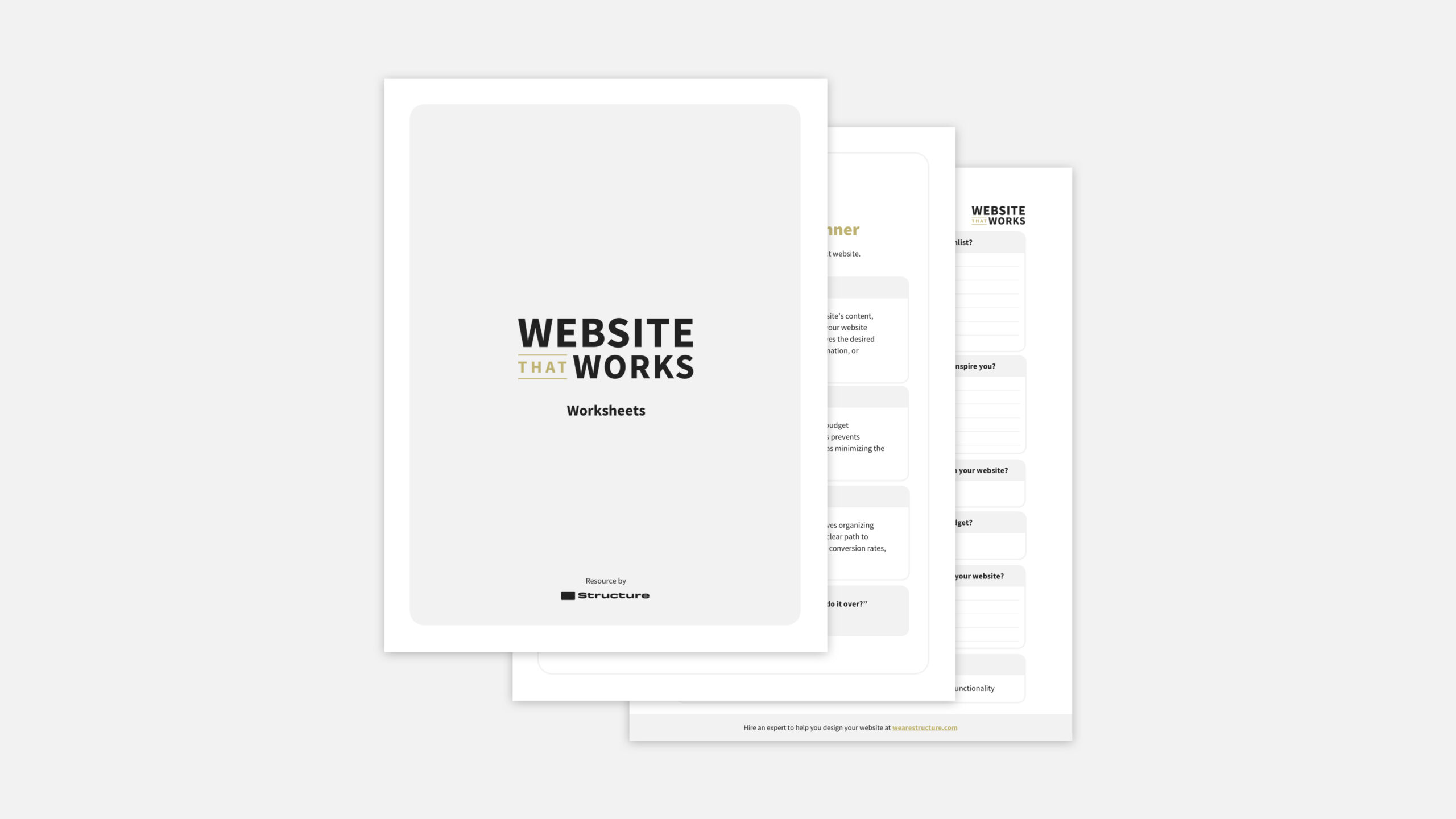
    We’re offering a free Website Strategy Template to make it even easier. Follow the outlined steps for a fail-proof strategy, simplifying an otherwise complex process. By completing this, you’ll have a robust website strategy.

    Free Website Strategy Template

    Download the Structure Website Design Planner to create a website strategy that makes your project successful!

    While numerous website strategy templates exist, they’re often unengaging spreadsheets or overly complex. Our template streamlines the process, making it accessible to business and marketing leaders, not just content strategists, UX designers, and developers.

    Without further ado, here are the ten steps!

    Structure Website Design Planning Template

    Step 1: Document basic company information

    The Company Worksheet addresses fundamental company-related queries. It’s not a comprehensive brand strategy, but it confirms existing decisions. It delves into specifics by starting with the company name, core values, target market, and offerings. 

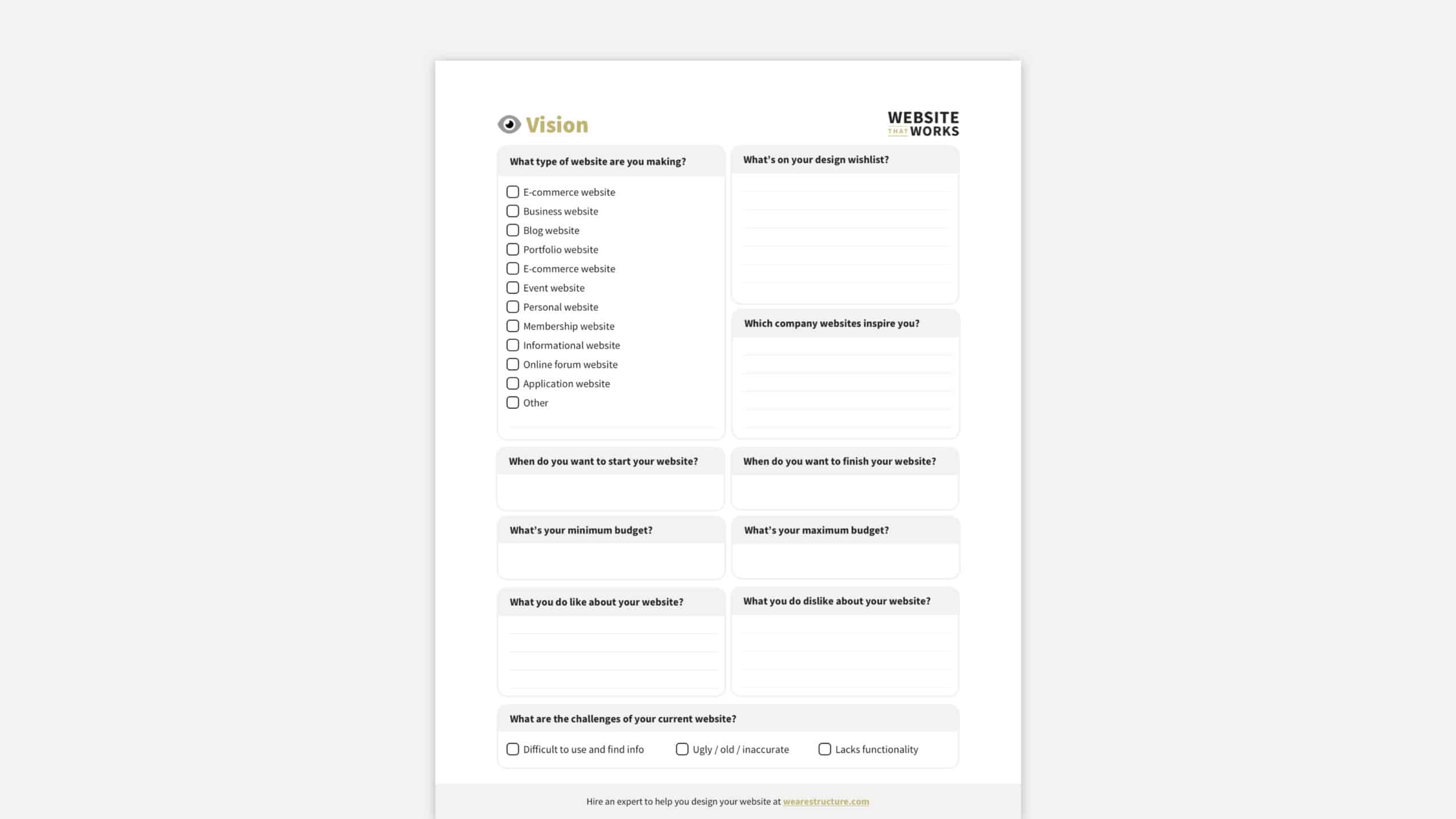
    Step 2: Organize your ideas into a clear vision

    Begin with the end in mind. The Vision Worksheet captures your ideas and focuses on the process and end product rather than a vague vision. 

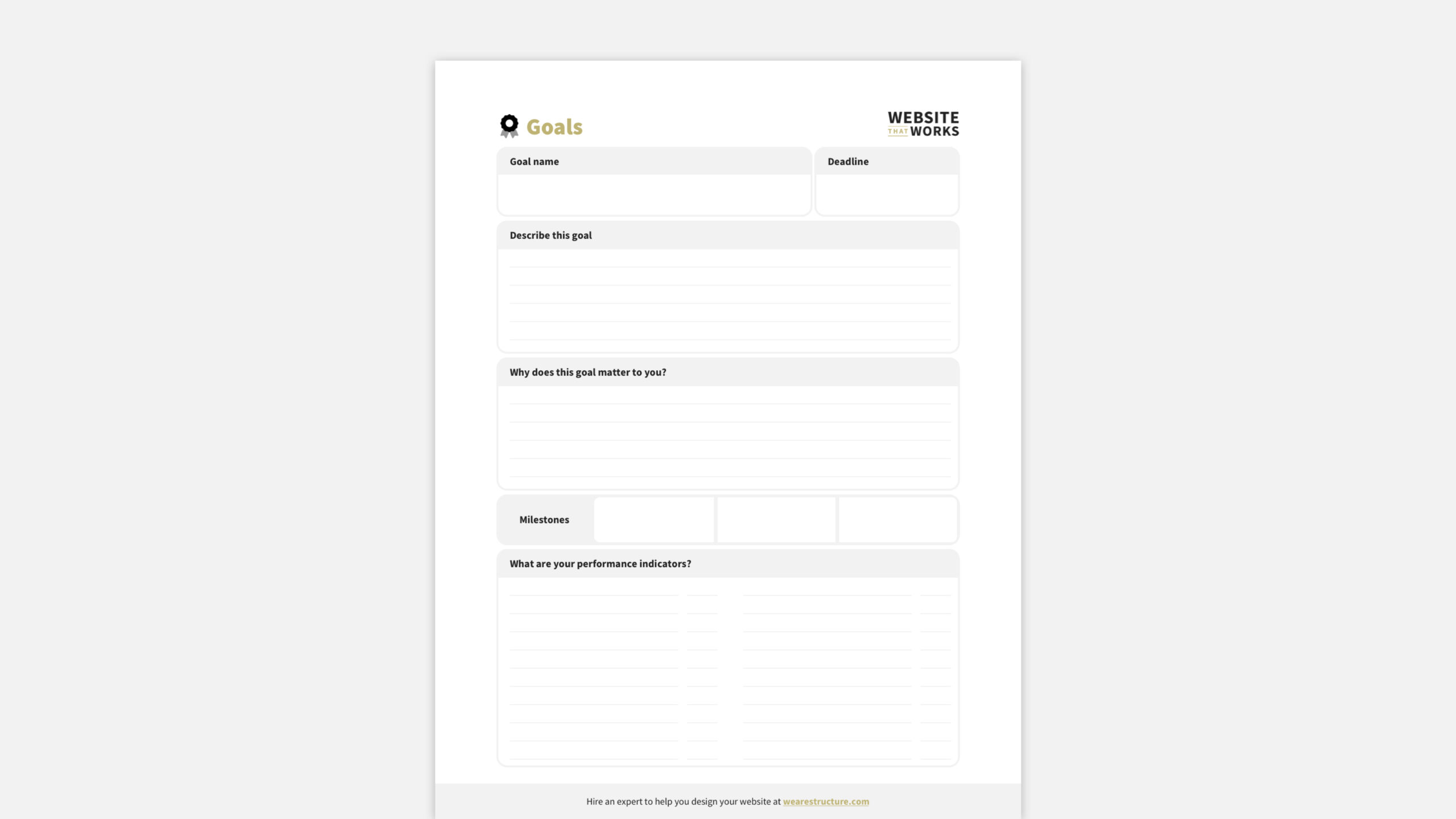
    Step 3: Set SMART website Goals

    Consider the Goals Worksheet your project’s compass, aligning your team on purpose and tracking success indicators. It functions as a roadmap, ensuring your project stays on course.

    Don’t forget to set “Milestones” and “performance indicators.” While these items might make it feel complex, they will make it more manageable. They represent specific steps towards your goal (begin with three) and how you measure their achievement.

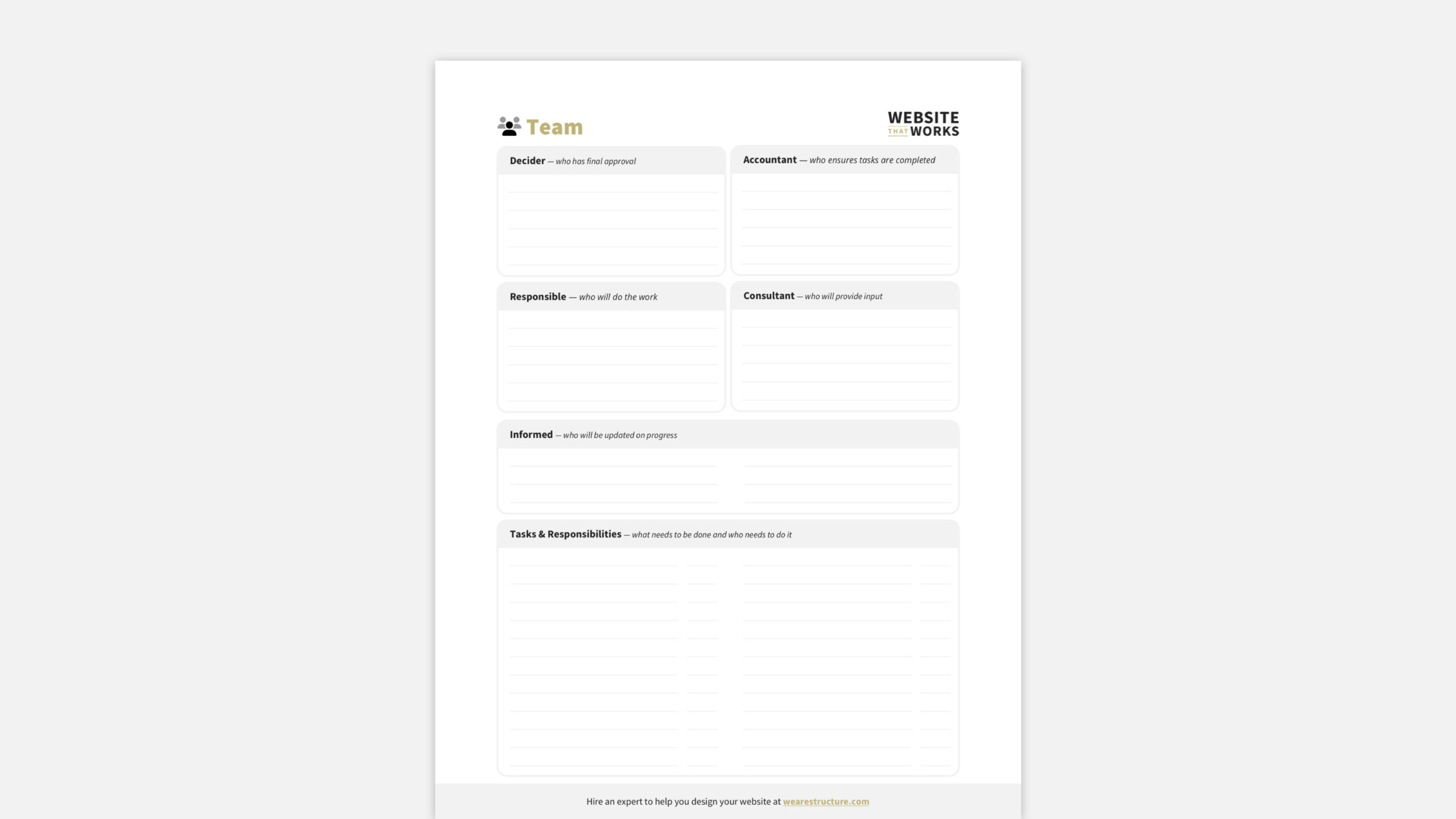
    Step 4: Build a team around you

    According to the African proverb, “If you want to go fast, go alone. If you want to go far, go together.” The conclusion is this: don’t bear all the responsibilities alone. Envision forming a team, whether internal or external, to collectively share the load and guide the project. 

    Moreover, imagine seamless teamwork where everyone knows their roles and responsibilities, preventing overlaps. Using the DARCI framework, the Team Worksheet in our website strategy template facilitates this result.

    Step 5: Unify your branding

    The disconnection between a powerful ad and a lackluster website negatively influences how the business is perceived. Ensuring harmonious marketing across online and offline channels is essential to maintain professionalism and credibility.

    Completing this worksheet is pivotal for your website strategy, as it may unveil asset gaps or outdated elements requiring refreshment.

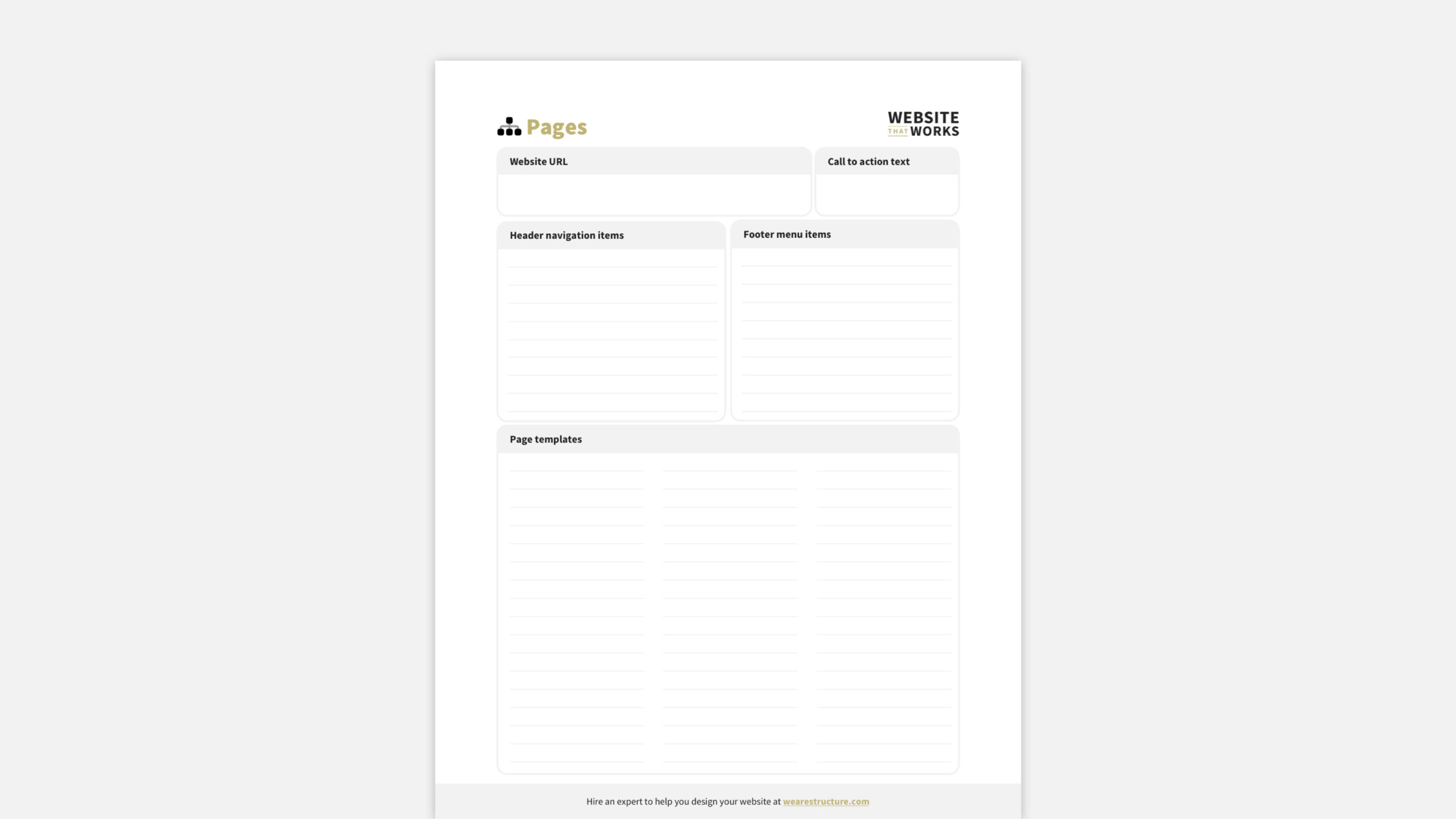
    Step 6: Plan your pages

    Most businesses planning a website redesign have a basic site map, but that’s the start. You’ll want to document your navigation (header and footer), page templates, and main pages associated with those templates.

    The notable question you might be asking yourself: “What’s a website page vs. page template?” A website page is a single page that uses a page template but with unique content like text, images, and videos that fit that page’s purpose. A page template is a pre-designed layout serving as a blueprint for multiple pages with consistent design and structure—for instance, one template for all products.

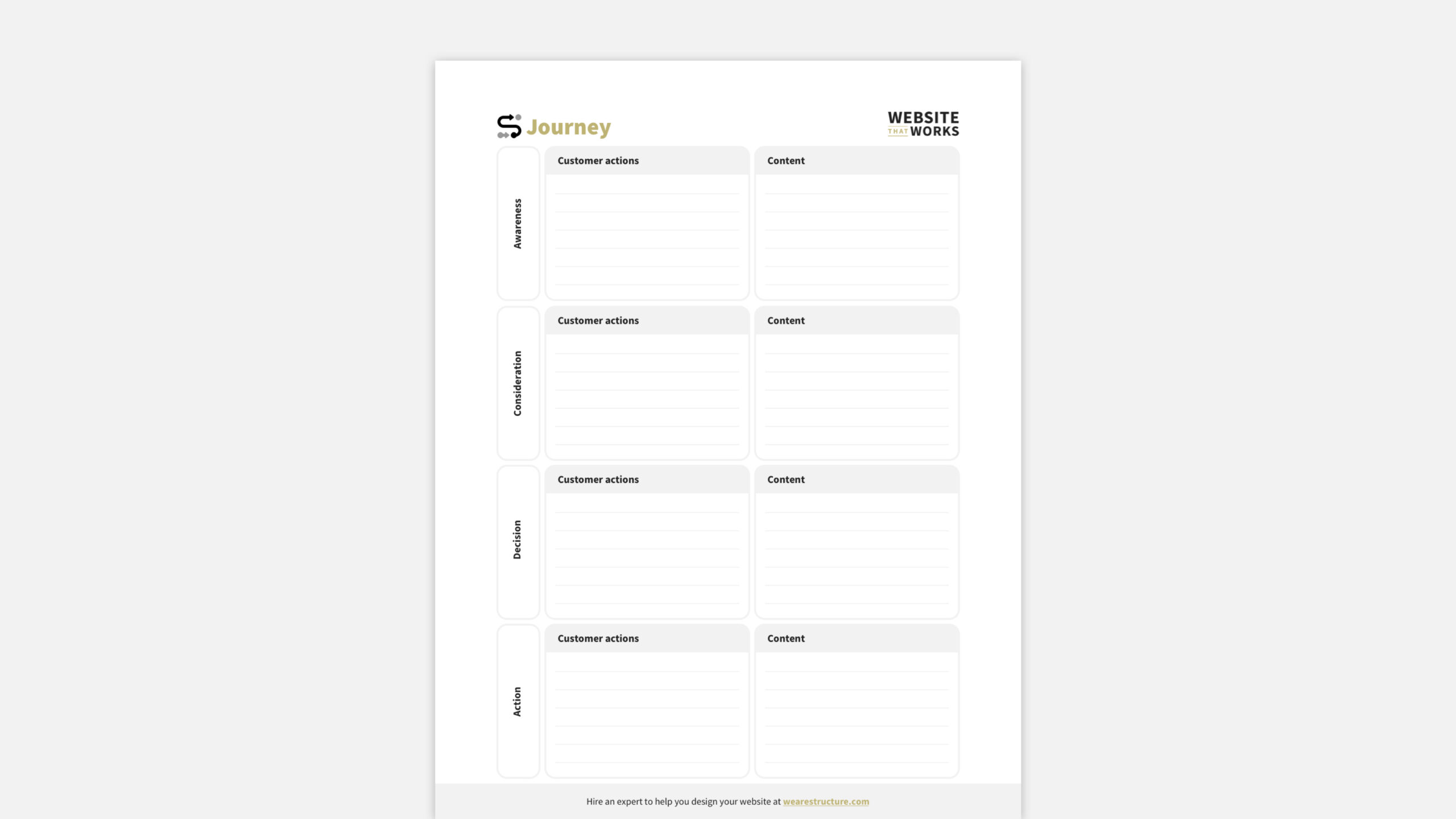
    Step 7: Map your buyer’s journey

    Your website isn’t an isolated entity; its pages aren’t isolated experiences. They should work together for a seamless customer journey, often called the “buyer’s journey.”

    In web design, a customer journey is the series of steps a visitor takes on a site, from arrival to completing a goal like purchasing. It comprises stages like Awareness, Consideration, Decision, and Action. The aim is a positive experience turning visitors into customers and nurturing relationships.

    For each stage, you’ll want to define desired customer actions and the content needed to support those actions. Use our website strategy template “Website Journey” worksheet quickly and efficiently.

    Step 8: Analyze competitor websites

    To stand out, understanding your competition is vital. To understand your competition, and identify how it impacts your website, follow these actions:

    1. Examine a competitor’s site
    2. Note three likes
    3. Note three dislikes
    4. Note three improvements or ideas for your site

    Repeat for at least three competitors or similar businesses.

    Step 9: Call out your business systems

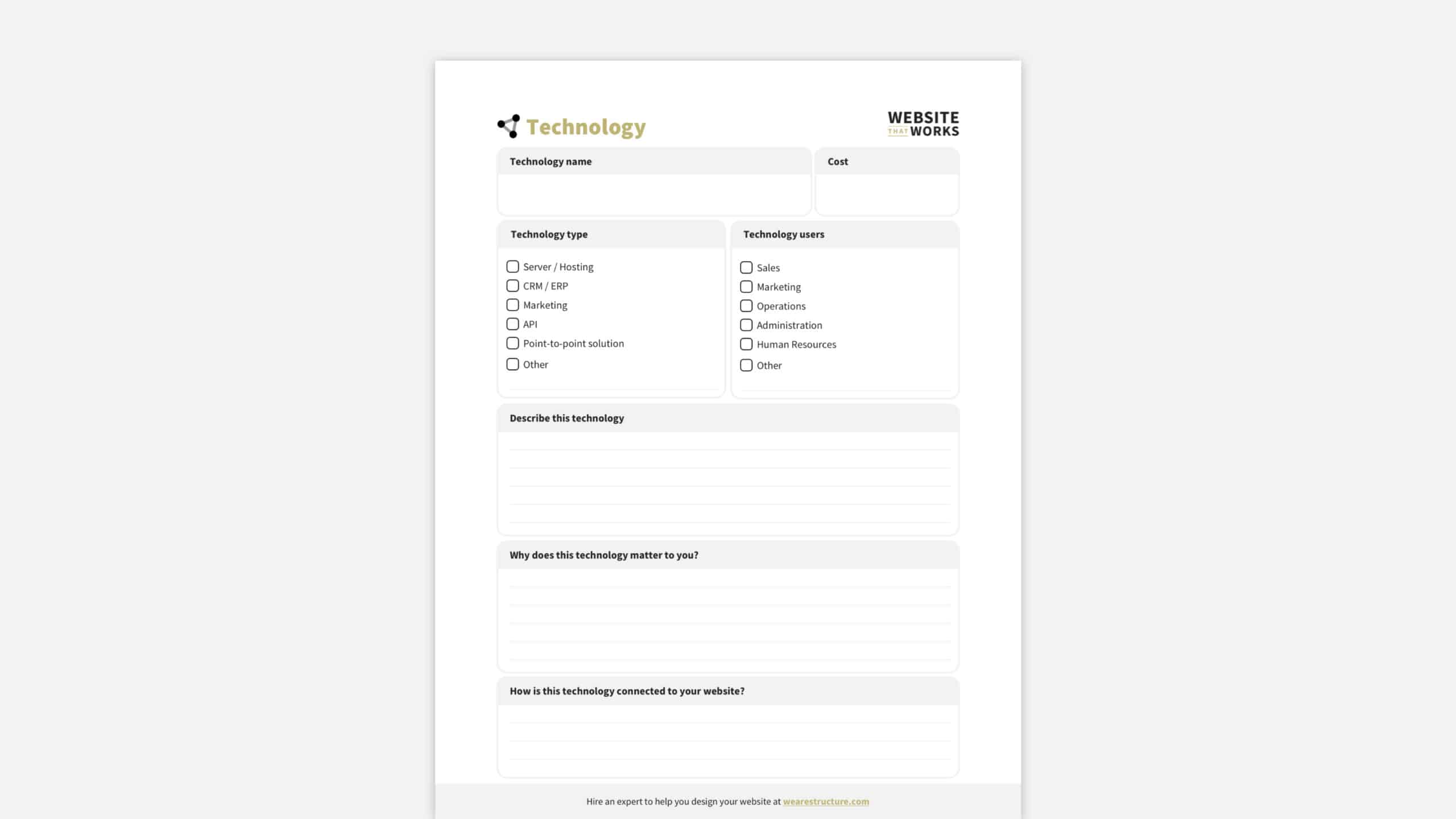
    Often, focus on appearance overshadows functionality. Integrations matter for social media, email marketing, CRM, or lead generation. Neglecting integrations during your website’s design and build phases can be costly.

    Step 10: Create a budget

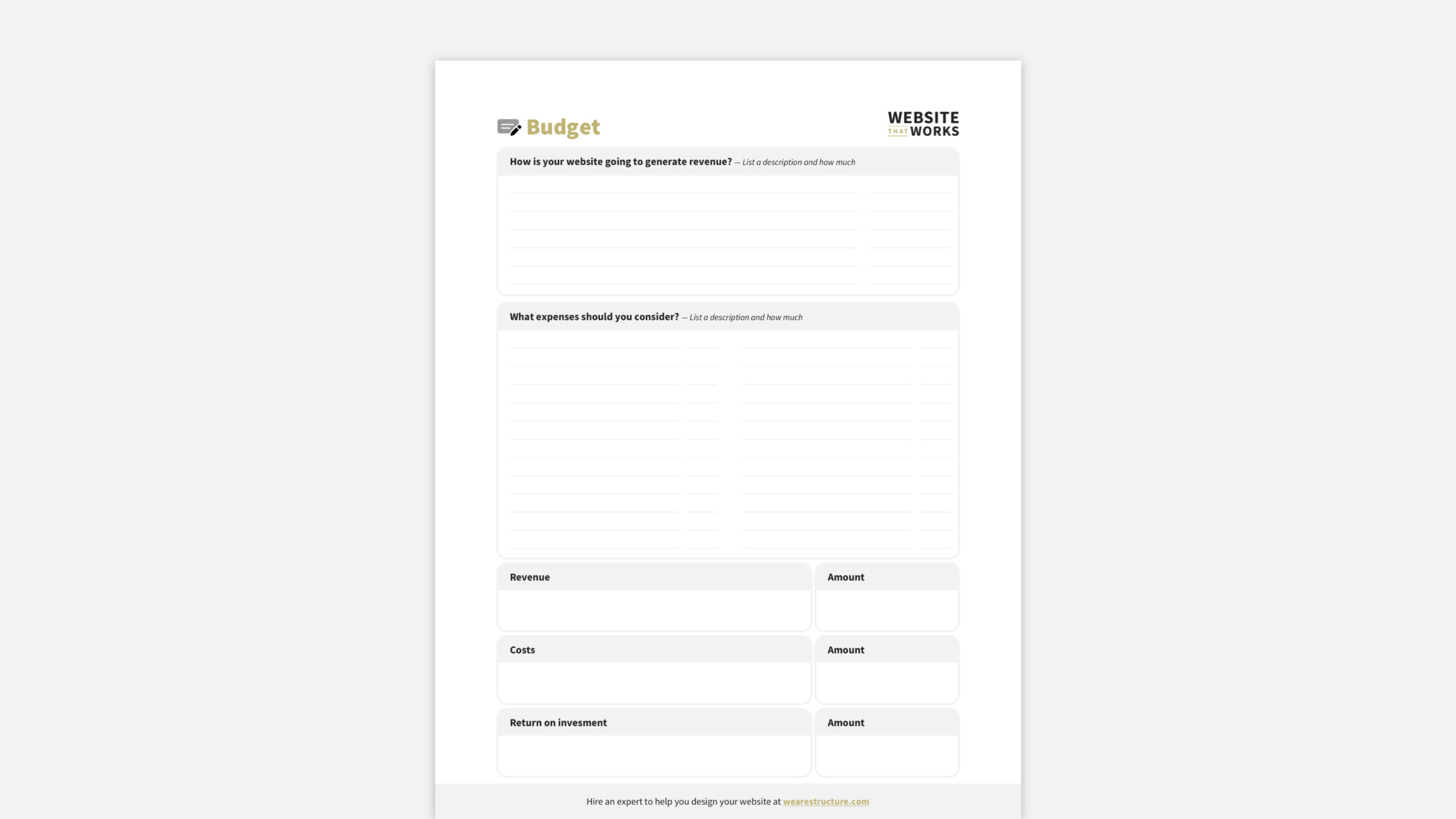
    The Budget Worksheet marks the final step, presenting the awaited website redesign cost. However, the challenge lies in seeing beyond costs alone. A website is an investment, not just an expense. Your budget should encompass potential earnings, savings, and expenses, calculating its long-term profit value.

    This budget process emphasizes your pivotal role in the business and the rationale behind investing in a functional website. Consider a budget covering your site’s lifespan, often 1.5 to 2.5 years, revealing significant returns in millions or tens of millions.

    Leaders Crafting Website Strategy

    Website strategy template questions our clients commonly ask

    What are some common web strategy examples?

    A well-defined website strategy helps guide design, content creation, and user experience decisions to achieve desired outcomes. Your website’s specific strategy should align with its goals, target audience, and industry. 

    But if you’re looking for inspiration, here are some examples of common website goals that organizations might employ to achieve their website strategy:

    1. E-commerce website goals

    • Focus on a user-friendly and intuitive design to encourage seamless shopping experiences.
    • Implement personalized product recommendations based on user behavior.
    • Optimize the checkout process to reduce cart abandonment.
    • Offer various payment options to cater to different customer preferences.
    • Utilize email marketing for abandoned cart recovery and customer retention.

    2. Content marketing goals

    3. Lead generation goals

    • Implement compelling call-to-action buttons on relevant pages to encourage user interaction.
    • For contact information, offer gated content (e.g., webinars, case studies).
    • Develop landing pages focusing on a specific offer and providing a clear value proposition.
    • Utilize A/B testing to optimize landing page elements for higher conversion rates.
    • Nurture leads through email drip campaigns and targeted content.

    4. Membership or subscription website goals

    • Provide a clear description of membership benefits and pricing tiers.
    • Offer a free trial or limited access to encourage users to sign up.
    • Create a members-only area with exclusive content, resources, or tools.
    • Use email marketing to communicate updates, special offers, and member-exclusive content.
    • Continuously engage with members to enhance their experience and retention.

    5. Branding goals

    6. Performance goals

    • Implement a responsive design to ensure the website is accessible and functional on all devices.
    • Prioritize fast loading times to prevent user frustration.
    • Simplify navigation and content presentation for smaller screens.
    • Use touch-friendly elements and buttons to enhance the mobile user experience.
    • Test the website across different devices and browsers to ensure compatibility.

    7. User experience goals

    • Incorporate interactive elements like quizzes, polls, and surveys to engage users.
    • Enable user-generated content, such as reviews or comments, to foster a sense of community.
    • Implement live chat or chatbots to provide instant customer support.
    • Host webinars, live events, or online workshops to interact with the audience in real time.
    • Utilize gamification elements to encourage user participation and loyalty.

    What is the strategy of a website?

    For most business websites, the primary purpose is driving sales through products, services, information, or ideas to a global or targeted audience. 

    Your website can inform, educate, entertain, or sell, depending on your goals. Whether you aim to reach new customers, provide support, share your expertise, or even express yourself, your website serves as a central platform to achieve those aims and engage with your customers.

    Think of a website strategy as the roadmap for your website project. It’s like having a plan that guides all your decisions and actions to ensure your website does what you want. This strategy involves everything from who your website is for, what it’s supposed to do, how it looks, and how people will use it. It’s like setting the direction for your website to help you achieve your business goals.

    What makes a website successful?

    Successful websites engage and educate visitors, converting them into leads and customers. This purpose should guide design, content, and features.

    What makes a website successful is that it accomplishes its goals. As I said in the last question, most businesses deem their website successful if it drives sales. If sales aren’t the goal for you, that’s okay! You’ll want to identify your ultimate goal: donations, inquiries, or impressions. 

    Either way, your website is an investment that evolves with your business to accomplish something. Figure out what that “something” is, and you will have defined success for your business.

    What is a responsive web strategy?

    A responsive website strategy involves designing and developing a website that adapts and functions seamlessly across various devices and screen sizes. 

    The goal is to ensure that the user experience remains consistent and user-friendly whether visitors access the site on a desktop computer, tablet, smartphone, or other devices. 

    This strategy involves creating a flexible layout, using responsive design techniques, and optimizing content for different screens. By implementing a responsive website strategy, businesses can cater to the preferences of their diverse audience and provide an accessible and enjoyable browsing experience regardless of the device used.

    What is a web branding strategy?

    That’s a good question! A web branding strategy is a comprehensive plan to establish and reinforce a consistent and compelling brand identity across a company’s website—and ensure that the website identity is consistent across all channels. 

    A successful web branding strategy ensures that visitors can immediately recognize and connect with the brand when they land on the website. This involves consistently incorporating elements such as the logo, color palette, typography, imagery style, and tone of voice throughout the site. By implementing a solid web branding strategy, businesses can create a memorable and authentic online presence that resonates with their target audience and fosters brand loyalty.

    How do you approach a website design?

    At Structure, we take a strategic approach to web design. We’ve identified that most websites don’t work like their managers and users want them to because of a failure to plan. That isn’t good if you invested tens of thousands of dollars in something that looks amazing but doesn’t help your business.

    That’s why every website project at Structure starts with a website strategy process. We also call it “website planning” or “website definition.” In short, it’s the process we take clients through to figure out what is needed in as much detail as possible, so we can deliver a headache-free design and build process—and, ultimately, a website that works for you.

    We aim to help 1,000 businesses and organizations plan and realize successful websites over the next ten years.

    What is a web strategy document?

    A website strategy document outlines the goals, objectives, tactics, and guidelines for developing, designing, and managing a website. 

    It serves as a roadmap that guides all decisions related to the website’s creation and requirements. This document typically includes information about the target audience, website purpose, content strategy, design principles, user experience considerations, technical requirements, integration with other systems, and more. 

    The result of a well-structured website strategy document ensures that all stakeholders are on the same page and provides a clear direction for the entire website project, from conception to execution.

    Download our free website strategy template if you’re looking for a simple way to get started.

    Free Website Strategy Template

    Download the Structure Website Design Planner to create a website strategy that makes your project successful!

    How do you write a website content strategy?

    The best way to write a website content strategy is to follow a proven plan… not write it from scratch. Download our Website Strategy Template to streamline your web design planning process and ensure a clear roadmap for your project.

    What web strategy would help an ecommerce business drive traffic to its website and increase sales?

    Several digital marketing strategies would help an ecommerce business drive traffic and sales to its website. It wouldn’t be hard to find a 13-point list. But that’s too complicated.

    If you’re looking to drive traffic and sales to an ecommerce website, do these three things:

    1. Create a product recommendation quiz
    2. Use pay-per-click advertising (like Google Ads) to drive targeted traffic to the quiz
    3. Ensure there are as few steps to purchase as possible.

    If you do these three things, your ecommerce website will be successful.

    What is a web strategy to determine the internal linking structure of a website?

    The strategy to determine the internal linking structure of a website is often called “Content Siloing.” This involves organizing the content on your website into distinct groups or categories, each focused on a specific topic or theme. 

    Within each content silo, you create internal links between related pages, enhancing user navigation and improving SEO by indicating content relevance to search engines. This strategy helps users and search engines understand the relationships between different pieces of content on your site.

    This is best done while developing your website strategy to ensure you execute consistently and effectively.

  • The Expositors Academy E-Course WordPress Website Design & Development

    The Expositors Academy E-Course WordPress Website Design & Development

    OnePassion Ministries, founded by Dr. Steven J. Lawson, came to Structure looking for a professional website to market, sell, and manage their new online course: The Expositors Academy. We came in on the ground floor to define the website strategy, provide a custom design that fits their goals, and develop an e-commerce and learning management system to create a seamless experience for their students.

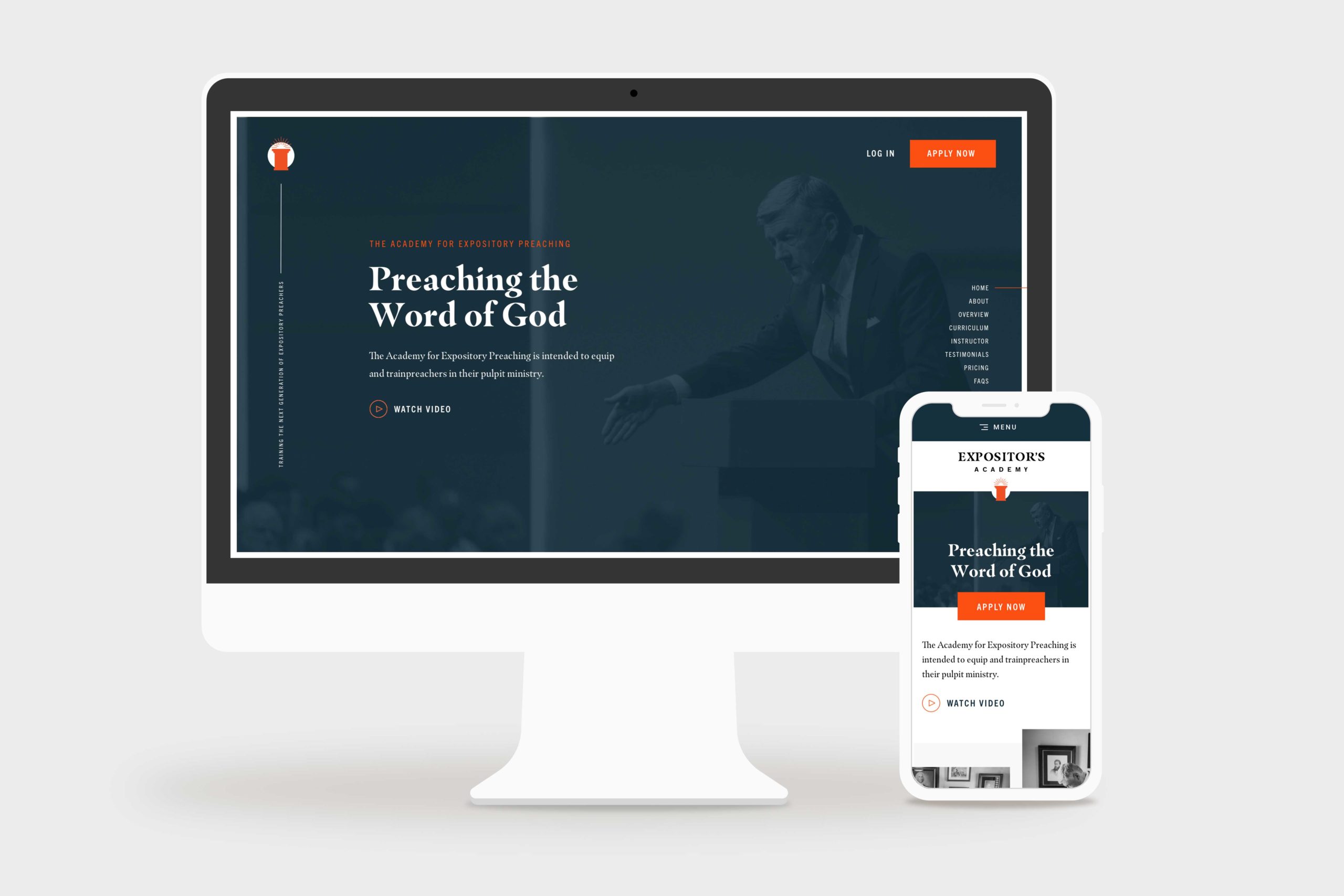
    The Expositors Academy Website Home Page Mockup
    the expositors academy home page hero, desktop and mobile

    Challenge

    One Passion Ministries had never launched a digital product like The Expositors Academy, so they were looking to us for ideas and action. Particularly in coordinating marketing, e-commerce, learning management, and business systems to launch their new course successfully.

    Solution

    Starting with strategy, we took The Expositors Academy through an end-to-end website design and development process. We used a thoughtful platform combination of WordPress, WooCommerce, and LearnDash, to create a first-rate online course experience.

    Results

    Within six months after launch, The Expositors Academy had 125+ students interacting with their platform. Better yet, The Expositors Academy manages the website and the product with little effort—and without constant bugs, issues, and maintenance headaches.

    I have had the opportunity to work closely with Simon and the Structure Team, and I couldn’t recommend them higher. They truly care about the service they provide and ensure that any project they are a part of is delivered with excellence. From creative ideas to execution, they are a professional team that will serve your business well.

    Jackson, Marketing Director

    Website Strategy

    When The Expositors Academy came to us, they were unsure which platforms, systems, or processes they needed to create an online course. 

    As is usually the case, while a website may look simple on the surface, a lot is happening in the background. That’s why we started with a website strategy package to help them plan and define precisely what they needed the website to accomplish.

    They wanted three different payment options, including a subscription option and an option to purchase a course license for another student who couldn’t afford it.

    They also had a remote team of assignment graders who needed to keep track of submitted assignments, provide document markup, and communicate feedback directly to the student.

    Last but not least, they needed to automate email communication to students that weren’t keeping up with the schedule, missing assignment deadlines, or hadn’t logged on for a while.

    Our website strategy team researched the best learning management system to fit their needs. We evaluated different options like Teachable, Thinkific, Kajabi, and others. However, those options didn’t integrate easily with The Expositors Academy business systems and became cost-prohibitive when providing user accounts for dozens of graders to do their work.

    That’s when we landed on LearnDash because it fit their requirements and perfectly supported their sitemap and customer journey. 

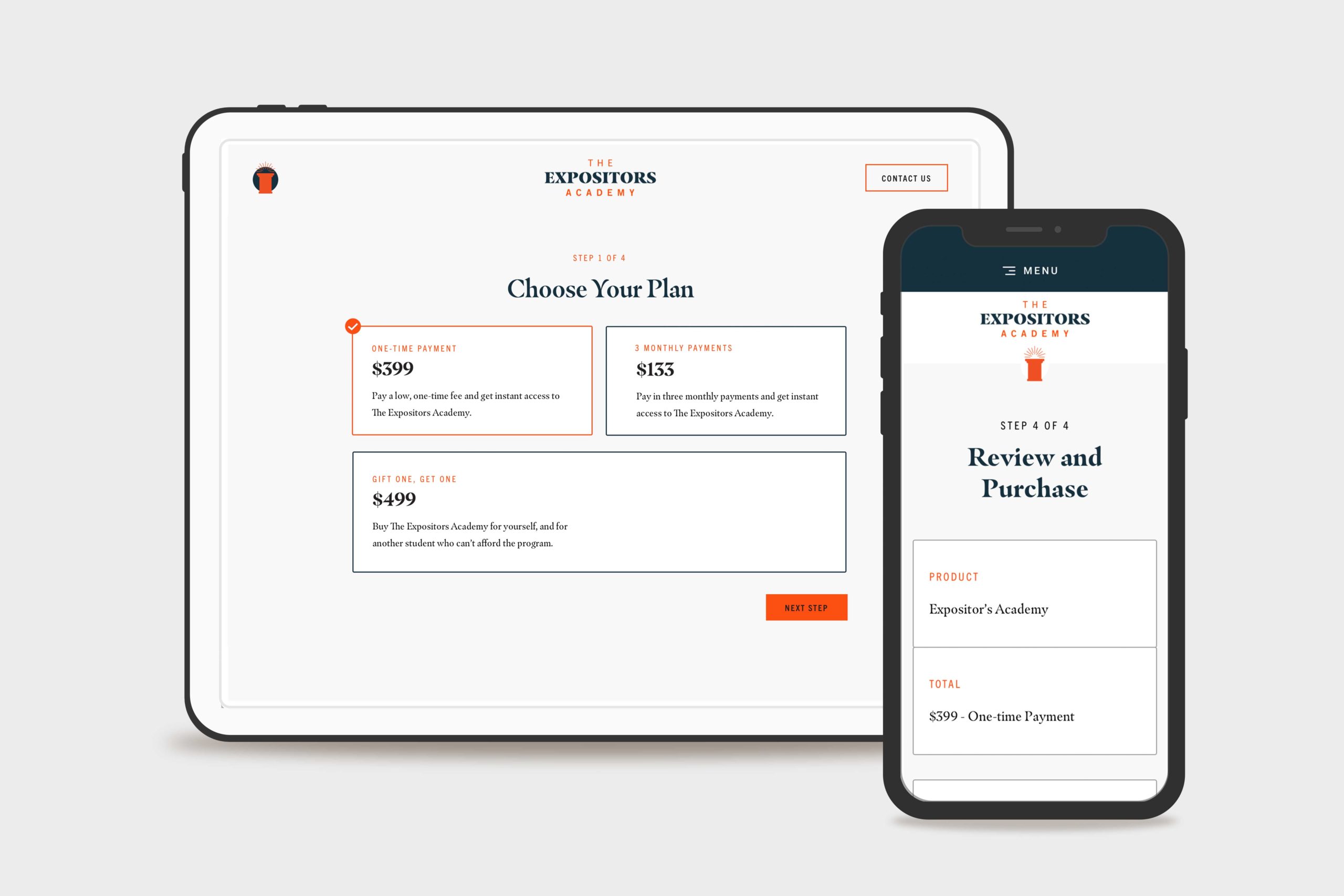
    The Expositors Academy Website Custom WooCommerce Checkout Flow Mockup
    The Expositors Academy Website Custom WooCommerce Checkout

    Website Design

    Next, we began website design. The website design process resulted in 15 screens of ready-to-build, fully-responsive marketing, ecommerce, and online course designs.

    Marketing Website Design

    To keep the website simple and fees as low as possible, we designed a simple three-page marketing website to generate leads. The three pages were Home, Application, and Contact.

    • Prospective students could learn about the course and curriculum on the home page.
    • They could apply for the program on the application page and ensure they were the right fit.
    • On the contact page, users could ask questions or inquire about details they needed clarification on.

    E-commerce Design

    Furthermore, we designed a custom e-commerce experience that seamlessly guided students through Payment Options, Checkout, and Account Creation for the course. When they finished the checkout process, they were logged into the course and ready to start.

    Learning Management System Design

    Lastly, we customized the LearnDash course dashboard by combining The Expositors Academy brand styles with the default layouts provided by the plugin (including a few interface improvements, of course!).

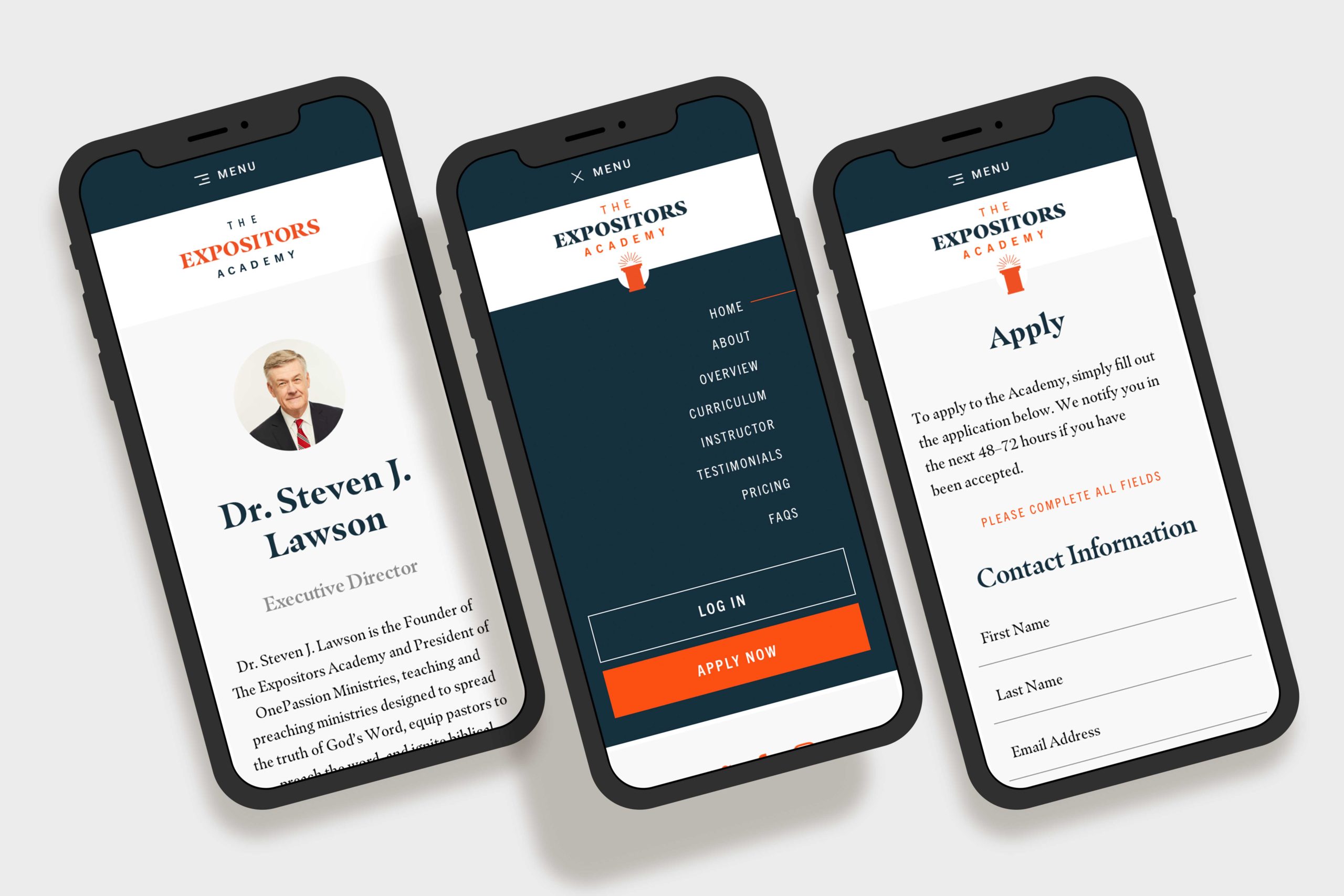
    The Expositors Academy Website Mobile Mockups
    The Expositors Academy Mobile Mockups

    Website Development

    The Expositors Academy was already familiar with WordPress CMS since we used it to build OnePassion.org, one of the other websites. 

    Front-end Website Development

    We developed a custom theme for The Expositors Academy built according to the design spec. We included custom Javascript animations from the Animate On Scroll Library to enhance user experience.

    Additionally, the website design called for a few other features like a nested accordion to house the curriculum information, an on-page navigation to help the user navigate the landing page sections, and a dynamic testimonial carousel.

    Back-end Website development

    We used WordPress and the LearnDash LMS WordPress plugin as the learning management platform. It was a helpful integration, so they could keep their marketing site and learning management system in the same place (and not have to manage multiple platforms).

    Using Genesis Custom Blocks with embedded Custom Fields, we set up the backend so they could edit the website content independently without breaking any formatting.

    Then, we integrated WooCommerce with WordPress and LearnDash, which made product creation, payment processing, order tracking, and more a breeze. Not to mention keeping the entire customer journey under one roof, from awareness to advocacy.

    QA, Training, and Support

    After populating the content we’d written and doing a thorough quality assurance process, we trained The Expositors Academy on a recorded video call. They walked away from the call with a thorough understanding of how the site worked and a recording and documentation for future reference.

    Final Thoughts

    The Expositors Academy online course WordPress website design and website development project is one we’re proud to share. It took months of united planning and preparation, with an incredible result.

    Ultimately, the website platform we built allowed the OnePassion Ministries team to enter the market in a new way and further their vision of training new expositors—and helping them reform the church.

    For additional reading, we designed and developed the nonprofit website for OnePassion Ministries at OnePassion.org .

  • How to Create the Perfect, High-Converting Home Page [Free Template]

    How to Create the Perfect, High-Converting Home Page [Free Template]

    Customers aren’t buying on your website? There’s a reason, and I bet it’s your website homepage. Your website’s homepage significantly influences how long visitors will spend on it—and if they engage with your business. Here’s how to make yours great so visitors stay and buy.

    What is a website homepage?

    A website homepage is, often, the first page visitors will see when they land on your website. It’s essential to make a good impression because if potential customers don’t like what they see, they’ll likely leave and never return.

    Think of your website homepage as the front door to your business. It should be welcoming, easy to navigate, and give visitors a snapshot of your offer.

    Your website’s homepage can include multiple sections that help guide users through your website. If the homepage is planned correctly, these sections can keep users engaged with your website for extended periods.

    Website Homepage Template Download
    download the perfect website homepage template

    Why your website home page structure is important

    The Nielsen Norman Group (a UX Research Firm) did a study linking the time spent on a website to something called “Weibull distribution,” which is a mathematical way to figure out when somebody gets frustrated and leaves (or “bounces”) from your homepage.

    In just 10 seconds, visitors will determine whether they want to stay on your website or leave. That’s according to research by Chao Liu and colleagues, who found that 99% of websites have a 10-second window of opportunity.

    Why is that important? Because it means you have 10 seconds to communicate your value. If visitors stay more than 10 seconds, they will continue engaging with your site and visit additional pages. But if you don’t catch their attention within those 10 seconds, you risk them leaving.

    Like most people, you may ask yourself, “Where do I begin?” Here’s our answer.

    Common website homepage problems

    First things first, don’t make these standard website homepage mistakes! Most companies aren’t getting engaged customers on their websites because they are making one of these mistakes. 

    The key to remember is this: if your website homepage has one of these problems, it won’t work even if you follow our homepage formula.

    1. Your homepage is about you

    Your website should center around your customers. How you can improve their life, what they gain from using your product, and how it eases stressors in their daily routine.

    You are not the hero. I know this sounds harsh, but stay with me for a second. This message could be summed up in five words: You Are Not The Hero. Yes, I know you solved their problem and changed their life – but that doesn’t make you the story’s hero. “Your customer has a problem, and then you come along as the solution” is something companies often think about because it’s easy to fall into that perspective…but it makes YOU look pompous and self-serving rather than humble and focused on them (which is much more attractive).

    Why not try something your competition isn’t doing? Instead of always putting yourself in the spotlight, focus on making your customer feel like the hero. They’ll appreciate it more than you think and will likely return to you because you make them feel special. All it takes is a change of messaging and perspective; to act as a guide or helper instead of the main attraction.

    On your home page, instead of saying, “We do this and that,” say, “We can help you do this and that.” Do you see the difference? In the first example, you’re the one doing; in the second, they’re the one doing (and you’re helping). 

    Make your entire website about your customer, and you’ll create raving fans who buy once and keep coming back for more.

    2. Your homepage is overwhelming

    Have you ever been to a website that throws so much information at you all at once? There’s so much there, and it’s all so overwhelming that you don’t even know where to start or what’s important. You have to leave the site altogether.

    Most companies do this: they overwhelm their customers before they’re ready for it, losing them entirely.

    Instead, you should set up your website ​using a framework so that it follows a process called “Drip, Sip, Drink.”

    To begin, give them a drip by providing sections on one page rather than overwhelming them with everything at once under one heading. 

    Each section offers the opportunity for further investigations and product detail – that’s the sip.       

    Then finally, if they’re satisfied with what they see thus far – include stories from customers or case studies as an extra convincing edge – we’ll call that the drink.

    If you use a tried-and-true formula and explain it using the Drip, Sip, Drink method, your potential customers will easily understand what you’re offering. They’ll see why it’s valuable and how to purchase it without issue.

    Doing this will help make sure your website is successful.

    3. Your homepage is confusing

    We think we’re being clear. But in reality, we’re being accurate. We have tunnel vision and only see what’s in front of us. As a result, we usually make one of two mistakes: 

    get too involved with the weeds and tell consumers too much about our goods immediately, confusing or frightening them. 

    We say business jargon phonetically using abbreviations that operate in the corporate environment, but the human on the other end has no clue what you’re talking about.

    If you try to sell too much at once, your customers will become overwhelmed and tune out. They’ll ignore everything you say if they think you don’t understand them or their problems. You need to engage your customers and get them to take action on your website! 

    Keep this in mind: if you confuse, you’ll lose. And make sure that what you’re saying is clear; if it doesn’t make sense, it won’t make money

    4. Your homepage doesn’t call people to action

    It’s incredible how many companies don’t ask for a sale. Don’t be one of them! To make it easy for your customers to buy the transformation, you’ll need to do two things:

    • Make your buy buttons easy to find 
    • Make them easy to understand

    Make your buy button visible in an easy-to-find location like the top right corner of your website. It’s also helpful if the button is a bright color that stands out, like red. You can also include a buy button in your hero section.

    Easy to understand means you’ll want your call to action to be direct. 

    • If you’re a photographer, don’t just say Hire Us. Say, “Schedule a Shoot.”
    • If you’re a painting company, your button should say “Request a Quote.” 
    • If you’re a consulting company, your button should say “Schedule a Call.”
    • If you’re a restaurant, your button should say “Make a Reservation.”
    • If you’re a brewery, your button should say, “Order Beer.” 

    Research demonstrates that hearing something takes an individual eight times to process the information thoroughly. So, if it requires eight repetitions for someone to comprehend hearing something one time, how many times do you need to ask a person to buy from you before they understand that you want them to purchase something?

    Include your CTA button on every page, and make it easy for visitors to take the next step.

    5. Your homepage doesn’t communicate the transformation

    Your homepage should show the success your customer will experience if they use your product or service

    Here’s why: your customer has two types of problems: external and internal. Another way of putting it is they have both physical and emotional issues. One problem they experience and one they feel.

    An external problem might be that I have a flat tire. The internal problem is that I can’t make it to work on time—my boss might fire me, and I can’t afford to lose my job.

    Every external problem, whether a flat tire or a leaky roof, manifests an internal problem — frustration, confusion, or even the feeling of “I don’t have what it takes.”

    Don’t be mistaken; your customers buy your products to relieve their internal tension. And when you communicate in a way, using words and pictures that show how you can reduce that tension, your customers will be more likely to seek your expertise.

    If you’ve watched a movie, you know every story ends in victory or tragedy. For your customers, it’s success or failure. They will feel one or the other, and I can guarantee they want to feel successful.

    The perfect homepage structure

    Most people think their website is all art: brand, visual design, beautiful images, etc. There’s certainly a lot of art involved in a website project. However, it’s about 20% art and 80% science.

    In other words, if you want your website to work, follow a formula or framework. Here’s that formula for the taking.

    Want a high-converting homepage?

    1. Header

    The header is the very top section of your website. Your header should include: 

    • Your logo
    • Your menu
    • Your call-to-action

    Let’s look at each of these header items in further detail.

    Logo

    On most websites, the logo is in the top left corner of your header. It’s clickable and takes visitors back to the homepage no matter where they are on the website. The website’s logo is one of the first things people notice when they land on a website, so it’s essential to make sure it’s recognizable, branded, and positioned in a spot where people will see it.

    Menu

    The menu is generally located next to or below the logo and contains links to the different pages on your website. The menu is how visitors will navigate your website, so making sure it’s easy to find and use is essential.

    It’s called a menu for a reason. It’s the place to show what you have to offer. Like a restaurant menu, it tells your customers what they can buy. 

    There are many items you can add to a menu. However, it’s best to include your main offer in your menu, and access any essential pages people might need (or want) to read before buying.

    Call-to-action

    The call-to-action (CTA) is a button or link that encourages visitors to take a specific action. The CTA should be prominently displayed in your header so visitors can’t miss it. It’s most commonly in the top right corner of the website.

    2. Hero

    Website Homepage Template Hero
    Website Homepage Template Hero

    The hero is the first main section of your website homepage.  It’s generally the most significant section on the page and is immediately below the header. 

    The big idea for this section is to show the transformation your customer will experience when they buy from you. The point is to give them a vision of how great life could be like… if they buy from you. 

    To accomplish this goal, the hero should:

    • Have a headline that communicates their aspirational identity
    • A subheadline that tells them what you’re selling
    • Include an image or video that helps explain your offer
    • Have a CTA that encourages visitors to take action 

    Let’s look at each of these hero items in further detail.

    Headline

    Customers see many “first things” when they land on your website homepage. However, the hero headline is usually the “first thing” they read.

    The headline should offer some value—what your product or service does for your customers. Donald Miller from Storybrand recommends using the headline to give customers an aspirational identity they can cling to. An aspirational identity is something that someone wants to become.

    If you can communicate what or who your customer wants to become that your brand can deliver (in five to seven words), you’ll see a massive uptick in engagement on your website.

    Subheadline

    As stated above, the subheadline should tell visitors what you’re selling so they don’t have to guess. It should be straightforward.

    Image or video

    An image or video in the hero can help explain your offer and make it more relatable to your website visitors. The image should be high quality and relevant to your offer.

    For example, if you’re a landscape design company, you might include a picture of a family enjoying their beautiful backyard. If you’re a vineyard, you might include a video of people enjoying your wine while a band plays in the background. 

    Call to action

    Tell them straightforwardly and instructively where they can go with your organization. This will help them take the next step.

    Your website’s CTA should be the same message across your entire site. If you want your customers to use the store locator to find your nearest location, every CTA should read,  “Find a Location.”  

    The CTA should also stand out so it’s easy to find. You can use an accent color or make it a button instead of just a link. 

    3. Problem

    Website Homepage Template Problem
    Website Homepage Template Problem

    In this section, you take your client on a roller coaster ride from the ultra-high of showing them how wonderful their life could be to the reality they’re in now.

    The problem section should:

    • Include a headline that tells visitors what their main problem is 
    • A subheadline that helps them understand they’re not alone 
    • An image or video that further illustrates the problem  
    • A CTA to encourage visitors to resolve their issues now

    You’ll show them how much they need what you offer and let them know you understand their pain. You’ll also give them a glimmer of hope that their problem can be solved.

    4. Position

    Website Homepage Template Position
    Website Homepage Template Position

    If they’re still reading, they’re very interested at this point. It’s the perfect time to introduce yourself and how you can help. 

    The position section should:

    • Include a headline that tells visitors that you care
    • A subheadline or bullet point that shows your credentials 
    • An image or video that helps explain your position  
    • A CTA to encourage visitors to take the next step

    Customers want two things when you ask for a sale: Empathy and authority. They want to know that you care. That’s why most of our clients hire us—they say we care more than the other web agency. I think it’s true!

    Additionally, your customer needs to know you have the credentials to follow through on your promise. For example, you don’t just hire a doctor that cares. They need to have been to and passed medical school. Even more, you might want to know your doctor has healed a few people before you, and you’re not just his first test case.

    This is where you provide both empathy and authority. The headline that tells them you care is empathy. The points that show your credentials are the authority.

    What kind of points do you put in the authority area? You can put many things in this area, but testimonials from past customers are the best. Testimonials reinforce empathy, authority, and trust.

    5. Solution

    Website Homepage Template Solution
    Website Homepage Template Solution

    This is where most homepages go wrong. They start selling too early. They present a solution without ever establishing the problem or gaining trust.

    If you place your solution right here, you’ll ensure your website’s homepage walks visitors through a sales process that makes them fully aware of their need for an answer. Here’s where your solution (products or services) enters the scene. At this point, your customers are primed and ready. 

    • They have a vision.
    • They feel the pain.
    • They trust you.

    This section lists your core offerings, best-sellers, or top-performing product categories. Include a title and an image or video for each item. You should also include a CTA that encourages visitors to buy that item (or at least learn more about it).

    6. Success

    Website Homepage Template Success
    Website Homepage Template Success

    I’ll illustrate the success section with a story. My family recently went on a hike where we had to cross a muddy creek. I had my four young children with me, and there was no way I was about to allow them to cross the creek without ensuring they would make it across successfully or turn back quickly.

    Lucky for us, someone before us had cut or placed tree stumps in a perfectly-paced path across the creek. This step-by-step path reduced my fear and gave me confidence that we could all cross—or turn back—at any point. We felt great crossing because there was nothing to lose!

    Now, that’s what this section does for your customers. You might as well call it the Crossing the Creek section. This is where you give your customers a step-by-step plan so they feel confident crossing the creek with you.

    Specifically, you want to give them three steps to success. 

    1. First step
    2. Major milestone
    3. Result

    First Step

    Usually, the first step is the immediate next thing you want them to do on your website. In my illustration, it would be “Step on the Stumps.” Structure’s core offering is “Take the WebsiteBuilder Quiz.” 

    Major Milestone

    The second step is a significant milestone that will mark their journey. While crossing the creek, it would be, Enjoy the Adventure.” For Structure, it’s “Launch Your Website.” 

    Result

    Lastly, you want to communicate the result, or feeling, of accomplishing the journey. In our hike, it would be something like, “You’ll Want to Do It Again.” For Structure, “Your Website Works & Makes You Proud.”

    7. Call to action

    Website Homepage Template Call to Action
    Website Homepage Template Call to Action

    You’ll want to cut the clutter and ask for the sale in the call-to-action section. Be very clear about what you wish to your website visitors to do. Your CTA section can include a variety of content items, but the most effective ones only have three parts:

    • Headline
    • Description
    • Button

    Headline

    The headline is a statement closely related to the solution you presented earlier. It should be clear, Concise, and actionable. 

    Description

    The description is a brief sentence that gives website visitors more information about what they’ll get by taking the desired action. 

    Button

    Lastly, the button should say something like “Buy Now,” “Add to Cart,” or “Sign Up.” And it should stand out from everything else on the page so website visitors can’t help but click it. 

    8. Footer

    Lastly, there’s your footer. This isn’t technically a part of the homepage specifically, but it’s on the page. Think of your Footer as the Junk Drawer of your homepage—you put everything that you thought was important but doesn’t fit into one of these sections.

    Use it to link to your Contact Us page, Careers page, blog posts, etc. Many companies use it as a place to put their newsletter sign-up form (which is a great idea)!

    Ultimately, following this formula (from header to footer) will ensure your website’s homepage is designed to guide visitors through a process that makes them fully aware of their need for your solution. By following the simple website template I’ve outlined here, you can build a website that works.

    Want a high-converting homepage?

    Three great website homepage examples

    Here are three well-structured website homepage examples that follow this formula. I want to point out that these three companies are in vastly different industries. Yet, they’re all following the same formula because it works regardless of your industry.

    Yardzen

    Yardzen Website Homepage

    Yardzen is an online landscape design service in California. They bridge the gap between local landscape designers and sleek technology companies. Their website homepage is lengthy and includes additional content, such as social media feeds, sustainability information, and a newsletter section. 

    Homepage structure

    Here’s how Yardzen structures its homepage:

    1. Header
    2. Hero
    3. Overview
    4. Success
    5. Call to action
    6. Social Media Feed
    7. Solution
    8. Testimonials
    9. Position
    10. Sustainability
    11. Position
    12. Blog Posts
    13. Call to action
    14. Newsletter
    15. Footer

    Homepage insights

    You’ll notice that they repeat several sections, like position and call to action. They include a few sections that could likely go in the footer and condense their homepage to the most vital sections. 

    Without any insight into how their homepage performs, I would recommend that they make the following changes.

    • Communicate the problem you’re solving earlier and clearer (ideally in replacement of Section 3: Overview)
    • Remove Section 6: Social Media Feed or move it below your final call-to-action
    • Remove Sustainability, Newsletter, and Blog Posts as they’re accessible in the header and footer

    Either way, Yardzen is an excellent example of a well-structured website homepage that follows our formula loosely. Their homepage would likely perform even better with a few minor tweaks.

    Shasta Power

    Shasta Power Website Homepage

    Shasta Power is a solar development investment fund in Oregon. We’re biased here because we did the website design, development, and management. However, it’s still fun to analyze!

    Their website homepage is medium length and follows the formula loosely as well. Although, it does include the top three sections in order, which is very important.

    Homepage structure

    Here’s how Shasta Power structures its homepage:

    1. Header
    2. Hero
    3. Problem
    4. Solution
    5. Position
    6. Success
    7. Content Offer
    8. Blog Posts
    9. Call-to-action
    10. Footer

    Homepage insights

    Shasta Power follows the homepage structure much closer to Yardzen. However, testing a few tweaks and re-organizations would be worth testing to see if it was more effective.

    • Switch the Solution & Position the order
    • Move the Blog Posts below the Call-to-action

    That said, the Shasta Power homepage is a great one that we’re proud of—and we know they are too!

    Jasper

    Jasper Website Homepage

    Jasper is an AI technology SaaS company in Texas. Their homepage convinced us (we use their tool to aid our copywriting and editing), and we think it does a great job. However, you’ll notice that it has some formula elements, but not all. There’s always room for improvement!

    Homepage structure

    Here’s how Jasper structures their homepage:

    1. Header
    2. Hero
    3. Overview
    4. Position
    5. Solution
    6. Product Announcement
    7. Position
    8. Call to action
    9. Footer

    Homepage insights

    The shortest homepage of these examples still includes many elements required for a great homepage. Here are a few recommendations I’d make.

    • Dedicate a section to the problem you’re solving (replace it with the Overview section)
    • Replace Section 6: Product Announcement with a Success section to show users the steps they need to experience your product

    Common questions about the website homepage template

    Do you have to follow this formula exactly to get results?

    You do not have to follow this formula exactly to get results. There’s room for creative liberty and optimization. We recommend using this formula as a starting point, especially if you’re not getting the results you want from your website or don’t have data to inform how customers use your current website.

    Once you implement this formula, we recommend tracking how users interact with your website homepage and making adjustments based on the data you’re receiving. You might need to move one section of your website down in your specific industry or with your specific customers because it’s losing interest. You might need to move another one up because it gets a lot of interaction, but it’s near the bottom of your page (and you want more people to see it).

    However, this is a proven formula that works for almost all companies in all industries, and it’s a great place to start when you’re redesigning, optimizing, or improving your homepage.

    What if we have other content that we want to include?

    Add it between the CTA and the footer after the success section. Whatever you do, don’t add it before the problem because that disrupts the flow.

    What if we want to include a video on our website homepage?

    Great question! A video can go in any section as some of the content for that section. 

    For example, in the hero, you might want to use a background video showing someone using your product instead of an image. Or, in the success section, you might want to use a customer testimonial video instead of written quotes. These enhancements will only improve the experience your customers have with your website.

    You can get creative with where you put your videos but make sure they’re adding value to that specific section, and website visitors will appreciate it.

    Will this template work for our company?

    Yes, this website homepage template will work for companies of all sizes in all industries, whether you’re B2B or B2C. If you want more website traffic, leads, and sales, this is the template for you.

    Note that these are the main building blocks, but you can rearrange them and be creative with how you fill in each section.

  • Website Design Planning: Our Simple, 3-Step  Process [Free Template]

    Website Design Planning: Our Simple, 3-Step Process [Free Template]

    Website design planning will set you up for success in every project stage, whether you do it yourself or hire help. Learn how to plan a website that attracts and converts visitors.

    Imagine if your website delivered as many leads, sales, and opportunities as you wanted.

    Imagine if your website looked impressive, and you were proud to use it to represent your business.

    What if it connected with all your business systems and automatically processed data, so you didn’t have to do it manually?

    A well-planned website can do all these things.

    That’s why the top-performing, highest-converting, most beautiful websites didn’t get built haphazardly—they were designed with a plan. 

    Free Website Design Planning Template

    Download the Structure Website Design Planner and use it to define and design your website!

    Maybe you just finished a brand overhaul.

    Or you’re launching a new product or service. Perhaps you’re even preparing for a new level of growth.

    Whatever your reason, a website design or redesign project can be a huge success or a colossal failure. 

    A strong plan creates a smooth process.

    Fear not! After designing our first website in 2010, I can confidently say that a strong web design plan creates a smooth web design process.

    That’s worth repeating. A strong website design plan creates a smooth website design process.

    In this article, we will pull back the curtain and share the Structure website design planning process, end-to-end.

    This is the same process we use to create $50,000+ websites that look amazing and generate more business than you believe. Let’s start!

    Structure Website Design Planning Template

    Website Design Planning Sucks

    Most websites we’ve redesigned never started with a plan, so we were hired to redesign them!

    Of course, our website redesign process includes planning, but most people don’t start there.

    Instead, they start at a random point in the process and hope they don’t skip over anything with too many downstream effects.

    I’m giving most folks a hard rap, but the truth is, I understand entirely. Website design planning sucks (most of the time) for a few reasons.

    Structure Website Design Planning Template
    Structure can help your team with website design planning

    1. Planning a website design takes time

    Let’s be honest.

    Most business leaders, marketing leaders, and entrepreneurs are busy. They want to accomplish work quickly.

    Planning in general (and website planning in specific) is the last thing we want to slow down to do.

    We all love a good plan’s clarity, calmness, and conclusion. However, it is tricky to block out the time on your calendar and prioritize the thinking time to do it.

    The website builder platforms (like Wix, Squarespace, Duda, GoDaddy, Weebly, etc.) know this.

    That’s why, when you sign up to build a DIY website, you start by picking a template and jump right into the building. They skip the planning, assuming you already did or will never do it.

    The good news is that website planning doesn’t have to take as much time as you’d think.

    By following the planning process we share in this article and utilizing our free Website Design Planning Guide, you’ll save lots of time because you’ll know what to do.

    2. Website planning takes knowledge

    It’s true.

    Website planning takes a basic understanding and knowledge of a website, how it works, and its role in your business.

    Therefore, when you go to “plan” a website, you may not know where to start or what to do. That’s okay; it’s another reason why having a Website Design Planning Guide can help. 

    If this is you, consider watching our (free) training on your website’s role in your business and how it affects each part of your marketing. It will help you better understand your website before you start the planning process. You can check it out HERE.

    3. Web design planning is uninteresting

    When most people think about a website design (or redesign), they think first about the art aspect of the website.

    They think about the website’s appearance: the logo, colors, fonts, and images.

    We like to look at beautiful things.

    However, most people don’t realize a website is 25% art and 75% science.

    In some ways, a website is like an iceberg. The art is the tip—the piece that stands out that everyone can see.

    However, most of what goes into a website happens behind the scenes. 

    We tell our clients this: great websites are much more FORMULAIC than most people think. Our website design planning process is a formula that will give you results if you follow it.

    4. The work to define a website requires alignment

    Now, it’s time to face the music.

    One of the biggest reasons website planning sucks is that your team has to define, align, and make decisions.

    That can be a challenge for any team, whether you’re website design planning or strategic planning.

    However, alignment is one of the biggest reasons organizations don’t define their website—and if they do, it’s an insanely painful process.

    Our Website Design Planning Guide helps organizations find alignment easier because the planning process isn’t ambiguous or random.

    You can work through the website planning process in just a few short meetings.

    Free Website Design Planning Template

    Download the Structure Website Design Planning Guide and use it to define and design your website!

    How You Can Do Website Design Planning Right

    The Structure Website Design Planning Process starts with the Define Phase, which takes four work sessions in our Website Planning Workshop, utilizing different worksheets in each work session.

    • Session 1: Strategy
    • Session 2: Shape
    • Session 3: Systems
    • Session 4: Schedule

    Let’s start by digging into the first item.

    1. Strategy Worksession

    This work session serves as the kickoff point for the planning process.

    In this session, you won’t think about your website or user needs as much as your business needs.

    This session includes the following worksheets:

    Vision Worksheet

    The vision worksheet helps you document what you’re hoping to create.

    It won’t help you create a lofty, unrealistic vision for something you can’t afford. It’s intended to stay practical and specific.

    DOWNLOAD THE FREE WEBSITE DESIGN PLANNING GUIDE TO GET THIS WORKSHEET

    Goals Worksheet

    The goals worksheet aims to align your team around your website project’s purpose.

    It also clarifies your website’s goals and how to know if it delivers the desired results.

    DOWNLOAD THE FREE WEBSITE DESIGN PLANNING GUIDE TO GET THIS WORKSHEET

    Team Worksheet 

    The team worksheet uses the DARCI Framework to define roles and responsibilities for your team.

    This helps you know your strengths and weaknesses and ensures you aren’t stepping on each other’s toes.

    2. Shape Worksession

    This work session is the second of three.

    It builds on your website strategy to define the systems that will make your website work for your business—and create an exceptional experience for your customers, too!

    Customer Journey Worksheet

    The customer journey worksheet helps you document how your customers buy from you. It lets you know your customers’ touchpoints with your website—which is a pivotal factor in knowing which pages are vital to the website.

    DOWNLOAD THE FREE WEBSITE DESIGN PLANNING GUIDE TO GET THIS WORKSHEET

    But most importantly, the Customer Journey worksheet lays the foundation for your website’s information architecture.

    If you’re not familiar with this term, it essentially means:

    • What information is included on your website
    • How that information is laid out
    • Where it has the most impact

    Diving into information architecture is worth another blog post in itself and is something that you’ll lean on a UI (user interface) and a UX (user experience) website designer to help you with.

    They’ll structure the information and lay out the visual elements to guide your customers through the perfect journey.

    More on this after the website planning process is complete.

    Sitemap Worksheet

    The sitemap worksheet helps you assess your website’s current pages and, in conjunction with the Customer Journey Worksheet, enables you to define the pages needed on your new website.

    You can also determine which pages to link in your header and footer navigation.

    DOWNLOAD THE FREE WEBSITE DESIGN PLANNING GUIDE TO GET THIS WORKSHEET

    3. Systems Worksession

    The third website design planning work session looks at how your website interacts with all functions in your business.

    You see, many think that the website is only a marketing and sales function. But that’s not true!

    It can be a tremendous resource for other functions like Administration, Finance and Human Resources, Operations, and more.

    Spend this time planning how your website systematically can save time and money through digital automation.

    Business Systems Worksheet

    The last worksheet in this session is the business systems worksheet.

    This helps your team become aware of the business systems you’re currently integrating with your website. Additionally, it helps facilitate any changes or upgrades needed before you get too far down the road.

    DOWNLOAD THE FREE WEBSITE DESIGN PLANNING GUIDE TO GET THIS WORKSHEET

    4. Schedule Worksession

    This final session includes one worksheet intended to set the stage for the design process by bridging the gap between your plans and visual design. Everything you’ve done so far in the planning process will be summarized in your wireframe worksheet.

    Budget Worksheet

    The budget worksheet is intended to help you estimate the value of your website.

    Most website budget worksheets only focus on the cost—ours take a more value-based approach and looks at the Return on Investment (ROI).

    We help you list how your website will generate revenue and what expenses should be considered. The goal is to answer this question: Revenue – Costs = ROI.

    DOWNLOAD THE FREE WEBSITE DESIGN PLANNING GUIDE TO GET THIS WORKSHEET

    How Structure Can Help with Website Design Planning

    So, that’s how we do website design planning at Structure.

    It’s a process, no doubt!

    However, I hope you can see that you’ll walk away with a comprehensive website plan by breaking down the planning process into three focused sessions with a few worksheets.

    You can guarantee your upcoming website is already stepping ahead of your competition.

    1. Download the Free Website Design Planner

    If you’d like to use our process for your website planning, go ahead! Get each worksheet for free when you download the Website Design Planning Guide.

    2. Register for a Structure Website Strategy Workshop

    Spend a few days with Structure to plan your website, and we’ll save you a few months of mistakes trying to figure it out independently.

    3. Watch Our Free Website Training

    We’ve put together an excellent training on your website’s role in your business and how it affects each part of your marketing.

    It’s called How to Build a Really Attractive, High-Converting Website That Makes You Proud.

    It will help you better understand your website and set you up perfectly for the planning process.

    4. Learn How Our Process Works

    Now that you know the Structure website design planning process, you might wonder how the other steps work.

    • When do we start the design?
    • Where does development fit into the process?
    • What steps do you need to take in which order?

    Check out our website’s How It Works page for the step-by-step breakdown.

    5. Take Our WebsiteBuilder Quiz

    If you’re considering hiring a Structure to help with your website design or redesign and want to know what it would cost, take our quick Website Design Quiz.

    It lets you tell us about your business, website goals, and timeline and will recommend a design package to get you started.

    6. Schedule a Free, 30-minute Consult Call

    We’re excited to help!

    You can take the call yourself or bring your team (the more, the merrier). Schedule a call if you’re ready to talk to one of our experts about your website.

    We’ll discuss your website, you’ll get free advice and guidance, and we’ll recommend a personalized package that fits your unique needs.

    Learn how to plan and a website design

    Website Design Planning FAQs

    What is website design planning?

    The first step of a website redesign is web design planning.

    Planning entails determining and documenting the type of and how exactly your firm wants to create a website and why or what the goals are.

    Website design planning is also known as Website Strategy.

    This step is crucial because it allows everyone on the project to be on the same page about what needs to be accomplished with the new or redesigned website.

    A well-crafted website strategy will answer five key questions:

    1. Who are we designing this website for? (Hint: It’s not just “anyone who visits the site.”)
    2. What do we want them to do when they get there? 
    3. What content will be most useful/relevant/engaging for this audience? 
    4. What are our business goals for this website? 
    5. Who is responsible for content creation and maintaining the website content?

    You must return to the drawing board if you can’t answer these five questions. Trying to build a website without a clear strategy is like playing darts in the dark—you might eventually hit the target, but it will take much longer (and be much less fun) than if you turned on the lights first.

    Does every website need website design planning?

    The answer is yes… if you want your website to accomplish clear goals—such as generating leads, taking orders, or communicating with your target audience.

    We strongly recommend doing some strategy work for most websites before diving into design and development. Trust us; it will save you time (and money) in the long run.

    However, there’s always an exception; not every website needs formal design planning.

    For example, a website for a personal blog or small business that’s just getting started, for example, may not need the same level of strategic thinking as a large enterprise website or an ecommerce site.

    In these cases, “Yes, informally may be a sufficient answer. You should consider the five website strategy questions in the above answer from a high level. 

    Who is website design planning for?

    While the planning process is crucial for everyone involved in creating or redesigning a website, it’s essential for two groups of people: 

    1. The project stakeholders, who are responsible for approving the budget and timeline for the project plan 
    2. The project team who will be doing the actual work of designing and building the website

    Project stakeholders are often high-level decision-makers, such as the CEO, CFO, or CIO.

    Often, for our clients, it’s the CEO, VP of Marketing, and Marketing Director. Some may not be intimately familiar with all the project details, but they must understand enough to make informed decisions about allocating resources.

    On the other hand, the project team will be deeply involved in every step of the process, from researching the competition to writing content to designing and coding the website.

    They must understand the project goals to do their jobs effectively and clearly.

    Both groups need to be involved in the website design planning process.

    Stakeholders need to provide input on the website’s overall purpose and goals, while the project team can offer insights on how best to achieve those goals.

    What are the benefits of website design planning?

    There are many benefits to taking the time to do formal website design planning, including: 

    1. A more precise understanding of the project goals 
    2. Improved communication between stakeholders and the project team 
    3. A more efficient and effective design and development process 
    4. A website that’s more likely to meet the needs of its users 
    5. Improved ROI for the business

    When done correctly, website design planning can help everyone understand what needs to do and why. This, in turn, leads to better communication, a smoother design and development process, and a final product that’s more likely to achieve its goals.

    What are the steps I need to take to plan a website?

    No one-size-fits-all answer to this question exists; every team will do it differently. Our team, however, uses the three-step process outlined in this article’s body. 

    1. Strategy Worksession
    2. System Worksession
    3. Shape Worksession

    We’ve found that this approach leads to the best results, but you may need to adjust it to fit the specific needs of your project.

    The planning process doesn’t have to be complicated or time-consuming.

    By taking a structured approach and involving all the key stakeholders, you can ensure everyone is on the same page. You will save time and money in the long run, and it will help you build a better website structure.

    Where can I find a website design planning template?

    Right here!

    Download the Structure Website Design Planning Guide for your website project’s A to Z roadmap.

    Furthermore, this is the same website planning template we use to create $50,000+ websites that look amazing and generate more business than you believe.

    How important is website design planning?

    Website design planning is the most critical part of a website design.

    Period.

    Unquestionably, there’s nothing more vital that you can do for your future website than starting with a plan.