
Category: Web Design

  • How to Buy a Website Domain Someone Already Owns

    How to Buy a Website Domain Someone Already Owns

    A client came to us recently with an inquiry about the design and development of a new e-commerce website for a new product line they were launching. However, there was a problem: they requested a specific website domain name already taken. Someone else owned the domain!

    Maybe you have been in the same situation. You’ve settled on the perfect domain name for your new business or website, but as you start building it, you realize that the domain is already taken. It can be a discouraging setback after all the strategy and brainstorming that went into choosing that domain in the first place!

    So, what do you do if you find yourself in this situation?

    We followed our proven process of buying a domain name that someone else already owns for this particular client. But if you are wondering how to do the same thing for yourself, you’re reading the right blog post.

    Let’s look at the steps to purchasing a website domain someone else owns, whether you should use a domain broker service, and what the steps would be if you choose to go with a domain broker service.

    How to purchase the domain

    1. Find out who owns the domain

    The first step to purchasing a domain someone owns is to find out who currently owns it. You can use the WHOIS domain lookup link: https://lookup.icann.org/.
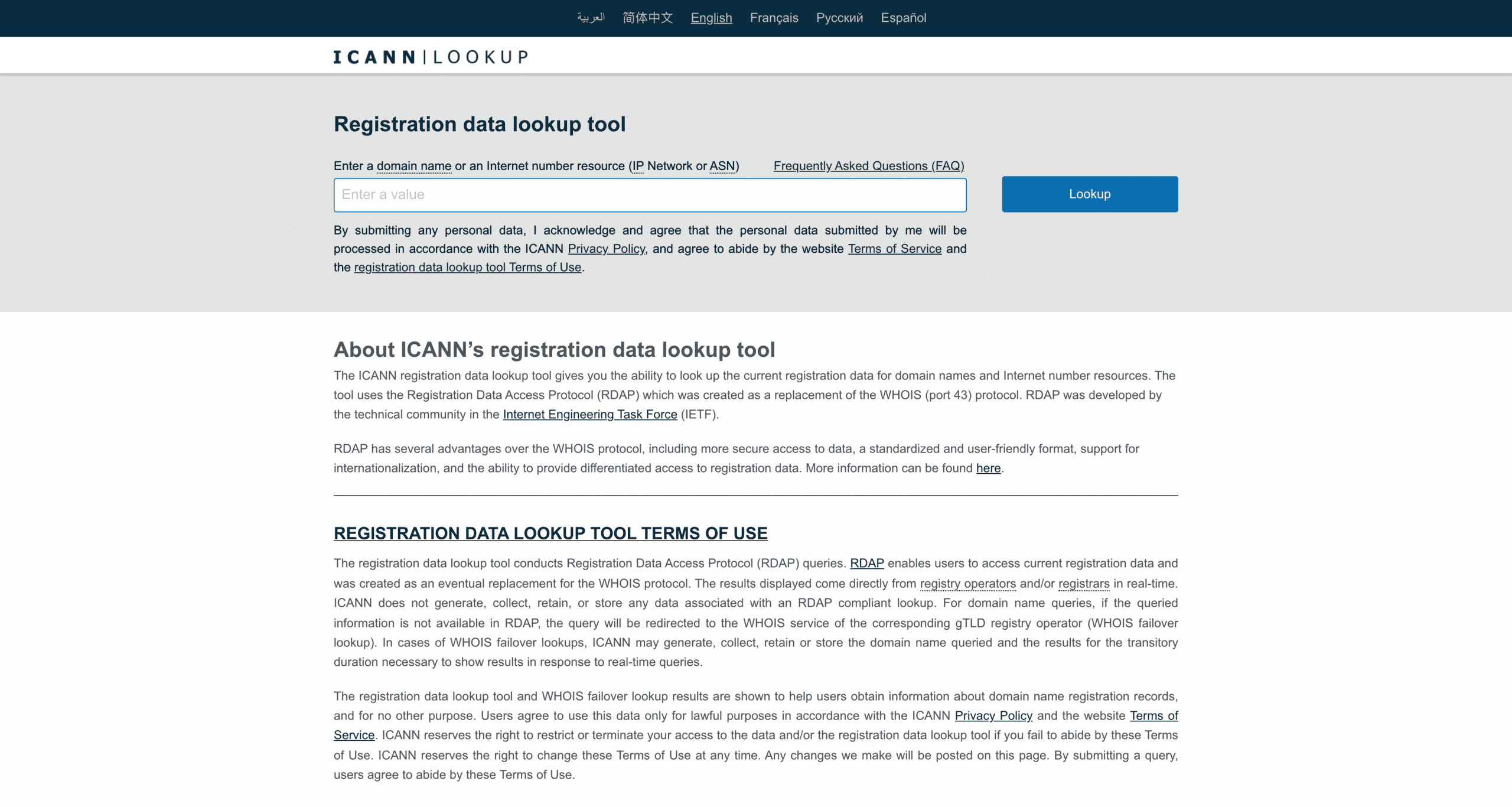
    ICANN / WHOIS website domain lookup

    Try to find the contact information for the owner. The contact information typically will be private, but email addresses like privacy@ or info@ are often forwarded to the correct owner. Give it a try!

    Most web admins won’t reply, but just one small piece of information can help you dig deeper and find out who can help you.

    2. Negotiate a price

    Most domains are available for purchase anywhere from $2–$200. If someone already owns the domain, they will charge more—anywhere from $250–$25,000. Communicate with them to determine what the price will be.

    3. Pay for and transfer the domain ownership

    If the domain costs you over $200, you need to be sure you get an agreement signed by you and the individual selling the part. That way, if anything gets weird or goes wrong, you can point back to the agreement and get the domain you paid for in court.

    You should then create an account where the domain owner’s domain is registered for easy transfer. Pay the owner for the domain with the payment method they request, and then you should see the domain in your account within one to two business days from the transfer start.

    What about domain broker services?

    Should you use a domain broker service?

    A domain broker service can be ideal if you hope to purchase a domain that someone else already owns. They typically are “white glove” services, so they take care of the whole process for you, and you can sit back and wait for it to happen.

    The service process

    The process is typically pretty simple. First, you submit a request for the domain and pay the initial fee (usually $100-$125). After that, you have a short consultation call with your broker, and then they handle it. The broker will contact the domain owner, negotiate a price, purchase the domain, and then transfer the domain for you.

    Broker service fees

    A domain broker service usually has an upfront fee of around $99, or 20% of the negotiated price.

    Benefits of hiring a domain broker

    There are several benefits to hiring a domain broker. One of the biggest ones is that it is sometimes just less awkward for everyone involved to have a third party handle the negotiation. It can help both parties feel more comfortable.

    The domain broker also has more access to information than you probably do as an independent business owner. They can access exclusive details to contact the domain owner more quickly and easily.

    A domain broker can also save you time by taking care of the headache of the process. They’re experienced and can get it done more quickly.

    Where can I hire a domain broker?

    There are a few sites that are ideal for hiring domain brokers. One of them is GoDaddy Domain Broker Service. You could also try Grit Brokerage, or VPN.com.

    We’re happy to help you track down your perfect domain as part of a website design project. We’ve helped clients track down and buy premium domains like bookworthy.com, budega.com, and others.

    What if you can’t buy the domain?

    So, what happens if the domain owner won’t sell the domain to you? Rest assured, it isn’t the end of the world. There are other options for things you can do to keep your name and have a domain that goes with it seamlessly.

    One option for you is to use a different version of the domain. Instead of.com, you could try a TLD like .net, .biz, .org, or .co.

    Another option is to add a word or two to the beginning of your company name. For example, Proof, a sales conversion booster tool, has a domain called useproof.com instead of just the basic proof.com. Other words such as try, hire, or meet could be used similarly. It can act as a small advertisement along with being your domain name.

    Here at Structure, we had to use this technique as the web domain structure.com wasn’t available. So, instead, we went with wearestructure.com.

    It’s time for a premium website that brings you customers

    Most websites don’t create sales. That’s because most people think you need a beautiful website to impress browsers, when instead what you actually need is a website that’s designed for buyers. 

    Make a website that makes money for your business. Watch our free website training 5 Reasons Why Your Website Doesn’t Create Sales and you’ll know how to create fans of your business, and stop losing to the competition.


  • How to Find (and Hire) a Good Web Design Agency

    How to Find (and Hire) a Good Web Design Agency

    The problem is apparent. Your customers spend significantly more time online daily (thank you, COVID-19). Therefore, the distant dream of redesigning your website someday is no longer just important—it’s urgent. You need a web design agency to help.

    You’re smart—and you know that if customers can’t find your business online, they’re finding your competition. You need a website that works.

    So you’ve started looking for a web designer or web design company to help. But what you find is discouraging at best.

    • Most web design agencies are constantly chasing new clients (because they can’t keep the ones they have).
    • Most web design agencies keep their best ideas to themselves (because they’re afraid they’ll be mocked if it’s dumb).
    • Most web design agencies create distance in their client relationships (to protect themselves from being hurt when things go south).

    Ironically, these flaws are why so many people have bad experiences with web design agencies in the first place.

    These flaws hurt a web agency’s ability to forge a long-term relationship with their clients—and do great work! Because it causes them to avoid the problematic things that produce results.

    Does that sound like the kind of web design partner you want to hire?

    3 things to look for before you hire a web design agency

    1. They do good work

    This could go without saying, but your web design company needs a portfolio of work proving their capability.

    They don’t need a huge portfolio or even a portfolio of work with big clients like Google and Airbnb. What you should be looking for are website projects like yours. Their projects should have a style you like. Their projects should function how you like.

    2. They make time to understand you

    A lot of web design companies solve problems that don’t exist. In other words, they slap on a solution that doesn’t solve anything. A good web design company starts a relationship by understanding your face. If they don’t, they don’t care.

    This means that your web design team should give first. They should give their time, money, and effort to understand you and try to win you over. This often takes the form of a discovery conversation or pilot project so they can dig into what you’re up against.

    3. They’re not too expensive or too cheap

    Too many people spend too much or too little on a website. They either hire an agency with too much baggage and drama, so it’s costly, or they hire a freelancer on Upwork who does a crappy job and hardly costs anything.

    Think of your website as a car, truck, or boat. It’s a machine that you buy to give you what you want. A good car, truck, or boat gives you fun, comfort, or safety.

    If you were buying one today, you wouldn’t buy the most luxurious option because it would probably be way more than you need. You also wouldn’t buy the cheap crap because it wouldn’t be as fun, comfortable, or safe.

    You’d look for a car, truck, or boat that will be a good investment and will give you what you want. You should be willing to pay enough to ensure you get what you want.

    Don’t settle for cheap, easy, or sleazy

    If you’ve been in business for any time (or watched The Godfather), you’ve heard the phrase, “It’s just business. It’s not personal.” That’s just a lie web design companies tell to preserve their ego and self-confidence.

    We believe business is personal.
    This changes everything.

    At Structure, we live and work by this code. Business is personal. This belief means we embrace uncommon levels of humility, selflessness, and transparency for the good of our clients.

    We make everything about the client. Here’s what that means . . .

    We’re not salesmen, we’re agency consultants

    Our primary goal isn’t to sell you into a big project or an ongoing retainer. We’re here to help. We know hiring us will be a breeze if we do that well.

    We start every relationship with a free discovery call or pilot project.

    Instead of protecting the business, we protect our clients

    This means we’re not afraid of losing money on a client or a project. Our clients are our business, so the only way to stay in business is to take exceptional care of our clients.

    This is why we have a proven web design process that we’ve time-tested repeatedly. It ensures you get the best care and your project goes on without a hitch.

    Instead of getting everything we can out of the relationship, we give everything we can to the relationship

    We’re here to give, not take. When you provide a gift for someone, you want them to love it, use it, and be proud of it. Why? Because you’re proud of it. We want you to feel the same about our work. This means we take extreme ownership of everything we do and make it great for you.

    This is precisely why our agency has a website guarantee.

    Are you ready to hire a web design agency?

    At the end of the day, if your web design team can demonstrate vulnerability, you will experience a more profitable relationship and feel more inspired by the work they do for you.

    If you’ve made it this far, you’re probably thinking, “I need someone like this to build my website for me.” We’d love to help. Here’s where to start.

    Schedule a web design agency discovery call

    Scheduling a discovery call is excellent if you’re unsure of what you need and want to chat. We mostly chat for about an hour to dig deep and understand what you and your business are all about.

  • 5 Stages of a Successful Website Redesign Process That Works Every Time

    5 Stages of a Successful Website Redesign Process That Works Every Time

    Redesigning a company website can feel intimidating, especially if you’ve never done it before or you’re already overwhelmed by the projects on your plate. It’s so much easier when you have a proven website redesign process to follow.

    In this article, we will walk you through the Structure Website Redesign Process that we’ve used for hundreds of clients over the last five years (September 20, 2023, at the time of this writing).

    To cut to the chase, we have a 5 Step Website Redesign Process that works every time (if you follow it!).

    1. Define
    2. Design
    3. Develop
    4. Manage
    5. Grow

    You can do these steps on your own or with your internal team. You could probably get a solid head start with this article and our Free Website Redesign Planning Guide.

    However, if you’re considering hiring an expert to help with your website redesign project, it’s much easier to trust someone who has a plan and has worked on it repeatedly.

    Unfortunately, you don’t get that with most local web design agencies or freelancers.

    This 5-Step Website Plan is the same process we’ve used for clients in executive coaching, manufacturing, private equity, e-commerce, cannabis, consumer packaged goods, and many more.

    If you’re in one of those industries, that’s great! But even if you’re not, this website redesign process will still work for you.

    And even if you’ve got a small website or spinning off a new one, you can use this process. While it’s perfect for a website redesign, it works great for a new website.

    Let’s build a website that keeps your customers hooked.

    Step 1: Define – Website Planning

    A website redesign isn’t art.

    It’s science.

    Unfortunately, in the many website redesign projects we’ve worked on, the primary problem with any web project that doesn’t meet goals or expectations is a failure to plan.

    Of course, at Structure, we start with planning. So that’s not an issue when you work with us.

    But in my experience as a digital marketing veteran at software companies and agencies, the same website issues have come up over the years.

    And they all come back to one thing: failure to plan.

    It’s not just my experience, either!

    Research suggests that 68% of marketers did a site redesign in the last 12 months – but 1/3 were unhappy with the results.

    Furthermore, failed website redesigns cost an average of $55,000 plus an additional $115,000 over the next 12 months to fix.

    Ralf Speth, CEO of Jaguar Land Rover, said it best:

    If you think good design is expensive, you should look at the cost of bad design.

    Likewise, if you think a good website is expensive, you should see the cost of a bad website.

    That is why we start every website redesign process with a website plan. And you should, too.

    Get Our Free Website Redesign Planning Guide

    Download the Structure Website Design Planner to plan a website launch that makes your project successful!

    How does the “define” stage of the Structure website redesign process work?

    All website projects start with a free 30-minute Consult Call where we’ll gain an understanding of what you’re hoping to create.

    We’ll ask questions like…

    • Why do you need a new website?
    • What do you need your website to do for your business?
    • How did your last website perform? What worked/didn’t work?
    • Which platforms are you using, and do you like them?

    During this call, we’ll also be able to recommend a website design package that fits your goals. Once you decide on a package, we’ll start with a virtual or in-person Website Workshop.

    During this workshop, we’ll help you define and document the following information:

    1. Basic company information
    2. Who is on your team
    3. The vision for your website
    4. A competitive analysis
    5. Brand documentation
    6. Your buyer’s journey
    7. A sitemap of your pages
    8. Content plans for each page
    9. Technology requirements
    10. Website build budget

    The final answers comprise your Website Plan.

    Step 2: Design – Website Layout

    Website design is more than mocking up a pretty version of your brand for a webpage; it’s designing a home for your customers to visit to engage with your business and buy from you!

    Whether you’re starting by looking for a fresh look for your website or you already know you want to add new functionality, the website redesign process hinges on understanding what makes an outstanding strategic design.

    Website Redesign Process: Define

    What is a strategic design, you might ask?

    A strategic design is these things:

    • Visually appealing and on-brand
    • Well-organized and easy to navigate
    • Engaging with compelling content
    • Designed for your target audience
    • Optimized for search engines
    • Responsive, so it looks good on all devices

    Creating a strategic website design that meets all these criteria can seem daunting, but it’s important to remember that your website is a vital part of your business and should reflect your brand and meet your business goals.

    In short, your website design should focus on how it works, not just how it looks.

    How does the “design” stage of the Structure website redesign process work?

    The Structure Website Design Package you choose will determine what you receive from the process. However, here are some of the deliverables you can expect:

    • Wireframes
    • Desktop Designs
    • Mobile Designs
    • Tablet Designs
    • Content & Media
    • Functional Specification

    If you’re unsure what this means, that’s okay! Our team of website design experts can help. We’ll coach and consult with you to clearly understand the goals and needs of your website, and then we’ll create a custom website design that’s right for you.

    Step 3: Develop – Build

    During the website development process, the aim is to create a site that aligns with the design concepts established in the prior phase.

    Moreover, this is the stage where you guarantee that your website operates smoothly, catering to the objectives, technology, and user requirements outlined in the Website Plan.

    This is another reason the website plan is so critical. It is a guiding source of truth throughout the website redesign process.

    Achieving these objectives will create a website that accomplishes your plan and sets you up to crush your business goals.

    Website Redesign Process: Development

    How does the “development” stage of the Structure website redesign process work?

    Upon your approval of the Functional Specification (the final design deliverable), our development team will begin building your website on a separate development site so your live website isn’t affected. 

    We’ll optimize your website for all devices and browsers and essential SEO, accessibility, and load speed as standard practice.

    Then, we’ll break your website. But don’t worry, it won’t stay broken!

    We’ll fix any issues and put checks in place to ensure it’s bulletproof for your team and users.

    Testing is completed with a Training Call so you know exactly how everything works. Then, you’ll get to review and approve your website.

    When you approve, we’ll launch your website and push it live onto your domain for customers to use and love. 

    If you’re lost by now, here’s a quick recap:

    1. Structure Builds Your Website
    2. Structure Completes Quality Assurance (testing)
    3. Structure Provides Website Training
    4. Your Review
    5. Structure Launches Your Website

    Ultimately, by the end of this step, you’ll have a new website to delight every visitor.

    Your website will be easy to manage and set up to work for your business.

    And we have a Work For Free Warranty to cover you in case of any unexpected flaws.

    Step 4: Manage – Updates & Monitoring

    All websites must be updated and optimized, especially after being redesigned.

    It’s a common practice for local agencies to “lock” you into a management plan with them. Often, this subscription is part of the deal. Or, they might hold the key to your hosting.

    Either way, we’re not fans of locking you into anywhere you don’t want to be.

    That includes a management or hosting plan you don’t know why you’re paying for. That’s not our style.

    Website Redesign Process: Support

    We want to hand off your website to your team with training and support to ensure it’s working and meeting your business goals.

    You’ll have every tool and resource if you want to manage it yourself.

    However, managing your website takes time. It can easily take a few hours a week.

    Most clients don’t have a team to hand their website to, so we continue working with an active WordPress Website Management package.

    We love managing websites we’ve built, and it’s honestly one of our favorite partnerships for long-term growth.

    The reason is that we’re “in your corner” to support any ongoing initiatives, optimizations, and projects.

    We’re here for whatever you need, as long as you need it.

    How does the “manage” stage of the Structure website redesign process work?

    Website management with Structure is more hands-off for you than most other steps in the website redesign process.

    This means you may not see much of what’s happening in the background.

    But as soon as you hand off your website for management, we immediately do the following:

    • Setup daily site backups
    • Test forms and conversion funnels
    • Make monthly plugin and software updates
    • Report on website performance monthly
    • Audit website performance & SEO annually
    • Make ourselves readily available to answer any questions you have

    That’s it! If you want to learn more, you can download our free PDF Overview (no email required).

    Step 5: Grow – Increase Results

    In the end, the effectiveness of your website launch hinges on its capacity to generate traffic, capture leads, and drive sales.

    However, achieving these objectives becomes impossible if your website isn’t functioning correctly. In this final phase, you will execute marketing campaigns tailored to your target audience.

    Subsequently, you will consistently fine-tune your strategies in response to the distinctive challenges and opportunities you encounter. The growth phase is where your website truly reaches its full potential.

    How does the “grow” stage of the Structure website redesign process work?

    Often, we work with our clients to develop a sales funnel to drive sign-ups and sales.

    For most clients, this means focusing on three initiatives, in order:

    1. Acquire Traffic
    2. Generate Leads
    3. Increase Sales

    Website Redesign Process Common Questions

    [gs_faq id=”2091″]

    [gs_faq id=”2093″]

    [gs_faq id=”903″]

    [gs_faq id=”892″]

    [gs_faq id=”895″]

    [gs_faq id=”897″]

    [gs_faq id=”2095″]

    [gs_faq id=”2097″]

    [gs_faq id=”2099″]

    [gs_faq id=”2102″]

  • Should You Hire a Web Designer or Do It Yourself?

    Should You Hire a Web Designer or Do It Yourself?

    There comes a time when every company, business leader, or entrepreneur needs help with their website. Usually, that happens when they’re starting a new company, launching a new product or service in an existing company, they realize their current website just isn’t bringing in the leads or sales they wanted, or maybe most common, their website doesn’t reflect the quality of work they do anymore. You wonder should you hire a web designer or do it yourself.

    So what should you do?

    The problem is . . . it’s SO EASY to waste a ton of time trying to do it yourself. It’s also SO EASY to waste a ton of money with an agency . . .  especially if your website doesn’t work any better than it did before you hired that agency. 

    Within the last year, I’ve had two clients who made both of these mistakes. One wanted to rebuild their old company’s new website by himself, but it didn’t take long before he started and got way over his head and realized he was wasting endless amounts of time getting nowhere. 

    I also had a client who came to me because he spent $5,000 on a brand new website that, when it was done, didn’t correctly represent their product. 

    Let me pay your dumb tax. I’ve spent my 10,000 hours in the school of website hard knocks, and I want to help you avoid the website money pit—so you don’t make the same mistakes so many of our clients do before they come to us for help. 

    Let’s break down should you hire a web designer or do it yourself – and in the process, I hope to help you find a framework to decide for yourself. I’ll also share a third option you may not have considered before but might be just the thing you need.

    DIY Business Websites

    The option most business leaders consider first when deciding should you hire a web designer or do it yourself, is DIY. Let’s call this the done-by-you option. 

    Could they or could someone on their team do it BY themselves?

    So they check out Squarespace because they’ve seen ads that say “A Website Makes It Real.”

    Or, if they’re tech-savvy, use a drag-and-drop builder like Elementor on WordPress.

    I’m not going to dissect each platform, as both can be good. But I want to look at the idea of done-by-you, why you’d do that, and why you shouldn’t.

    A few reasons to do it yourself include

    • You get to control the entire process
    • You save money not hiring an agency
    • You know how your website works, inside and out

    These three reasons are precisely why so many people are DIYing their websites. It’s cheaper than hiring an agency, and they don’t trust someone else to do it as well as they could. All good. However, this presents a few trade-offs.

    If you DIY your website…

    • You have to do it yourself
    • You spend time instead of money
    • You may feel lost and confused, not knowing if you’re doing it right

    You may have heard it said to make money, you have to spend money. That’s precisely why people hire landscapers and house cleaners because it’s better to hire someone to do that than do it themselves. The same thing in business is why people hire an executive assistant. It’s not very useful for an executive to make travel plans instead of closing a deal.

    In business and life, everything is about opportunity cost. It’s about time and money you’re either earning, spending, or wasting.

    That’s why considering DIY website building; you must look at the opportunity cost. Opportunity cost is what you will lose by choosing this decision. If it takes you 100 hours or an agency $5,000, what’s more expensive? If your time is valued at 100 per hour, you’re technically paying twice what you’d pay an agency by doing it yourself. 

    By DIYing, you get to control the entire process, and you’ll know your website inside and out, but you’re still not an expert in website design. You have to expect that the website will be quirky, may be confusing to customers, and may feel “homemade.” Is that something you can afford? Another way of thinking about it is, can you afford to do it wrong? Is ROI so fluid that you can risk it not working as it should?

    If you’re just starting and you don’t have much to lose, you’ve got all the time in the world, or you’re confident in your ability to make a website, then DIY might be your option. 

    If you’re unsure, here are some reasons to (and not to) hire an agency and what that would look like.

    Hire a Professional Web Design Agency

    Some business leaders are wise and jump to hire someone for their website. Let’s call this done-for-you.

    They understand specialization and opportunity cost and can easily do the math to know they can’t afford to do it wrong or can’t do it themselves. 

    Maybe this is you. If so, this works out well because…

    • An agency will manage the process soup to nuts
    • You’ll save time by not doing it yourself
    • You’ll feel confident they know how to do it right

    You’ll pay an agency $10-25k for a small to medium-sized website. A more extensive, more complex website will cost you $25-50k if you already have products, services, and heavy traffic. But, it’s honestly not too difficult to justify either of those costs if you’re a growing business.

    The best part is, you don’t have to do it yourself. It’ll be done well and will likely be beautiful, and will reflect the quality of your products or services. 

    However, when you hire a web design agency…

    • You lose control of the process
    • The cost can feel intimidating
    • There’s a chance it may not work in the end

    Do you remember the story I told at the beginning of this video about my client who paid an agency $5k for a crappy website? Yeah, he was just starting, and $5k was a lot, especially for a small website for a startup with no traffic. And the fact that after it was all done, he hated the experience with the agency, felt like he wasted precious seed money, and didn’t reflect well on his products, was a sign that he should’ve done it himself.

    The truth is that he could’ve made a website himself. I believe most business leaders would do it themselves if they could. But like this client, they don’t know how and don’t have a step-by-step plan for getting there. They’re not confident that they can do it right and want more control over the process than an agency can give them.

    The Bottom Line: Should You Hire a Web Designer or Do It Yourself?

    You know your website could be making more money for your business. But when customers don’t understand how your product or service helps them, they tune you out and take their dollars elsewhere.

    Watch our free video training on How to Build a Really Attractive, High-Converting Website That Makes You Proud.

    I’ll guide you through a simple process that will help turn your website into a sales machine because you remove the obstacles that are stopping people from buying from you and implement automated and sustainable sales systems that could DOUBLE or TRIPLE your revenue.

  • Website Goals: What Do Customers Want From a Website Online

    Website Goals: What Do Customers Want From a Website Online

    If you’re a marketing or business leader, your website goals include wanting customers to engage with your website and buy your products or services.

    But you’ve probably learned by now that you’re good at getting in your way of success. I’m speaking from experience here.

    When we communicate with customers on our website, we have our “business hat” on; which means we do everything backward from how the customer wants to see, hear, and experience it.

    In short, we communicate what we want to say—not what they want to hear.

    We do this by using photos of our team or our office building instead of photos of our customers using our products or services.

    And we explain our services in the most detail but leave out the details that matter most.

    And people leave. Never coming back and never buying.

    It’s because they’re looking for two things you never give them.

    These things aren’t complicated. It’s so stupid that you’ll kick yourself after I tell you.

    Here it is…

    They’re looking to understand and be understood.

    If you give them these two things, no matter what you sell, they’ll want to buy from you. And there’s no better place to communicate those two things than on your website.

    Let’s look at how you can use your website to accomplish your customer’s goals, starting with their desire to be understood.

    Website Goals #1: To Be Understood

    To be understood, your customers must know you care more about their problem than your product. 

    Most business leaders can’t seem to make their customers feel understood because they have the curse of knowledge. 

    This is something you and your company need to avoid at all costs.

    What is the curse of knowledge? The curse of knowledge happens when someone like you knows so much about their products and services they project that knowledge onto their potential customers. You care, and you genuinely think you are doing them a service.

    The problem is most customers will only give you a couple of seconds to make your pitch on your website. That means it needs to be easy to understand. And the best way to be easy to understand is to make your pitch less about you and more about them.

    Less about your product and more about their problem.

    When you do this and communicate with empathy and authority, they’ll trust you and feel like you understand them. 

    This works because your competition isn’t doing this. They’re over there strutting their stuff, and you’re over here caring for customers. While they may look better, you’re doing better.

    And as I’ve mentioned before, what’s better than padding your pride with a website that stuns impressive is padding your pockets with one that sells.

    Now, don’t leave out your product or service from your website altogether because your customers need it to win the day—make sure it’s in its place. 

    So before you present your product or service, present your understanding of your customer’s life and pain. They’ll feel understood and want to buy.

    Website Goals #2: To Understand

    Second, they want to understand HOW your product or service will help them overcome their challenge.

    In our website design planning work with clients, I teach much about the difference between information and transformation.

    We go super deep in the process, but I’ll distill it into a fundamental principle here for you. 

    People will get bogged down and lost if you list all your products and services on your home page. 

    Most agencies would tell you to break down your products and services into bite-sized categories so it’s much easier to digest what you sell. That’s good advice and would probably be helpful in many ways. But that advice only touches the surface of the subject.

    Your customers aren’t just looking to understand better what you sell or how your product works. They don’t need more features or facts. They don’t need to be bogged down by new releases.

    Not that those things aren’t cool because you worked hard on them, but your customers want more. Your customers want much more than that.

    They want to understand how your product works for them.

    All you have to do is explain it to them.

    Let me get practical. 

    You know the Skittles tagline, “Taste the rainbow?” Skittles isn’t stupid. That’s precisely what your customers want. They want to taste the transformation they’ll experience when they buy from you.

    So, on your website, do this: talk less about your products and more about how your products help your customers.

    Make your website an engaging marketing tool—not a painful one

    You know your website could be making more money for your business. But when customers don’t understand how your products or services help them, they tune you out and take their dollars elsewhere.

    Watch our free video training on How to Build a Really Attractive, High-Converting Website That Makes You Proud.

    I’ll guide you through a simple process that will help turn your website into a sales machine because you remove the obstacles that are stopping people from buying from you and implement automated and sustainable sales systems that could actually DOUBLE or TRIPLE your revenue.

  • 5 Reasons Your Manufacturing Website Doesn’t Work (and What to Do About It)

    5 Reasons Your Manufacturing Website Doesn’t Work (and What to Do About It)

    You know it already, but I’ll spell it out: Your website needs work. You know it. I know it. Your customers know it.

    I’m not talking about whether it’s broken or offline. If it is completely down, that’s another issue entirely.

    What I’m talking about is this:

    • It’s old and outdated
    • It doesn’t give you any leads or sales
    • The competition is passing you by

    Meanwhile, you do no know who to turn to or how to improve it. You have enough going on as it is.

    In the next few minutes, I’ll explain five reasons most manufacturing websites don’t function or work very well, along with practical changes you can make RIGHT NOW to make it work.

    1. Your manufacturing website is about you

    Your website should be all about your customers. What they get, how you can help improve their lives, and what jobs you or your products help them do.

    This principle could be summed up in five short words: you are not the hero. Let me say that again; you are not the hero.

    You see, what a lot of companies do is they think they’re the hero of their customer’s stories. After all, they have the problem, and you’re coming up with the solution. So you’re the hero. Right? You solved their problem. You changed their life. Except, while every story does have a hero, in your customer’s story, it’s not you. It’s them.

    If you do what your competition isn’t and make your customers feel like the hero they want to be, they’ll come back to you because you’re the only one they know who makes them feel like you do.

    So, how do you do that, you ask? You do a 180-degree shift in your messaging and reposition yourself as the guide, the helper.

    Even your About page needs to reflect this principle. Your About page isn’t about you; it’s about your customers, how they struggle, and how you can help them. Unless people are hiring you for your team, they’re not coming to you looking for long lists of team members or company history. They want to know if you can fix THEIR problem.

    On your home page, instead of saying, “We do this and that,” say, “We can help you do this and that.” Do you see the difference? In the first example, you’re the one doing; in the second, they’re the one doing (and you’re helping). 

    Make your entire website about your customer, and you’ll create raving fans who buy once and keep coming back for more.

    2. Your manufacturing website is overwhelming

    Have you ever been to a website that bombarded you with tons of information immediately? There was so much there you didn’t know what was necessary or what to look at next. It was just so overwhelming you had to leave. 

    Most companies drown their customers in information before they’re ready for it. 

    Instead, you need to set up your website to facilitate a process called “Drip, Sip, Drink.”

    Here’s what I mean. The first section on your homepage should have your easy-to-understand tagline where you say what you sell and give them a clear call to action.

    Then in the sections below, you should talk about the different jobs your products or services do for your customers so they can look at everything from a distance – in other words, you give them a drip. And don’t put it all into one section; break it down into one section per job.

    If they like the drip, they’ll go deeper and find your product page that gives them more information about your product – that’s the sip. 

    Then, if they like your product, they’ll read your case study or customer story – that’s the drink. 

    Suppose you break your offering into bite-sized categories and communicate it using the Drip, Sip, Drink process. In that case, it’ll be much easier for customers to understand what you’re offering, why it’s essential, and how to buy it.

    Do this, and your website will work.

    3. Your manufacturing website is confusing

    As business owners, we think we’re being clear. But in reality, we’re being precise. We have tunnel vision. We only see what’s right in front of us.

    Because of that, we usually make one of two mistakes: we either get way too into the weeds and tell customers too much about our products too soon and we confuse them or scare them away, or we say generic, jargony, business things using acronyms that work in the business world but the human on the other end has no idea what you’re talking about.

    This is why fixing our first two problems is so important. If all you do is talk about yourself and your business and bombard your customers with information, they will be confused and leave.

    There are a few studies that show how our brain does one of two things when it receives new information: 

    It either makes sense of it by turning it into a story or, if it can’t make sense of it, it ignores it. 

    You don’t want customers doing either of those things on your website: zoning out or ignoring everything you have to say. 

    No, you want them to engage and take action!

    But they can’t if your website is just another thing bombarding them with more information that they don’t know what to do with.

    I want you to remember this: if you confuse, you’ll lose.

    People should be able to go to your website and understand what you offer and if it’s for them within five seconds. If it takes them longer than five seconds, you’re losing sales. Ask yourself, are you being clear? Because if it doesn’t make sense, it won’t make money.

    4. Your manufacturing website doesn’t call people to action

    You’d be surprised how many customers have difficulty figuring out how to buy your product.

    Your website should include an easy call to action. That means a button that says, “buy now, schedule a call, Register today; those are clear calls to action.” Learn more and get started aren’t clear. If you don’t have this, you’re losing out.

    You’re not going to scare people away by being obvious. You’re helping them buy from you so they can get what they need, and you can get paid.

    Let me give you a story. I like to hunt. Recently I was hunting for turkey with my brother-in-law. We had been in the woods since 4:30a before the sun came up. It was so dark I didn’t even know what I was sitting on; I just knew it wasn’t my bed. Anyway, we made calls and sat still for a few hours until, around 7:30a, we heard a turkey. It kept gobbling our way. We typically text back and forth when we hear something that might be a turkey. So I sent him a text to tell him which direction the turkey was coming from so we could go home with a turkey instead of going home empty-handed. 

    Here’s what I text him. Gobbler at 3:00. I told him exactly where it was coming from so he could see it and shoot it. If I had said turkey to the right, he would’ve been looking everywhere and may have missed it! But because I was clear with where the turkey was, he knew where to look.

    The good news is that call-to-action buttons can’t wander away as turkeys can. If you’re clear, they’ll work. The bad news is that the turkey wandered away from us, and we didn’t come home with anything.

    So don’t miss this one. Make it easy for customers to buy by being transparent with your calls to action.

    5. Your manufacturing website doesn’t communicate transformation

    Your website should visually display the success your client will experience if they use your product or service. 

    Here’s why: your customer has two types of problems: external and internal. Another way of putting it is physical and emotional. One problem they experience and one they feel.

    An external problem might be that I have a flat tire. The internal problem is that I can’t make it to work on time, my boss might fire me, and I can’t afford to lose my job.

    Every external problem, whether a flat tire or a leaky roof, manifests an internal problem — frustration, confusion, or even the feeling of “I don’t have what it takes.”

    Please don’t be mistaken; your customers buy your products to relieve their internal tension. And when you communicate in a way, using words and pictures that show how you can relieve that tension, your customers will be more likely to seek your expertise.

    If you’ve watched a movie, you know every story ends in victory or tragedy. For your customers, it’s success or failure. They will feel one or the other, and I can guarantee they want to feel successful.

    Make your website work

    Okay, very good! There are five reasons your website doesn’t work and how to fix them.

    1. Your website is about you
    2. Your website isn’t emotional
    3. Your website is confusing
    4. Your website doesn’t call people to action
    5. Your website doesn’t communicate transformation

    So, you may ask yourself, where do I go from here? If you took notes, you probably have some excellent action steps. If not, I’ve got a few for you.

    First, facts are stubborn things. If your website isn’t getting you sales, there’s a reason. Look at your current website and see if it follows any principles I shared today. 

    If you’re following all five, you’re a pro. 

    If you’re following three of the five, you’re in a good spot where a few minor changes will make a big difference. Take them one step at a time and get to work.

    You’ve got some work if you do not follow these principles. But I understand you might be overwhelmed by all this. It’s okay, start with principle one and make your way through the list, one at a time.

    If you’re ready for the next step, I invite you to watch our free video training on How to Build a Really Attractive, High-Converting Website That Makes You Proud.

    I’ll guide you through a simple process that will help turn your website into a sales machine because you remove the obstacles stopping people from buying from you and implement automated and sustainable sales systems that could DOUBLE or TRIPLE your revenue.