In our rapidly changing world, where technology keeps advancing, the connection between manufacturing web design and factory efficiency is vital. Even though these areas might seem unrelated, they significantly impact how modern factories operate. This connection is key to transforming manufacturing processes. By integrating manufacturing web design into operations, companies can adopt smarter, more streamlined approaches—redefining how industries improve efficiency, collaboration, and output.
The core of this change involves mixing digital design ideas with detailed manufacturing processes. This combination might seem unusual, but it has significant effects. By smoothly blending website design practices into manufacturing, we’re starting a significant change in how factories run, and products are made. This article is a deep dive into how web design strongly influences manufacturing, revealing the complex ways digital tools and physical processes work together to make things work better. As we dig further, we’ll explore how web-based technologies spark new ideas, make workflows smoother, and create a strong connection between the virtual world and the real world.
The Meeting of Creativity and Machinery: Understanding Manufacturing Web Design
At the core of this transformation is the idea of manufacturing web design. This complex blend of digital interfaces, user experiences, and data-driven systems works together to manage modern production. The manufacturing world used to be all about physical factories, but now it’s influenced by the digital world. This affects how decisions are made, how teams work together, and how things are made.
Making Decisions with Data in Real-Time
To run a factory smoothly, making good decisions is crucial. Web-based dashboards and analytics platforms become essential tools, giving people up-to-the-minute information about production, inventory, and the supply chain. These visual tools help managers and decision-makers quickly figure out problems, predict trends, and make wise choices to keep things running well. Having actionable data lets manufacturers wisely use resources, adjust production schedules, and handle disruptions, leading to less downtime and more productivity.
Connecting the Supply Chain
The connection between web design and manufacturing is evident in how the supply chain works. From getting materials to distributing finished products, web-based platforms help everyone involved see what’s happening and work together. Supply chain management systems, made more accessible by user-friendly interfaces, let us keep an eye on shipments, inventory, and changes in demand. This connection stops things like running out of stock, lowers the costs of having too much list, and helps manufacturers respond quickly to changes in the market, so products are available when and where they’re needed.
Virtual Connections: Working Together from Afar
Modern manufacturing is often spread across different locations around the world. Web design helps virtual collaboration and communication become possible, removing the limits of time and distance. Unique online portals, video meetings, and project management tools let teams work together like they’re in the same place. This digital connection breaks down barriers, letting teams from different areas work closely together, which leads to more innovative ideas and solutions.
Managing the Whole Product Lifecycle
Web design’s impact doesn’t stop at the production stage; it reaches through the entire lifespan of a product. Web-based Product Lifecycle Management (PLM) systems gather information about product design, changes, and quality control. These systems ensure everyone has the latest design details, reducing mistakes, rework, and project delays. Plus, PLM platforms help design and manufacturing teams work better together, making smoother prototyping, testing, and improvements.
Making Customization and Customer Service Better
In today’s world, customers want personalized experiences and quick responses. Web design helps manufacturers create user-friendly interfaces that make it easy to place orders, track their progress, and customize products. With easy online tools, customers can design products to fit their needs, improving their experience and helping manufacturers avoid mistakes after production.
From Prediction to Maintenance: Using IoT and Analytics
Web design’s influence goes beyond the factory floor and into predictive maintenance. Manufacturers use Internet of Things (IoT) devices and sensors in products to learn about how they’re used and how well they’re working. These devices connect to web-based platforms that inform when maintenance is needed. By analyzing real-time data, manufacturers can predict when equipment needs fixing, which cuts down on unplanned downtime and prevents costly breakdowns.
The Future: Adding Augmented Reality and Digital Twins
Looking ahead, the partnership of web design and manufacturing offers exciting possibilities. Augmented Reality (AR) and Virtual Reality (VR) technologies could change how training, maintenance, and design work. Manufacturers could use web-based AR and VR to create lifelike simulations, helping workers learn and fix equipment in a virtual space, speeding up learning, and reducing mistakes.
Another interesting concept is the “digital twin”—a virtual copy of a genuine product or process. This digital twin, hosted on web platforms, lets manufacturers simulate changes and see how things might work before they’re done. This helps with innovation and lowers the risks of making changes.
Advancing Sustainability with Web-Driven Insights
As factories aim to be more environmentally friendly, web design in manufacturing plays a role. Web interfaces help track real-time energy use, waste production, and carbon emissions. This allows manufacturers to use resources more wisely and reduces their environmental impact. These insights help make decisions that align with sustainability goals, turning manufacturing into a way to care for the planet.
Changing the Workforce
The impact of web design on manufacturing goes beyond making things more efficient—it changes jobs, too. As technology automates some tasks, employment in manufacturing shifts. Workers will need different skills, like being good with digital tools. This means the relationship between web design and manufacturing asks for workers who can adapt to new ways of doing things.
Manufacturing Web Design: How It Blends Realities
The merging of web design and manufacturing sets off a transformation that reshapes industries worldwide. Manufacturers create a system of constant improvement and innovation by combining user-friendly design, data insights, and easy connections. From real-time information that guides decisions to supply chain coordination that helps distribute resources, web design becomes a driving force for manufacturing to adapt and evolve in the digital age.
As technology moves forward, the partnership between the online and physical worlds promises more efficiency, sustainability, and success. The era of manufacturing web design shows how humans can use innovation and tradition together, combining digital precision with tangible reality. At this turning point, the manufacturing landscape becomes a canvas for web design to paint a picture of efficiency, innovation, and progress—a picture that echoes with the rhythm of a new era of industrial growth and achievement. This powerful blend of web design and manufacturing is like a bridge between two worlds, connecting the virtual realm of technology with the tangible world of products.
Looking deeper, it’s clear that the partnership of web design services and manufacturing is a powerful force that can drive positive change in several key areas.
One of these areas is efficiency. When machines, equipment, and processes are interconnected through web-based platforms, they can communicate and share information in real time. This means adjustments can be made quickly, problems can be addressed promptly, and production can become smoother and more streamlined. As a result, manufacturers can save time and resources while producing high-quality goods.
In addition to efficiency, sustainability is a crucial concern in today’s world. Manufacturing processes can significantly impact the environment, from energy consumption to waste production. Web design integrated into manufacturing operations allows for real-time resource use monitoring and optimization. Manufacturers can make informed decisions that reduce their ecological footprint by tracking energy consumption and waste generation. This benefits the planet and aligns with the growing demand for environmentally conscious practices.
The partnership between web design and manufacturing also extends its influence to the workforce. As technology changes the way factories operate, it also changes the skills needed by the people who work there. Digital literacy, adaptability, and problem-solving skills are becoming more critical. This transformation underscores the dynamic relationship between technology and human capability, emphasizing that progress is achieved when technology empowers individuals rather than replaces them.
Conclusion: Manufacturing Web Design
The interplay of web design and manufacturing is a remarkable evolution that holds the potential to reshape industries, enhance efficiency, and contribute to a more sustainable future. As we stand at the crossroads of these two domains, the road ahead leads to a horizon where innovation, collaboration, and technology converge to create a brighter and more interconnected industrial landscape. The journey of manufacturing web design serves as a testament to human ingenuity and adaptability, reminding us that by embracing change and harnessing the power of technology, we can forge a path toward excellence and progress.
As we explore the dynamic landscape of private equity, we encounter a world where expert evaluations of financial opportunities and strategic decisions drive growth. In this high-stakes environment, private equity website design plays a crucial role—serving as a digital bridge between firms and investors. A well-designed website is no longer just a marketing asset; it’s a strategic tool for showcasing credibility, communicating value, and enhancing investor trust.
In this ever-changing environment, the emergence of private equity website design as a transformative catalyst is genuinely remarkable. The convergence of private equity and web design heralds a new era characterized by enhanced investor engagement, heightened transparency, and streamlined efficiency. This comprehensive article aims to delve deeper into web design’s profound impact on the private equity sphere. We will unravel how it shapes communication strategies, elevates branding efforts, and simplifies interactions, ultimately nurturing a symbiotic relationship between investors and fund managers.
Let us begin by delving into “The Convergence of Capital and Creativity:
An Introduction to Private Equity Web Design.” In an industry where strategic allocation of capital can steer the trajectory of enterprises, the art of effectively engaging investors holds paramount importance. Web design is the virtual gateway, enabling private equity firms to spotlight their unique value propositions, communicate their strategic outlooks, and provide insights into their operational frameworks. The fusion of private equity and web design is a testament to the adaptability and evolution of financial practices in the digital age.
The Impact of a Strong Online Presence
In a world where companies compete fiercely for the attention of investors, a website that looks good and is easy to use is like an open door to making a good impression. Private equity website design creates a digital image that shows their values, style, and how they invest. Clear and easy-to-use navigation, captivating pictures, and smooth user experiences show professionalism and make potential investors feel confident.
A well-made website is like a digital store inviting investors to explore the company’s offerings in a way like meeting in person. How the site looks, the colors used, and the pictures all help to shape the company’s identity. By adding branding to the design, private equity firms make a unified and recognizable look that investors find familiar and trustworthy.
Being Open with Interactive Reports
Transparency is a cornerstone of successful investor relations within the private equity world. Web design is pivotal in spreading the word about fund performance reports, portfolio updates, and other relevant information. Interactive dashboards and data visualizations transform complex data into understandable insights, enabling investors to monitor the progress of their investments. This high level of transparency nurtures trust, reduces information imbalances, and empowers investors to make informed choices.
By integrating web-based reporting platforms, private equity firms can provide investors access to up-to-date information, eliminating the delays that traditional reporting methods can bring. Investors can analyze performance metrics, compare fund benchmarks, and assess risk exposures more promptly. This improved access enhances the investor experience and positions the firm as a source of timely and valuable insights.
Making Communication Better
Effective communication between private equity firms and investors is essential for nurturing lasting relationships. Web design amplifies this communication by offering personalized interaction channels. Integrated messaging systems, online investor portals, and secure document-sharing platforms simplify information exchange, promoting efficient dialogues and reducing administrative burdens.
Investor portals, powered by robust web design, offer investors a central hub to access documents, reports, and updates. These portals can be tailored to cater to different investor categories, providing a customized experience that aligns with investor preferences and needs. Furthermore, two-way communication channels enable investors to ask questions, share feedback, and engage in discussions with fund managers, enriching the overall engagement process.
Trust Through Being Experts
A robust web design isn’t just a display of a company’s financial performance; it also projects its expertise in its respective industry. Private equity firms leverage their websites to disseminate insights, trends, and in-depth analyses, effectively showcasing their in-depth knowledge. This information-sharing transparency enhances their credibility, fostering trust among investors who regard them as dependable partners to rely on and gain knowledge from.
Including blogs, articles, and research reports on a company’s website is a conduit for sharing valuable insights. Private equity firms establish themselves as frontrunners in their domain by elucidating shifts within the industry, proposing innovative investment strategies, and discussing emerging developments. This enhances their image and attracts investors who seek a deeper understanding of the market’s intricacies.
Making Investor Checks Easier
Web design is key to making the process of checking out investments easier. Investors can use websites to find legal papers, information about rules, and the terms of funds, making it faster to check everything. If the website is organized well, investors can quickly find and read what they need, making investing easier and quicker.
Virtual places where data is stored, right on private equity websites, give a safe space for sharing private papers when checking things out. Because the design is smart, investors can find their way through tough info, pick papers they want, and keep track of their checking process. This organized way of working makes investing feel better and lets people know everything’s being looked at closely.
Being Ready for Phones and Tablets
In a time where we use our phones a lot, making sure a website looks good on small screens is essential. A website that works well on phones and tablets means investors can see info and use the site just as easily, whether they’re on a big computer or a small device. This flexibility makes things more accessible and makes the experience better.
Having a website that works well on phones isn’t just about being easy to use, it’s about showing investors the company cares about what they like. An investor who can go on a website without any trouble on their phone is likelier to check things out and stay connected to updates.
The Path Forward: Tailored Experiences and AI-Driven Insights
Looking forward, the role of web design within the ambit of private equity continues to evolve. The concept of personalization, propelled by the prowess of Artificial Intelligence (AI), is primed to redefine investor engagement. Web-based platforms can harness AI capabilities to analyze investor behavior and preferences, thus tailoring content and interactions accordingly. Personalized recommendations, relevant content offerings, and targeted communication collectively enhance the investor journey, fostering robust relationships and augmenting overall satisfaction.
Moreover, the infusion of AI-driven insights is orchestrating a transformation in data analysis within private equity. Web design interfaces integrating AI-powered analytics extend real-time insights into market trends, the competitive landscape, and investment opportunities. Armed with these insights, professionals within the realm of private equity are empowered to make data-informed decisions, optimize investment strategies, and seize emerging prospects.
Conclusion: Private Equity Website Design Is The New Way To Talk With Investors
As private equity continues to evolve, its fusion with web design sparks a profound transformation in investor engagement. By integrating innovative design principles, technological advancements, and user-centric interfaces, private equity firms are empowered to create a digital ecosystem that resonates with investors and enhances their confidence.
The era of private equity website design symbolizes a shift towards greater transparency, streamlined communication, and elevated investor experiences.
An unwavering pursuit of excellence marks this evolution, a steadfast commitment to aligning investor interests, and a dedicated embrace of digital innovation. The convergence of capital and creativity captures the essence of modern finance—an ever-evolving landscape where technology enhances human capabilities facilitates collaboration, and nurtures enduring partnerships. As private equity ventures into the future, the resonance between design and investment unfolds a tapestry of heightened investor engagement, fortified relationships, and a collective dedication to growth and success. Through the harmonious blend of private equity and web design, a new horizon of financial interaction emerges—one that skillfully wields the digital canvas to craft a portrait of innovation, trust, and enduring value.
Furthermore, as private equity ventures into the unknown future, the blend of design and investment unfolds a richer view of how investors engage, relationships grow stronger, and success is achieved. This mix of private equity and web design creates a new way of doing financial business—using digital tools to showcase innovation, trust, and lasting value. In this ongoing story, the partnership between financial expertise and creative design sets the stage for a strong bond that adapts to change, overcomes obstacles, and leaves a legacy of collaboration for future generations. Through this partnership, the world of private equity keeps evolving, reminding us that when capital and creativity come together, there’s no limit to what can be achieved.
Creating a website redesign budget is essential for all businesses and organizations—no matter how small or large you are. Unfortunately, when it comes to website redesigns, they’re often planned to fail because the stakeholders fail to plan.
This article aims to help you budget and plan for your website redesign. The reason it’s so important is that your website is way more than just a pretty face for your company. It’s a strategic asset that serves as an online presence, drives business growth, engages customers, and contributes to achieving your overall marketing and business objectives.
Website redesign conversations often begin with a rush for quick answers on cost and time. They typically go something like this: “Hi, Simon! We want to redesign our website, and it needs to be done in two weeks. How much is it going to cost?”
Most people want the answer: “Sounds like a simple project! It’ll probably cost $5,000, and I can start redesigning your website tomorrow.”
If I do it for $5,000 and get started tomorrow, the client would be thrilled… until they realized it was amateur hour and I failed to complete any due diligence (aka, planning).
Skipping planning can lead to costly issues like hidden costs, scope changes, and failed expectations. Each of those issues cost everyone involved extra time and money they weren’t anticipating spending. And if it wasn’t planned time and money, the additional costs always come with significant frustration and disappointment.
Furthermore, it’s important to remember that your website is your business’s flywheel. It runs your marketing and sales efforts, connects customers to your products or service, and is often the main thing that sets you apart from competitors. If there’s one place not to go cheap, it’s with your website redesign.
The best analogy for a website is a physical building. I liken it to a skyscraper, so I often explain website principles to my clients regarding building construction. It’s much easier to understand an idea as it relates to an apparent physical object than it is a digital ideal.
Imagine if you were a builder, and I came to you and asked, “Can you remodel my skyscraper? How much is it going to cost?”
If you answered, “Sounds like a $10,000 job to me. I can pick up the materials and get started tomorrow,” I should immediately be concerned for several reasons.
You have no idea how giant my skyscraper is
You don’t know what I want the remodel to look like
My plumbing could be from the 1950s
Without knowing this information and much more, you have no idea what the remodel will cost, what materials you’ll need, and how long it should take.
Even more, it would be unsafe.
Whether you’re building a website or a skyscraper, what might seem like a “simple project” will quickly become a series of headaches due to failure to plan and communicate.
This is precisely why most website designers are accused of betraying trust. They consistently over-promise and under-deliver. It’s not because they’re unskilled in design or don’t know how a website works—they often do! They don’t know how to plan a website or run a professional service business.
So, how much for a website redesign? The answer is, “It depends on what you want. Let’s begin by making a plan.”
And it all starts with addressing the essential question: “What’s the cost?” Let’s dive into budgeting for your website redesign.
3 steps to creating a website redesign budget
Step One: Download our Website Design Planner
There are dozens of website redesign budget templates available online, but you’ll find that most are just dressed-up spreadsheets that are boring and analytical. Or, they’re insanely complicated and are meant for website professionals like content strategists, UX designers, and developers.
I created the Website That Works Planner by accident. It was after a series of mistakes, migraines, and failure to plan the websites we were redesigning for our clients. When I started Structure, our team mostly worked on small websites that didn’t require as much planning (although they still needed it at some level).
As our web design client base grew, we met companies with more complex websites that needed to be redesigned. After failing to complete due diligence on a few projects, our team created a framework to keep us from screwing up a project again. And it worked! What came out was the Website That Works Planner and many successful website redesigns after that.
This is why we created the Website That Works Planner. If you follow the ten steps outlined in our planner, you’ll create a fail-proof website redesign plan (including the budget) to ensure your team is aligned and ready to start the design process. It’s incredible how difficult it can be to screw it up.
Using the Planner makes budgeting more manageable than it seems. Despite the many factors at play, our proven process simplifies it all. Finish this process, and you’ll gain a solid website plan and budget to be proud of.
Step Two: Complete the Website Planner Worksheets (They Will Inform Your Website Redesign Budget)
The planner covers ten specific areas related to your website redesign project. Each area is broken down with a single worksheet that asks a series of questions.
One of the worksheets is the Website Budget Worksheet. You can download and use that worksheet individually if you are inclined to do so. However, we’ve found that isolating the Budget Worksheet makes you more likely to overlook important information. Either that, or you’ll quickly over or underestimate the costs because you don’t know the whole picture.
Simple truth: no part of a website is isolated. Instead, it must integrate with all aspects of your business.
To make your website work, you must take your time. If planning feels overwhelming or you’re eager to be done, remember: a solid plan now ensures a smoother journey ahead.
Many of our clients are freewheeling visionary entrepreneurs or run-and-gun types of people. In many ways, that’s why they’re successful. The problem is that completing all the worksheets in our planner sounds as beneficial as using a boulder to lift a feather. Can anyone say, “Overkill?”
The truth about website redesign budgeting (or planning) from a like-minded visionary entrepreneur
Trust me; I get it. When we created the Website That Works Planner and started using it for our clients, I was convinced it was overboard. I unnecessarily extended the website redesign process, making it more expensive.
Here’s the thing: it took more effort upfront but consistently saved our team hundreds of hours and our clients tens of thousands of dollars.
The point of the Website Design Planner is to cause you to doubt yourself, which in this case, is very beneficial. If you can survive the pain of filling out the worksheets, you’ll feel insanely confident in your direction and know what your website redesign will cost.
Often, new questions are generated spontaneously for each answered question. But attempt to answer these questions as briefly as possible and document further notes in the notes portion of the Website Planner.
Here’s a quick rundown of each worksheet and how it impacts your website redesign budget.
1. Company Information Worksheet
You’ll want to address basic company-related questions in the Company Worksheet. This worksheet isn’t intended to be a comprehensive brand-strategy process (although it might spark one). Instead, it’s meant to document and confirm alignment on the company basics that are already decided. You’ll start with your business’s name, core values, target market, and offerings, then drill down into more details.
The questions you’ll answer in the Company Worksheet are:
What is the company name?
When was the company founded?
What do you sell?
Who do you sell to (people)?
Who do you sell to (vertical)?
Why should customers choose your products or services over the competition?
What are your core values
What is your product or service guarantee?
What is your product or service warranty?
Answering these questions will help define the basics of your company so you know if you need to include funding to revisit any of these aspects before continuing with your website redesign.
2. Website Vision
The best place to start is at the end. The vision worksheet is your tool for putting your ideas on paper. It won’t encourage a grand, generic vision. Instead, it keeps you focused on the process and final product.
The questions you’ll answer in the Vision Worksheet are:
What type of website are you making?
What’s on your redesign wishlist?
When do you want to start your website redesign?
When do you want to finish your website redesign?
What’s your minimum website redesign budget?
What’s your maximum website redesign budget?
Answering these questions will help define the basics of your vision and help you know what kinds of functionality and requirements to account for in your website redesign budget.
3. Website Goals
Think of the goals worksheet as your team’s compass for your website redesign project. It gets everyone on the same page about the project’s purpose and goals. Plus, it helps you track success by defining clear indicators. It’s like a roadmap to keep your project heading in the right direction!
The questions you’ll answer in each Goals Worksheet are:
What is your goal?
What is the deadline for this goal?
Describe the goal in detail
Why does this goal matter to you?
What milestones lead up to this goal?
What are your performance indicators?
Most people get stuck on the “milestones’ and “performance indicators.” They’re not as troublesome as they seem. The way to think about them is the specific steps to reach your goal (start with three steps) and how you know you’ve achieved each step.
There’s nothing worse than wearing all the hats yourself—whether you intended it to be that way. Instead of being overworked and overwhelmed, imagine assembling a team around you (internal or external) and assigning areas of ownership to others so they can help guide the project. Phew! What a relief already.
As the African proverb tells us, “If you want to go fast, go alone. If you want to go far, go together.”
Furthermore, what if everyone on the team knows exactly who’s doing what, so you’re all on the same page? No stepping on toes, just smooth teamwork! That’s what the Website Team worksheet provides.
You’ll answer the questions in your Team Worksheet:
Who is the Decider, and has final approval?
Who is the Accountant and ensures tasks are completed?
Who is Responsible to do the work?
Who is the Consultant who will provide input and advice?
Who needs to be Informed of progress?
What tasks must be completed, and who is responsible?
You might recognize the DARCI framework from this list if you know project management frameworks. We think that using a framework like DARCI simplifies roles and responsibilities. As the project lead, you can say, “This meeting is for those Responsible and Accountable only; we’ll discuss next week’s deadlines.” Or, “This meeting is for those who need to be Informed; it’s a milestone check-in.”
Filling out these roles and responsibilities will help ensure that you include the additional costs for the team members in your website redesign budget.
5. Website Brand
We’ve all seen it before—a great ad paired with a terrible website. Consistency matters, and when lacking, it leaves a negative impression. Even if customers can’t pinpoint the issue, they’ll sense that things aren’t cohesive, affecting their business perception.
That’s why a robust website can’t stand alone. Consistency in all your marketing efforts, online and offline, is vital for a professional and credible business image.
In the website brand worksheet, you’ll answer these questions:
Who can access our logo and brand guidelines?
What is their contact information?
Which colors are you using?
Which fonts are you using?
How feminine or masculine do you want your website (on a scale of 1-5)?
How classy or modern do you want your website (on a scale of 1-5)?
How abstract or literal do you want your website (on a scale of 1-5)?
How playful or sophisticated do you want your website (on a scale of 1-5)?
How geometric or organic do you want your website (on a scale of 1-5)?
Do you want to use more images or illustrations (on a scale of 1-5)?
Completing the Brand Worksheet is vital for your website redesign budget because your branding will shape your website’s overall structure and design. While completing this worksheet, you may realize you don’t have all the brand assets required to accomplish your vision. Or, you might realize the logo is 20 years old and needs a refresh before plugging an outdated brand image into a flashy new website.
6. Website Pages
Most businesses seeking a budget for their website redesign will have developed a simple site map or a general list of pages. But it’s usually just the tip of the iceberg.
In the Pages Worksheet, you’ll start by documenting the most important pages of your website by defining which pages are listed in your header and footer navigation. Then, you’ll list each page template on the site.
The most common question is: “What’s the difference between a website page and a website page template?”
A website page is a single, individual web page containing specific content such as text, images, videos, and other elements. Each page is designed to serve a particular purpose, provide information, or engage users—for example, a Product Page for a blue doggie pool.
On the other hand, a website page template is a pre-designed layout that serves as a blueprint for creating multiple pages with a consistent design and structure. For example, a Product page template will be used for all products on the website, not just the blue doggie pool. But also the doggie toys and doggie blankets as well.
You’ll answer these questions in the website pages worksheet:
What is the URL?
What is the primary call to action?
What are the header navigation items?
What are the footer menu items?
What are the page templates?
This worksheet directly impacts the website redesign budget because it sets the size or scope of the redesign project. There’s a significant difference between a redesign for a 5-page and a 50-page website. You’ll want to ensure that you account for the website size in your website redesign budget.
7. Website Journey
As I stated, your website is not an isolated part of your business. In the same way, your website’s pages are not isolated experiences on your website. Instead, they should work together to orchestrate a seamless buying experience for your customers. This is commonly referred to as the “buyer’s journey.”
A customer journey in the context of web design refers to the path or series of steps that a website visitor takes as they interact with a website. It encompasses their entire experience, from their initial arrival on the site to completing a specific goal or action, such as purchasing, signing up for a newsletter, or contacting customer support.
The customer journey is often divided into several stages: Awareness, Consideration, Decision, and Action. There are many variants of the stages, but we feel that these four stages allow our clients to understand the customer journey from start to finish clearly.
For each stage, you’ll answer these questions in the website pages worksheet:
What actions do we want the customer to take?
What content (e.g., pages, resources, media) do we need to support that action?
Of course, the goal is to provide a positive and seamless experience that encourages visitors to become customers and fosters long-term relationships.
The Journey worksheet directly impacts your website budget because you’ll need to factor in the costs of creating the content that will guide your visitors through each stage of the buyer’s journey.
8. Website Inspiration
If you want a website that will set you apart from the competition, you must know what the competition is doing. There are many ways to do this, but we like to keep it simple.
That’s why the Inspiration worksheet invites you to:
Look at a competitor’s website
Write down three things you like
Write down three things you dislike
Write down three things you want to improve or ideas to implement on your website
We recommend you do this for at least three competitor’s websites. If you’re unaware of, or can’t find a direct competitor, find an indirect competitor or a business with a similar model.
As you can probably imagine, the ideas you generate on this worksheet will impact the line items on your budget. If one of your competitors uses a Product Recommendation Quiz that you like and you want to implement something similar on your website, you’ll want to include that in the budget.
9. Website Technology
Frequently, people get caught up in how the website looks, and this focus overshadows how the website works. Your website’s integration with other functions, such as social media, email marketing, customer relationship management, and lead generation, is critical. You don’t want to lose connections or fail to account for re-connections required during the design process.
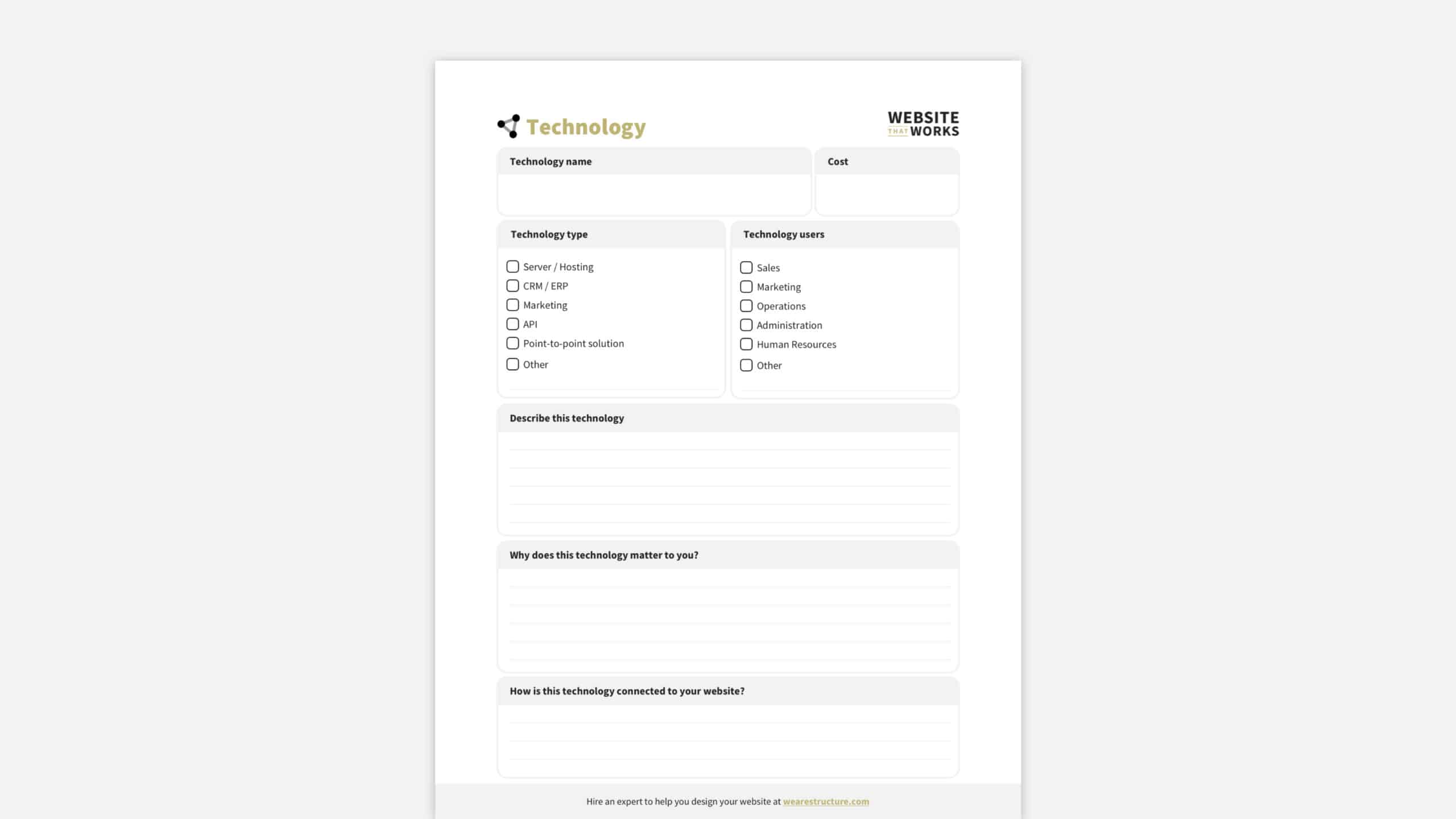
This is why our technology worksheet asks the following questions for each integration to document your technology requirements:
What is the technology name?
What does the technology cost?
What kind of technology (server/hosting, API, CRM, etc.)?
Who uses the technology (sales, marketing, operations, etc.)?
Describe the technology
Why does this technology matter to you?
How is this technology connected to your website?
Additional costs may be associated with integrating new or existing technology during the website redesign. If so, this will be beneficial information as you complete your website redesign budget.
10. Website Budget
Finally! We arrived at the Budget worksheet. Every worksheet in the Website That Works Planner comes together to give you what you’ve been waiting for—the cost of your website redesign.
But there’s a problem. The problem is that most website budgets only focus on the costs: what expenses must be considered? Don’t get me wrong; it’s essential to know the costs. But if you only look at the costs, you only see part of the masterpiece.
You must view your website as an investment rather than a liability. In your budget, consider potential earnings, savings, and expenses. Calculate your website’s long-term value in terms of profits. Our Budget Worksheet helps you do just that.
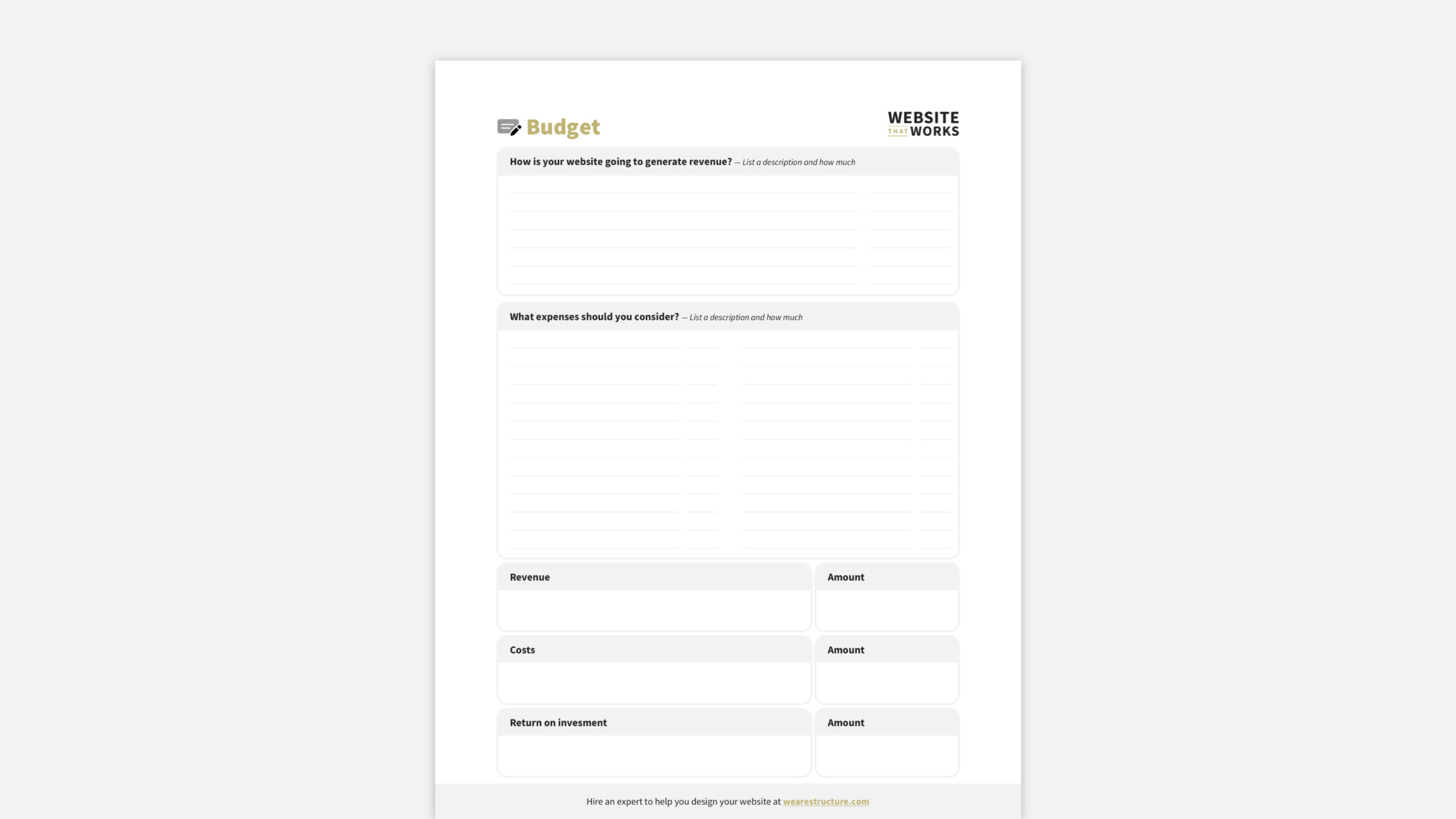
In the budget worksheet, you’ll answer the following questions:
How will your website generate revenue? And how much?
How will your website save on operating costs? And how much?
What expenses do you need to consider? And how much for each?
What’s the total revenue and savings?
What’s the total cost?
What is the return on investment (revenue minus costs)?
This website redesign budget exercise will help you (and your team) understand your significant role in your business and why you can justify spending more on a website that works for your business.
I encourage our clients to budget for their website’s lifespan, typically 1.5 to 2.5 years. Typically, we see significant returns on investment in the millions or tens of millions of dollars.
Step Three: Share Your Website Plan (Including Your Website Redesign Budget) like an RFP
Many companies and organizations will create and send an RFP (Request for Proposal) to website designers to get an estimate for their website redesign project. Unfortunately, the RFP typically lacks 90% of the needed info for an accurate proposal. Even a multi-page RFP often lacks the correct details for an estimate.
This means that either the web designer provides a vast ballpark estimate or they require you to submit to their discovery process… which means you wasted a couple of dozen hours writing an RFP that they’ll never look at. You need a comprehensive website plan and budget to determine an accurate cost.
Imagine this: you download the Website That Works Website Planner and complete the worksheets. Then, you send your website redesign plan, including the budget, to a website designer and request their estimate. They’d be able to see exactly what you want, your goals, your competitive analysis, your budget, and much more.
You’ve already done the planning. This means they can get started on the design! Use the Website That Works Planner like an RFP, and you’ll get better estimates and timelines—guaranteed.
How a website redesign budget can make your project successful and profitable
A well-planned budget is a guiding framework that promotes effective decision-making, streamlined execution, and alignment with strategic objectives. It ensures that your website redesign is successful and efficient, delivering a solid return on investment while meeting user and business needs. Here’s how it can lead to positive outcomes.
1. You’ll have a clear direction
A budget provides a roadmap for the entire redesign process. It outlines available resources, achievable tasks, and the project’s scope. This clarity prevents confusion and keeps the project on track.
2. You’ll be able to prioritize
Budgeting forces you to prioritize tasks and features. By allocating funds to the most impactful elements, you ensure the redesign aligns with your strategic goals and meets your business priorities.
3. You’ll create a source of truth
A budget helps define the scope of the redesign. By clearly outlining what’s feasible within the allocated funds, you avoid scope creep—unplanned additions to the project that can lead to delays and cost overruns.
4. You’ll know which resources you’ll need
Budgeting allows you to effectively allocate resources like time, personnel, and tools. You can assemble the right team, set realistic timelines, and secure the necessary assets for the project.
5. You’ll reduce the risk of failure
A budget accounts for potential risks and uncertainties. If you’re extra cautious or have a large or complex site, we often recommend a 10-20% contingency fund to ensure you have enough set aside in case unexpected extra fees occur. A contingency fund helps address unexpected challenges without derailing the entire project, ensuring smooth progress.
6. You’ll have an easier time finding help
With a clear budget, you can confidently select vendors or contractors that fit within your financial constraints. This ensures you’re getting quality services without compromising your budget.
7. You’ll share a common language
A well-defined budget is a communication tool among team members, stakeholders, and external partners. It fosters transparency and a shared understanding of financial expectations.
8. You’ll ensure the website is done right
Budgeting encourages a focus on quality. When you allocate resources thoughtfully, you can invest in high-quality design, development, and content creation, resulting in a more polished outcome.
9. You’ll have what you need to set timelines
A budget helps you manage time effectively. Properly allocating resources and monitoring progress can prevent delays and guarantee the project’s timely completion.
10. You’ll know if the project was profitable
A budget provides a benchmark for success. Staying within budget signals effective project management, financial responsibility, and a project that meets its goals.
11. You’ll have a reference point
A budget isn’t set in stone; it can be adjusted as needed. If priorities change or unforeseen circumstances arise, having a budget allows you to reallocate resources while staying mindful of financial constraints.
12. You’ll account for hidden or future expenses
A budget doesn’t end at launch. It sets the stage for post-launch activities, such as ongoing maintenance and updates, ensuring the website’s longevity and relevance.
Pro tips for creating a perfect website redesign budget
After working on countless website redesign projects, we’ve learned a few things we would recommend anyone budgeting for a website redesign should consider. Remember that some tips might require a designer or developer’s input.
People often use web design and development interchangeably. This is the web industry’s fault because it’s not uncommon for a web designer to develop and a web developer to design. Freelancers or studios commonly exhibit this “jack of all trades” profile, where they handle both web design and development.
To add fuzziness on top of fogginess, many of these freelancers or studios estimate website projects as one cost for both design and development. Therefore, it’s tough to see a clear line between the two.
In short, web design focuses on a website’s visual and user interface aspects. In contrast, web development is responsible for turning those designs into a functional website through coding and programming. Both design and development are integral to creating a successful and effective website.
To use our physical building analogy, a web designer is like an architect. They make the plans, and they draw up the plans. But the architect isn’t on-site with a hammer. The builder is on-site with their team of specialized trades to turn building supplies into a building that matches the design.
We estimate web design and development as distinct project phases in the professional world. There’s no way to know precisely what the “build” will cost if you don’t know what the “design” spec looks like.
In summary, as part of your website redesign budget, creating separate line items for design and development is essential. They’re distinct skill sets and project phases—and will require separate costs.
2. Plan for content creation (and migration)
After handling many website redesigns, we’ve got some tips for your budget. These vary based on project scope and content complexity, and some might need input from a designer or developer. But ballpark estimates are available online for most.
Remember, your initial budget might need adjusting. It’s a tool, not a contract. Working with a web team gets accurate estimates, keeping costs aligned with your goals.
Copywriting
Hiring professional copywriters to create or revise the textual content for the website, including product descriptions, service offerings, about pages, and other relevant information.
Editing and Proofreading
Ensuring that all content is accurate, error-free, and consistent in tone and messaging might involve costs for professional editing and proofreading services.
Graphic Design and Visual Content
Costs for designing custom graphics, infographics, images, icons, and other visual elements that enhance the overall look and feel of the website. An agency’s web design fees may include these costs, but they’re not always guaranteed to be included.
Photography and Videography
If you need new photos or videos to showcase products, services, team members, or facilities, you might incur costs related to hiring photographers or videographers.
SEO Optimization
Search engine optimization (SEO) is always essential after a website redesign. Include costs for keyword research, optimization of content, and, potentially, ongoing SEO monitoring and adjustments.
Transitioning from an old website to a new one might involve costs related to migrating existing content to the new platform.
Translation Services
Translational services could become a significant cost if your website needs to be available in multiple languages. Don’t forget to factor in additional costs if localization is also necessary.
Project Management
Managing the content creation process may require project management, which could involve additional costs. Some agencies will include this as part of their estimate, but you’ll always need to dedicate some internal resources to managing the content aspects of the project internally.
Licensing and Permissions
There could be licensing or permission costs if using third-party images, videos, or other content.
User Experience (UX) and User Interface (UI) Content
Designing and developing features like tooltips, pop-ups, and interactive forms could incur costs for more interactive elements. You’ll likely have to get these specific costs with your estimates.
3. Factor time for internal testing and quality assurance
After building your website, you’ll need to test it and ensure it looks and functions as expected. Think of it like a “walkthrough” of a new skyscraper. You want to ensure the paint color is correct, the toilet flushes, and the heater pumps out hot air.
Now, you should expect your website developer to do thorough testing—for functionality, responsiveness, and user experience. Before you do your “walkthrough,” they need to ensure that the new site performs well, adapts to various devices, and provides a positive interaction for visitors.
However, you’ll want to allocate internal resources to your own testing and quality assurance (QA) process. Bank on spending time on each testing activity.
Functionality Testing
You’ll want to ensure all the cool stuff on your website works how it should. We’re talking about checking links, forms, buttons—everything that helps people get around and do stuff on your site. Don’t forget to make a test purchase or schedule a sales call to ensure customers can get through!
Responsiveness Testing
Your customers are surfing your site on various gadgets—from tiny phones to big laptops. That’s why you’ll want to ensure your website looks and works great on all your devices. Virtual testing tools like BrowserStack can help you view your website on devices that aren’t readily available.
Browser Testing
Browser testing is another crucial aspect of website development and redesign. It’s all about ensuring your website looks and works perfectly on web browsers like Chrome, Firefox, Safari, and Edge. You might be surprised, but having a site that looks perfect on one browser but turns messy on another isn’t uncommon. Again, your web developer should be testing this, but you’ll also want to check.
User Experience Testing
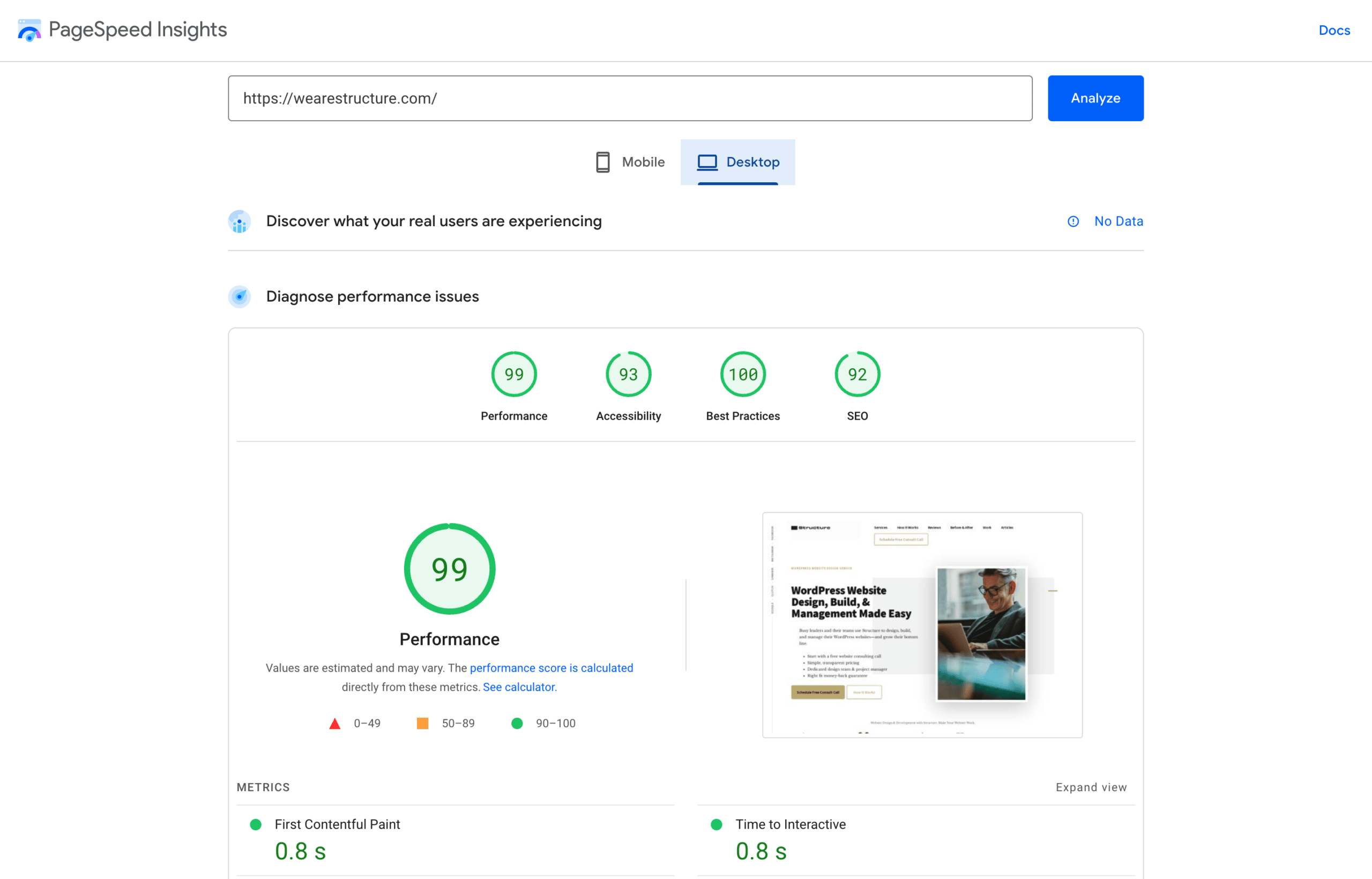
User experience (UX) testing is like testing your website by seeing how folks use it. This can be done virtually using tools like PageSpeed Insights. Tests help spot issues, confusing paths, or roadblocks that might hinder customers’ buying.
4. Prepare for unexpected costs in your website redesign budget with a contingency fund
Along the way, unexpected things can pop up, like surprise guests at a party. These could be unforeseen technical glitches, sudden design tweaks, or even changes in what you thought you wanted. That’s where your contingency fund comes in.
Setting aside a stash of funds to handle any surprises or changes along the way is always a relief. Instead of scrambling or compromising the project, you have a cushion to handle those extra costs or changes without derailing the whole thing.
The truth is that no matter how much due diligence you complete, website redesigns can still be a bit unpredictable. At Structure, we do an excellent job of sticking to scope, but I don’t want to set unrealistic expectations. Scope changes or unexpected hiccups can sneak in from any side.
We typically encourage our clients to set aside a 10% contingency fund. If there are a significant amount of variables or complexities, we encourage them up to 20%. Plan for between 10–20% of your website redesign budget.
5. Plan for management and maintenance in your website redesign budget
After you complete your website redesign, there’s still work to tackle. I’ve used the physical building analogy for websites in this article, which works well.
Website management and maintenance is a lot like hiring a property management company to manage your properties. You own them, and they bring you value, but you have better things to do than attend to renter requests and routine maintenance. If you’re planning to buy or build a rental property, hiring property management help is something you want to consider upfront.
One of our clients likened website management to an oil change for their car. They said they wouldn’t dare drive it for years without an oil change. It would ruin the engine!
Similarly, your website needs regular check-ups and tune-ups, and maintenance. Technology changes, bugs might creep in, and you might want to add new features. All of this requires ongoing care that you may not be equipped or interested in doing.
Website management and maintenance are valuable over the lifetime of your website
Setting aside funds for maintenance and updates means you’re future-proofing your site. You’re ensuring that it stays fresh, fast, and functional. It’s not just about keeping the lights on; it’s about keeping your site relevant and user-friendly.
Plus, remember that your business evolves. For example, you might launch with certain content, but as you grow and adapt, your website should too. That’s why having a budget for updates means you won’t be caught off guard when you want to revamp content or add new sections.
So, in a nutshell, allocating funds for post-launch maintenance and updates is like giving your website a long and healthy life. It keeps up-to-date, functional, and aligned with your ever-changing business needs. It’s not just a one-time launch; it’s an ongoing commitment to the success of your online presence.
Common questions about budgeting for a website redesign
If you’re a marketing or business leader, you might have various questions about budgeting for a website redesign. Here are some common questions and our best take on answering them!
How much should we budget for a website redesign?
Great question! Conversations about website redesigns often start with a rush for quick answers on cost and time. It’s common to seek a simple solution, but the truth is that most websites are much more complex than they look on the surface. Therefore, a website redesign is rarely ever simple.
If you want a broad ballpark figure, many website designers and developers can provide that. But to get an accurate cost for budget approval, you’ll want to create a website plan that includes a thought-through website redesign budget.
What factors affect our website redesign budget?
You probably want to know which elements impact the budget the most, so you can at least account for the big numbers.
A website redesign has dozens of cost factors, but the heavy hitters are the number of pages, custom functionality, and design complexity.
The number of pages
The size of your website matters. More pages require more design work, content creation, and potentially additional coding. Additionally, if you need to create new content or optimize existing content for SEO, this can add to the cost.
Custom functionality
More complex features, customizations, interactive elements, and integrations with third-party tools will likely increase the cost. E-commerce functionality, user accounts, booking systems, and advanced animations are examples of features that can impact cost.
Design complexity
It will likely increase the cost if you aim for a unique and intricate design involving custom graphics, animations, or illustrations. The complexity of the layout, color schemes, typography, and overall aesthetic impact the required design work.
Are there ongoing costs beyond the initial redesign?
Yes, there are always post-launch costs, like maintenance, updates, and hosting fees. The good news is that most of those fees will be familiar if you’re redesigning your website.
The only reason you’ll need to revisit the ongoing costs is if you plan on changing anything. For example, if you want to upgrade your hosting or switch website management providers.
How do we ensure a good return on investment (ROI)?
The best way to ensure a good ROI on your website redesign is to download the Website That Works Planner and plan a website with a good ROI.
There’s never a guarantee that you’ll get a good ROI, but the truth is that the best performing, highest-converting, most beautiful websites weren’t built overnight. They were planned to be excellent from the very beginning.
Can we repurpose existing content to save costs?
Absolutely! I would encourage you to keep what works. In other words, if it ain’t broke, don’t fit it!
The benefit of keeping as much content as possible is that it saves on content creation costs. Furthermore, it ensures that you don’t keep your organic traffic and search rankings instead of taking it by changing too many things at once.
Do we need to hire external professionals, like designers or developers?
Yes, you do. If you’re a professional, you’ll hire a professional.
I’ve seen it too many times. A client gets a quote from a professional website designer, and after the paramedics bring them back to life after severe sticker shock, they quickly hire their brother’s buddy, who has built a few sick websites on the side from his mom’s closet.
Chaos ensues, and you experience relational headaches, price hikes, and forgotten deadlines.
Here’s the blunt reality: what you pay is often what you get. If the budget seems unrealistically good, there’s usually a catch. It’s that simple.
How much do most companies and organizations budget for a website redesign?
Great question! As you might expect, the answer varies significantly based on many of the cost factors outlined in this article. However, you can expect to invest $15,000–$150,000 with a professional web agency like Structure.
If your website is straightforward, and you’re using a semi-custom website design process that entails customizing a pre-designed template or theme—and building based on that theme functionality, expect to create a website redesign budget of $15,000–$25,000. This includes all factors, including hosting, content, design, and development.
Website redesign budgets in the range of $50,000–$150,000+ are often for large, significantly complex websites that have hundreds or thousands of pages, require a substantial amount of custom functionality like translation and localization into different languages, and have a lot of custom design features like illustrations or video.
A website design brief is like a unique plan for making a website. Imagine you want to build a five-bedroom house. Before you start, you need a program that describes what it will look like, how big it will be, and what finishes it will have. A five-page website is the same—you need a plan that details your wants.
Your web design brief explains what the website is for, who will use it, and what it should do. It also talks about the website’s colors, pictures, and words. Just like when you plan a home build, the design brief helps anyone helping make the website understand what it should look like and how it should work.
This type of plan is essential because it ensures everyone is on the same page and knows what to do. In other words, it serves as a foundational roadmap for the project’s designers, developers, and other stakeholders to ensure everyone is on the same page and working towards a shared vision.
If you do not use a design brief, you’ll lack the essential information to guide the entire design process, from the initial concept to the final implementation.
First, what is a web design brief for?
At the core of a successful website design project is a clear and comprehensive design brief—a crucial roadmap outlining goals, requirements, and preferences. This document goes beyond documentation, acting as a bridge between stakeholders, aligning visions, and avoiding pitfalls.
Portrait of a cheerful female student studying at home, looking at camera.
Why writing a website design brief sucks—but it doesn’t have to
Nobody likes planning, which is why so many websites fail to work. They don’t get enough traffic, they don’t get enough leads, and they don’t get enough sales.
That’s why John Wooden, the Legendary UCLA Basketball Coach, famously said:
If you don’t have time to do it right, when will you have time to do it over?
John Wooden
You don’t want confused customers or a frustrated team struggling with your website. Here’s why writing a website design brief can be frustrating and how we’ve devised a better solution to make it easier.
1. Web design planning is boring
When people think about website design, they usually focus on its appearance—the logo, colors, and images. But what many don’t realize is that a website is mostly science, not just art. It’s like an iceberg—the visible part is the art, but a lot is happening behind the scenes. We tell our clients that successful websites are more like a formula than they might think—and our Website Planner is a proven formula that works if you use it.
2. Planning a website design takes a lot of time
Designing a website takes time, and busy business leaders often prioritize quick tasks over planning. Even though planning is crucial for clarity, finding time can be tricky. That’s why website builders like Wix and Squarespace let you start without a plan. Oof! The great news is, planning a website doesn’t have to be super time-consuming. Follow our steps and use our guide to save time while knowing what to do.
3. Website planning takes specific knowledge
Website planning requires a basic grasp of how websites function and their business role. When planning a website, you might not know where to start, which is why our Website Design Planner can assist!
If you’re uncertain, watch our (free) training on your website’s business impact and its role in marketing. This will help you grasp your website’s significance before you start planning.
4. A great website plan requires alignment
Here’s the challenge: the team must agree and decide when planning a website. This can be hard, whether for website design or almost anything. The agreement is why organizations often struggle to define their website; even if they do, it’s tough. Our Website Design Planning Brief helps organizations align. It’s a clear, structured process that takes only a few brief meetings.
5. Most website planning templates are technical
Most website planning tools are like fancy spreadsheets – they’re boring and numbers-focused. The Structure Website Planner is different. It’s designed to be enjoyable, acting like a creative guide that excitingly helps you organize your ideas, goals, and tasks. It makes website planning fun.
Plus, it’s not just about fun. The Structure Website Planner increases your chances of creating the website you want. It provides a clear path, ensuring you don’t miss the necessary steps. So, it’s enjoyable and handy for achieving your website goals.
The benefits of a design brief go beyond a checklist of to-do’s and information for designers to work from. It also reduces misunderstandings, aligns expectations, and optimizes resource use internally. Here are ten benefits you’ll experience by starting your web design project with a design brief.
1. Minimize misunderstandings
When you have a well-thought-out design brief, it’s like having a crystal-clear picture of the project. This helps avoid any confusion between the people involved, whether they’re the stakeholders, designers, or developers. In simple terms, it ensures that everyone is on the same page.
2. Align expectations
Think of the design brief as a map that lays out what the project aims to achieve, how it should look, and what it needs to do. When everyone agrees on this map, it’s like having a team on the same page. This way, there are fewer chances of arguments or surprises down the road.
3. Save time and money
When you’ve got a thorough design brief, it’s like having a well-organized plan that keeps things moving along smoothly. Designers and developers can get things done quicker because they know exactly where they’re going. This cuts down on many back-and-forth talks and changes, making the whole process work like a charm.
4. Enhance collaboration
Imagine the design brief as a meeting point for everyone on the team—the designers, developers, content folks, and all stakeholders. It’s a go-to spot where everyone can gather and figure things out together. This helps keep conversations and decisions organized as the project moves along.
5. Guide ideation
Think of the design brief as the frame of a painting. It gives a structure to the project, but inside that frame, designers get to unleash their creativity. They can develop cool, exciting ideas within the frame’s boundaries. This leads to a design that’s one-of-a-kind and works well.
6. Manage expectations
By detailing the scope, features, and functionalities in the design brief, clients can have a realistic expectation of what the final website will offer. Picture this: the design brief is like a menu that shows precisely what dishes a restaurant serves. You’ll know what to expect when you see all the details about the website—like what it can do and how it’ll look. This way, there’s no over-promising and under-delivering. And when you get what you expected, you’re pretty happy!
7. Reduce revisions
Having clear instructions in the design brief is like giving web designers a map that guides them to what the client wants. This means fewer times going back and forth to make changes. Both you and the designer save time and effort, making the whole process smoother and more efficient.
8. Improve your customer’s experience
A well-written design brief reveals who will use the website and what they like. Armed with this info, designers can create a user-centered design that caters to the needs and expectations of the intended users.
9. Make decisions a piece of cake
As the design takes shape, you have a roadmap to follow and a source of truth to know where you started. It’s like having a map that shows the best route to take. This makes deciding what looks great happen faster and with less hassle.
10. Know if the project was a success
The design brief acts like a yardstick to measure how well the final design turned out. You can check if the completed website matches the goals and things you wanted, and that’s how you figure out if the project aced its goals.
These essential elements should be included in every design brief.
1. Vision
Start at the end. Provide a high-level view of the website you want to exist for your company. Your vision is influenced by a combination of factors that shape its purpose, design, and overall direction. You’ll want to ensure you note these specific things:
Website type
Design wishlist
Target audience
Start and end dates
Budget minimum and maximum
Feelings about your current website
Some key influences on a website’s vision include what you sell, who you sell it to, design trends, and timeline or budget ideals. A successful website vision emerges from a thoughtful blend of these factors, creating a cohesive and purpose-driven online presence that resonates with the target audience and achieves the company’s goals.
2. Goals
Think about it this way: different companies have different goals for their websites. What they want to achieve with their website depends on what kind of business they’re in, who they’re trying to reach, and what they’re aiming for overall.
Goal name
Goal deadline
Goal description
Why the goal matters
Milestones
Key performance indicators
Some common types of website goals relate to lead generation, user engagement, or community building. Not all websites set out to achieve the same thing, which is why there’s no one-size-fits-all. Ensure you get clear and list what specific things you want to accomplish with your website.
3. Team
You’ll also want to document your team members and what they will be responsible for. This can be done in many ways, but we use the DARCI method (or DARCI framework) to ensure someone owns all tasks.
Decider: who has the final approval
Accountant: who ensures tasks are completed
Responsible: who will do the work
Consultant: who will provide input
Informed: who will be updated on the progress
Tasks and responsibilities
Your website team should include everyone involved in the project at some point. This includes your agency, freelancers, friends, advisors, and internal team members if you have them.
4. Brand guidelines
Your company’s visual identity, including logos, colors, typography, and brand voice, influences the design and aesthetics of the website to ensure consistency and reinforce brand recognition. What you document in your Website Design Brief is also known as shared information—don’t leave anything out!
Who has access to our logo and guidelines?
What is their contact information?
Which colors are you using?
Which fonts are you using?
What are the brand’s personality or characteristics?
Do you use images or illustrations more?
5. Pages
Just like a house is made up of its rooms, so is a website. Website pages play a fundamental role in a website design plan, serving as the building blocks that structure and organize the content and functionality of the site.
This is where you’ll specify each room you need in the house.
Website URL
Call-to-action text
Header navigation items
Footer navigation items
Page templates
Your website pages contribute to the overall design plan because they serve as the canvas upon which the design plan is executed. Each page has a specific role in delivering information, guiding user interactions, and achieving the website’s objectives. A well-thought-out arrangement of pages ensures a coherent, user-friendly, and effective website design.
Don’t forget to factor in contact pages, paid landing pages, a 404 template, and your legal pages!
6. User journey
Each part of your web design brief builds on the other part. After we have a vision, goals, brand, and pages, you can plan how a customer goes from prospect to purchase. This includes effective call-to-actions, landing pages, and content guiding visitors toward desired actions, such as purchasing or signing up.
Document the Customer Actions and Content to support each stage in the buyer’s journey. We often refer to the AIDA marketing framework to help remember the main steps of the journey:
Attention
Interest
Desire
Action
Use the Customer Actions portion to define a user’s actions to get to the next step. Then outline the types of content (text, images, videos) that will be included on the website to aid in that process.
7. Inspiration
Highlight key competitors and mention aspects you’d like to emulate or differentiate from them. Share design examples, websites, or styles that resonate with the desired look and feel.
Inspiration serves as a creative spark that ignites the design process. It involves seeking new ideas, design trends, and innovative approaches to elevate the website’s aesthetics and user experience. Here’s how inspiration impacts website design planning.
The competitive analysis involves studying similar websites in the same industry to understand their strengths, weaknesses, and strategies.
Incorporating both inspiration and competitive analysis in website design planning strikes a balance between creativity and strategic decision-making. It empowers designers to create visually appealing, user-friendly websites that are aligned with industry trends while ensuring the website’s unique identity and competitive advantage.
8. Technology
Technology and integrations are significant and evolving in a website design plan. They determine the functionality, performance, and user experience of the website.
Today, many technology types, functions, and roles impact things like Functionality, content management (CMS), e-commerce, data collection, security, accessibility, and so much more. We’re barely at the tip of the iceberg.
For your website brief, you’ll want to document each main piece of technology you need to work with your website to run your business. This includes the following information to start:
Technology name
Cost
Technology type
Users & roles
Tech description
Why the technology matters to you
How the tech is connected to your website
In essence, technology and integrations provide the foundation and capabilities for the website’s design. Choosing the right technologies and seamlessly integrating them into the design plan enhances the website’s functionality, user experience, and overall effectiveness in achieving its goals.
Be sure to address any technical constraints, platforms, and hosting preferences.
9. Budget
I get it; talking about budgets isn’t the most thrilling part. But trust me; it’s super important. Your budget is like a roadmap that shows you what can happen, what can’t, and the decisions you’ll need to make for your website design project.
Many companies look at the money they’re spending and see it as a problem. But here’s a more brilliant way: treat your website like an investment that brings you back something good. Think about the money you can make and save and what you spend. That way, you can determine how much your website could make for you in the long run.
Your website budget should include the following elements:
Expected revenue
Expected savings
Expected costs
Return on investment
Clearly defining the budget in the website brief helps set realistic expectations and ensures the project aligns with the available resources and desired outcomes.
At Structure, we’ve done everything – planning, designing, building, managing, and growing websites. We’ve got loads of experience and even crafted a Website Planner based on it. Here’s what we’ve figured out from working with websites of all sizes and budgets.
1. Don’t aim for perfection
While perfection might seem tempting in a web design plan, it slows things down. Embracing an iterative approach for continuous improvement within your project’s limits is more efficient and effective.
2. Use clear and descriptive language
Using clear language in a web design plan makes things smooth. It avoids confusion, errors, and delays, leading to a successful website.
3. Take your time and sleep on it
Taking your time and giving yourself a chance to sleep on a web design plan is a wise strategy. It promotes better decision-making, reduces stress, enhances creativity, and contributes to a more thoughtful and effective plan.
4. Focus on results
A results-focused website design plan ensures every detail drives excellent outcomes. Users love your site, you gain maximum value, and your website becomes a business superhero.
5. Set SMART goals
Using SMART goals in a web design plan is like having a smart strategy. It sets up a clear path to success, gets everyone working together, and boosts the chances of reaching your goals exactly as you want.
Common questions about creating and using a design brief effectively
People have some common questions about creating and using a design brief effectively. Remember, a well-crafted design brief is a valuable tool that streamlines the design process fosters collaboration, and sets your project up for success.
Why do I need a web design brief?
A design brief acts as a roadmap for your project. It clarifies goals, expectations, and requirements, ensuring everyone is on the same page.
What should be included in a web design brief?
At a minimum, your design brief should include project objectives, target audience, design preferences, functionalities, branding guidelines, and technical specifications. Download our free Website Design Brief Template to ensure you don’t miss anything.
How detailed should a web design brief be?
The level of detail depends on the complexity of your project. It should be clear enough to guide designers and developers but not overly complex.
How long should a web design brief be?
Think of it this way: you’ve got to talk about your vision, goals, and what you want to achieve. Our Web Design Planner has nine worksheets, but some, like the Goals and Technology Worksheets, can be copied for all your goals and techie stuff. So, your web design brief could be anywhere from two to thirty pages, depending on how big and fancy your website is.
What is a typical format for a web design brief?
Typically, people write a web design brief in a digital format like Google Docs, Microsoft Word documents, or Pages documents. However, our Web Design Planner provides a guided format you don’t have to imagine from scratch! Just fill in the blanks, and you’re done.
What is the difference between a project brief and a web design brief?
A project brief is a broader document that covers the entire scope of a project, while a web design brief is a more specialized subset of a project brief that specifically addresses the requirements and goals of designing a website.
What’s the difference between a website design brief and a website design proposal?
A website design brief is a document that guides the design process, while a website design proposal is a document that outlines how a designer or agency plans to fulfill the project’s requirements and meet the client’s needs.
How do you write requirements for a website design?
In a web design brief! Luckily, we’ve got a sleek web design brief that you can print, punch holes in, and pop into a binder. Fill it out with your team or as an RFP for a web designer, and you’re good to roll.
Who should be involved in creating a design brief?
You, the project managers, the creative designers, the tech wizards, and sometimes even the clients all come together to cook up a top-notch design brief.
Can a web design brief change during the project?
Website design briefs are like clay that can be shaped as you go. If new ideas pop up or things change, that’s cool. Just keep everyone in the loop so we’re all on the same page.
How does a design brief improve communication?
A design brief eliminates ambiguity by providing clear guidelines. It ensures everyone understands the project’s direction and reduces misunderstandings.
How can a design brief help avoid scope creep?
Think of a design brief as your project’s rulebook. It lays out what’s expected. When someone suggests changes, you can compare them to the rulebook’s goals and see if they fit.
If you’ve been asking yourself, “Should I get a new website for my manufacturing business?” you’re asking a well-timed question.
Many manufacturing companies leverage digital technology to enhance their business and generate more income through B2B partnerships. Unfortunately, many other companies still lag in using digital transformation for their marketing and website efforts.
If your company is one of those “lagging behind,” it’s okay—this article is written to help!
Eventually, every business needs a new website. And right now, with traditional marketing for manufacturing companies like trade shows and in-person sales calls falling from the spotlight, your website is your most visible and impactful marketing asset.
That said, a few critical indicators can help you know whether it’s time to upgrade your website. Let’s discuss how to know when it’s time.
Free, 30-Minute Consult Call
Book a simple call with a Structure consultant to discuss your website redesign project—no strings attached.
5 Warning Signs You Need a New Manufacturing Website
1. Your current manufacturing website is not mobile friendly
Chances are your potential customers are navigating all sorts of devices to reach your website, so it needs mobile-responsive! Everything must look great on their mobile phones and feel fantastic on their tablets—not just desktop computers. Don’t stay in the stone ages; ensure your site is mobile-friendly for all devices!
If your current website is not mobile-friendly, it’s time for a new website
2. Your website is confusing
Have you ever gone to a website that doesn’t make sense? Finding what you’re looking for feels like sucking information from a firehose. Don’t be the company with a clunky website experience! A user-friendly website makes it easy for visitors to find what they need quickly by breaking their products and services into bite-sized categories and displaying that information logically. If your website doesn’t walk your customers through a simple process to learn about your products or services, it’s time for a new website.
3. Your website is more than five years old
Are you still using the same old website from five, ten, or twenty years ago? Yikes! It’s time to do some significant updates. We all know that having an outdated website is like watching a low-budget home video from the 90s—it just doesn’t cut it in this day and age. Plus, if your brand has changed drastically (or at all) since then, your old website probably isn’t doing your image any favors anymore. Don’t be old school; upgrade your website and get with the times!
4. You haven’t updated your website lately
Suppose you’re not updating your website by adding new content regularly. In that case, chances are that your website functions like a lackluster business card instead of being the marketing machine you’re hoping for. Without new content like blog articles, press updates, or product development announcements, your chance to turn prospects into loyal customers will suffer. So rather than kicking yourself because you didn’t jump on the digital marketing bandwagon years ago, take the reins now and hop into the content coral with a new manufacturing website design that brings in business.
4. Your website is a spam magnet (a sign it isn’t secure)
In this day and age, it’s essential to have a secure website. It keeps your customers safe from potential privacy breaches and protects you from outdated bots or hackers who may try to access sensitive information. However, if your website gets unwanted spam every day, it could be a sign that malicious cyber-criminals are looking to steal information from you or your customers. You need a new website—and a partner to manage your website regularly—to upgrade your website’s obsolete and risk-prone aspects as soon as possible.
5. Your website is slow
Ah, website performance: who doesn’t love to talk about it? If you don’t know the 5-second rule, you must learn it now. If your website takes longer than 5 seconds to load, it’s too slow, and customers are ditching you for your competition. Stop giving away business! Like a good old truck engine can decrease performance over time, an outdated website can begin running slower, and you may need to tune it up or swap it out.
You see, your customers expect the same performance from your website that they do from the products or services you offer. They want fast loading times that give them what they want quickly. This is why website speed and overall performance should be a high priority.
6. You’re not generating leads or sales from your website
Are you stuck in lead generation limbo? Low traffic. No leads. And no sales. Maybe it’s time to hit the reset button and design a website that works. A website can be a lead generation machine—that is, if it’s designed perfectly around your business goals and built with the proper functionality.
When did your investment in lead-generating efforts last give you the desired return? If it hasn’t been recently, or your current website isn’t up to snuff, it might be time for a new manufacturing website.
7. You’re using an outdated or limited platform
If you’re still using an outdated platform that makes you feel handcuffed in the back of a patrol car, it might be time to trade your old manufacturing website for a new one. As technology advances, so should your website. It’s essential to use a platform that can grow with your business and provide the flexibility of features and functionality you need to keep pace as the world changes.
We know it can be tough admitting that your website sucks, but our team of experts is here to tell it straight. No fluff, only brass tax here. We’ll evaluate what’s wrong with your current site to design and build a new manufacturing website that will deliver results. Book a Free Consult Call, and let us show you how we can help!
Free, 30-Minute Consult Call
Book a simple call with a Structure consultant to discuss your website redesign project—no strings attached.
It’s common to believe that a new website will organically attract new B2B customers to your manufacturing business. A well-designed site can help generate leads and convert visitors into customers. Still, without an effective marketing strategy, it’s unlikely to make a big difference in sales.
Unless your current site is actively driving them away, it’s not likely to make an immediate difference. The way to “get them to come” is to design a new website and implement a strategic marketing strategy to get them there—and invite them to stay.
If you create a new website, will customers come?
Thinking, “if we build it, they will come,” is like returning to your 20s and saying, “If I just get married, we’ll live happily ever after.” If you’ve been married for a micro-fraction of a second, you know it doesn’t work that way. If you build it, customers may come, but if you want “customers” to come—and, more importantly, to stay—the real work comes well after the new website is up.
Before you build a new manufacturing website, ensure your current one is up to par, and that you have a solid plan for driving visitors. Remember, it’s not just about having an attractive website—it’s also about marketing your products and services to the right audience.
2. You want to be “trendy”
Many businesses feel like they need to keep up with the latest trends in web design. I’ve fallen into this trap before, so I understand!
But the truth is, most of your customers don’t care about trendy designs—they want a site that works well and is easy to use. If your manufacturing website solves customer problems and offers a great user experience, then chances are, most people won’t even notice if the design is trendy or not.
3. You think creating a new website will be quick and easy
Don’t underestimate the work involved in designing and building a new website. It can take months, even years, to get everything just right. Most websites take 3-6 months to design and build because you’ll need to plan, design and code your website. You’ll also need to create content and test it on different devices and browsers before making it public.
Furthermore, a website is not something you can just “set and forget”—it requires ongoing maintenance. That means you must consider the short-term design, build, and long-term management and marketing.
4. You think creating a new website will be cheap
Unless you’re interested in investing a minimum of $10,000 in a new manufacturing website, you’re probably better off sticking with your current site.
As many things are, you get what you pay for. So rather than paying the least amount possible for a brand-new website that doesn’t work, why not invest more and get something that works?
5. Your old manufacturing site isn’t that bad
Perhaps this is the biggest reason not to redesign your website: it simply isn’t necessary. If your site is working well and meeting your needs, there’s no reason to go through all the hassle and expense of starting from scratch.
So before planning your next website, ask yourself if it’s worth it. Redesigning your website can be costly and time-consuming, so unless it’s a bonafide business need—and you’re prepared for the process, it might not be worth undertaking such a project.
If any of these five reasons sound familiar, it might not be time for an update. But before you decide either way, Book a Free Consult Call with us so we can “look under the hood” and give you a professional recommendation. We’ll give you honest feedback and options that won’t break the bank.
Free, 30-Minute Consult Call
Book a simple call with a Structure consultant to discuss your website redesign project—no strings attached.
How to Check Your Manufacturing Website for Warning Signs
PageSpeed Insights for performance and user-experience testing
PageSpeed Insights will give you information about your website’s performance. This is important because it allows you to understand how your website’s users experience your site. It can help you identify problems with speed, resources, and usability before they become an issue.
PageSpeed Insights Structure Report
WP Engine Website Tester for speed and security testing
We strongly advise partnering with Structure as a proudly certified WP Engine agency. The free website tester they provide is unparalleled, and it will provide you with an invaluable site health report full of speed and security insights!
WP Engine website performance tester
Ahrefs Website Tester for SEO and marketing insights
This tool is handy. Ahrefs’ Website Tester is an irreplaceable tool to help you assess the overall performance of your website, troubleshoot any technical issues that could prevent pages from appearing in search engines, and uncover SEO errors like missing meta tags, duplicate content, etc.
Ahrefs Website SEO Tester
Need Help with a New Manufacturing Website?
Design your new manufacturing website with Structure. We have years of experience in web design, development, and marketing for manufacturing companies. Our website packages are designed to fit your budget and timeline while giving you the features and flexibility you need to succeed online. Schedule a Free Consult Call today!
Manufacturing Website Examples from Structure
In many articles online, you’ll find a large gap between “what we say” and “what we’ve done.” They might know how to say the right things or curate content from others, but they lack the experience to stand behind their pitch.
This list of manufacturing website examples designed and built by Structure shows you that we’re a product of the product. We are who we say we are—and we hope you are as inspired by the work as our clients were.
EarthCruiser
EarthCruiser is a well-known international manufacturer of luxurious Overlanding vehicles that began in Australia and became popular in Bend, Oregon. To secure their position as a dependable brand, we crafted an attractive website comparable to the thrill of their outstanding automobiles.
earthcruiser manufacturing website by structure
Western Interlock
By developing a modern, fully optimized website, we gave Western Interlock the digital presence it deserves. We built an experience where their brand shines, with lead generation and thought leadership at the forefront of our design principles. With manufacturing facilities in Oregon and Washington, their state-of-the-art production capabilities are reflected on the new site.
western interlock manufacturing website by structure
DryFireMag
DryFireMag is an up-and-coming firearms safety business based in Idaho that depends on its online store for sales. We helped them enhance their conversion rate and restructure their website, so customers can easily find what they need and complete a purchase.
DryFireMag manufacturing website by Structure
HydroSide
HydroSide is revolutionizing the irrigation sector of the agricultural industry through its progressive technology and automation. Thus, it required a unique website that embodied modernity rather than farm equipment to demonstrate its trailblazing spirit as an industry disrupter.
HydroSide manufacturing website by structure
BeGOAT
BeGOAT is a revolutionary energy drink company that has crafted an ingenious way of transforming coffee fruit waste into profitable assets. To bring their brand to life, we created a wholly optimized custom website that was captivating and filled with dynamism and enthusiasm.
BeGOAT manufacturing website by structure
Common Questions About Creating a New Manufacturing Website
You likely have specific questions if you’re looking for a new manufacturing website. We’d love to provide personalized answers to your questions during a free Consult Call. However, we can also answer some of the most common questions about creating a manufacturing website here.
How do I search for website companies that do manufacturing websites?
You might think the best way to find companies specializing in manufacturing websites is by searching for “manufacturing website design” or something similar on Google. Doing so could give you a list of quality web design and development companies with experience creating sites specifically for the manufacturing industry.
But beware that you might also get a list of lousy web design and development companies great at putting together long lists of “the top manufacturing websites of 2023,” so you click on their article. Note that most, if not all, of the websites on these lists, are websites they didn’t do!
Don’t get me wrong, searching on Google is a great place to start. But also ask around and use vetted agency search sites like Clutch. Most of all, check out a website agency’s previous work and read plenty of reviews to ensure they have a track record of delivering websites that work inside and outside the manufacturing industry.
How much does a manufacturing website cost?
The cost of your manufacturing website will depend on the features and functionality you need, the company you hire, and more. Generally speaking, most manufacturing websites cost between $15,000 to $50,000.
Of course, there are always exceptions to this rule. Some websites may have a few basic pages or just an online store, while others may have complex plugins or integrations that can drastically increase costs. It’s always best to speak with a website agency with experience creating manufacturing websites to provide an accurate quote tailored to your needs.
What is included in a typical manufacturing website design package?
A typical manufacturing website’s exact features and functions will depend on the company you hire and your unique needs. Generally speaking, though, most manufacturing websites include the following:
Responsive web design so it works well on any device
Site optimization for speed, performance, and sales
Structure website design packages start with project Definition to help us clarify what you need and get on the same page. We then go through a design process that will provide you with fully responsive design and development specs and a quote to make it real.
Do you have any suggestions on how to get more click-throughs on our manufacturing website?
Yes! There are several ways that you can increase click-throughs on your manufacturing website. Here are some of the most effective strategies that work for our clients:
Include compelling CTAs (call-to-action) throughout your website
Optimize your navigation and menus for easy use
Communicate the result your products and services will provide your customers
Use pictures of happy customers using your product or service
Break your products and services into bite-size sections that are easy to understand
Give your customers a 3 step plan for how to start working with you
Many other strategies work, which might be specific to your unique product, service, business, or sub-industry. Book a Free Consult Call with one of our website experts to get personalized recommendations for your manufacturing website.
What would you say if we asked you how to get more traffic to our manufacturing website?
Getting more traffic to your manufacturing website can seem like a daunting task. However, with the right strategy and tactics, you can increase your website’s visibility and attract qualified prospects.
Here are some of the top strategies we recommend our clients follow:
Optimize your website for SEO
• Leverage social media by creating content that is shareable, engaging, and informative
• Use pay-per-click advertising to target your ideal customers
Reach out to influencers in your industry or local community for collaborations
Promote your website with email campaigns or newsletters
As mentioned above, the idea that you will “build it, and they will come” is fundamentally flawed. You need a thoughtful marketing strategy to support your website growth if you want to get more traffic to our manufacturing website.
Is there a way how to get more leads from our manufacturing website?
Yes! You can use several strategies to get more leads from your manufacturing website. Here are some of our top tactics:
Use lead magnets like webinars, ebooks, and checklists to capture email addresses
Create focused landing pages with compelling content and clear calls-to-action
To get more leads from your manufacturing website, you’ll need what we call a Sales Engine. It’s essentially a marketing plan that charts your customer’s entire journey from the first moment they land on your site to the milestone where they make a purchase—and how your website can facilitate the whole process from start to finish.
Why isn’t my manufacturing company’s website working?
It’s difficult to say why your manufacturing company’s website doesn’t work without more information. However, there could be a few different factors at play. Here are some that are common for our manufacturing clients.
You’ve got a security vulnerability, or your website is being hacked
Your hosting servers are poor, temporarily down, or your hosting company is making a planned update to the shared server infrastructure
A vital license or subscription can’t renew because of a card or bank issue
Your website is bogged down with large files, and the pages are struggling to load on slow internet connections
If you feel like your manufacturing company’s website isn’t working, it might be time for a website redesign. An outdated or broken website can make it hard for customers to find what they need. Read this article or book a free Consult Call with a Structure website expert for ideas and recommendations.
What’s the best way How to translate your manufacturing website?
As a manufacturing company, your operations and customer base might be global. That’s why it’s essential to ensure your website is easily accessible to all potential customers, regardless of their language.
The good news is that most modern website browsers like Google Chrome, Safari, or Firefox can automatically translate your website into a different language for prospective customers, regardless of their language.
However, relying on a website browser to correctly communicate the intricacies of your products and services to customers can feel risky. You can also translate your manufacturing website with a quality translation tool like Google Translate or DeepL Pro. These tools will help you quickly and accurately translate the content on your website into different languages while preserving the original intent of the website. Our client United Language Group could also assist if you want more of a white-glove experience.
That said, translating your manufacturing website is one thing. Displaying the content of your website in different languages is another. You’ll want to work with a professional WordPress development agency like Structure to configure functionality that will help you add multilingual content to your website or recommend another solution.
As a business or marketing leader, a website redesign is probably something you’re pretty familiar with. Unfortunately, they don’t always go as planned.
We wrote this article to help save you from the typical website redesign mistakes most people make that destroy SEO and much more.
The famed American basketball coach, John Wooden, once said, “If you don’t have time to do it right, when will you have time to do it over?”
“If you don’t have time to do it right, when will you have time to do it over?”
John Wooden
The truth is, most people jump into a website redesign without knowing what they’re getting into—then they make a redesign mistake or take a shortcut that costs them a lot of time, money, or, dare I say . . . customers.
Without further ado, here are the six most common website redesign mistakes marketing leaders make.
These website redesign mistakes destroy SEO and user experience daily. Hopefully, this list will help you avoid making them yourself! Thanks for reading.
Free, 30-Minute Consult Call
Book a simple call with a Structure consultant to discuss your website redesign project—no strings attached.
When thinking about website redesign, please don’t get fooled by thinking it’ll take much fewer resources or time than it does.
Jumping headfirst into website design without creating a website strategy is a common pitfall. It’s for good reason!
It’s incredibly tempting to rush into things, especially with user-friendly no-code tools such as Wix, Squarespace, Elementor, and others that make it seem deceptively simple.
But it’s never as simple as it looks. One of our clients who started down that road confessed to me that they wanted to “throw their laptop off the top of the building” after the first day of redesigning their DIY website. Thankfully, they didn’t hurl the laptop into the street—they hired us instead.
At the end of the day, website planning takes time. But it pays to make a website plan and account for all the website design resources you may need. One website expert said, “Twenty hours spent on a needs assessment can easily save forty hours of development time during the building of the site.”
If you rush into your website redesign, you’ll have a surplus of political promises (that we know never come true) and a shoddy plan. Trust me: You don’t want to learn this lesson the hard way!
Free Website Design Planning Template
Download the Structure Website Design Planner to plan a successful website redesign that makes your team and customers happy.
2. Overhauling your website without doing user research
Before you do a website redesign, conduct some proper user research. The foundation for any successful website overhaul is understanding the people coming to your website and seeing how they interact with the website content—or don’t.
One overlooked design decision could lead to an avalanche of website disasters that would have me calling my lawyer in no time flat! So, save yourself the grief and hassle, get out there, and learn what makes your users tick before redesigning a website.
If you ignore this step in a website redesign, it will be a redesign mistake. There’s no more significant mistake than thinking all website redesigns are the same—you have to consider what’s been done on the website before.
Conversely, leveraging existing SEO equity can help jump-start your website redesign and ensure it succeeds!
Free Website Design Planning Template
Download the Structure Website Design Planner to plan a successful website redesign that makes your team and customers happy.
4. Thinking that your website is just a pretty face for your brand
A website redesign is daunting, and it’s easy to get lost in the aesthetics—you want to create something visually appealing, after all!
But when it comes to it, don’t forget that your website’s functionality is critical. Don’t make website redesign mistakes like overloading users with too much detail or neglecting intuitiveness. In other words, ensure you’re as helpful to your website visitors as possible—keep them interested in a beautiful website and guide them around with great functionality.
5. Starting from scratch instead of using what you already have
It’s easy to get a bit carried away with website redesigns. Our advice? Don’t throw away what you already have; build on the good stuff you have going on in your website and use that to infuse new energy and excitement into the site.
Think of your website as an old classic car. Revitalizing it isn’t necessarily bad, but tearing it apart and building something completely new is risky business (also, don’t let website designers treat your website like a six-second adaptation of Cinderella). Tell them upfront what aspects are untouchable so you end up with a website that looks fresh yet still feels familiar to your visitors.
6. Expecting your website redesign is going to go perfectly
If we haven’t been crystal clear yet, website redesigns are tricky. Luckily, we’ve seen enough website redesign mistakes to know that the key is to be prepared for the disruptions that come with them.
If we’ve learned one thing, there are always disruptions!
Though disruption might feel like bad news, it’s good! It means your website is in a state of continuous improvement. So don’t freak out when you bump into a roadblock while navigating the website redesign process. Instead, use these moments to make room for future success!
Free Website Design Planning Template
Download the Structure Website Design Planner to plan a successful website redesign that makes your team and customers happy.
If you’re considering a website redesign, don’t underestimate the time and resources required to do it right. Overhauling your site without first conducting user research is a recipe for disaster, and failing to consider your SEO equity is a huge mistake. Don’t forget that your website is more than just a pretty face; functionality is critical. A redesign is not an excuse to start from scratch – build on what you already have. Be prepared to deal with some disruption during and after the process.
Take these three steps to avoid making fatal website redesign mistakes
Want to avoid all these mistakes and redesign a website that works? Follow these three steps.
1. Start by creating a website redesign plan
Lucky for you, you don’t have to dream up a plan from scratch—or use one of the other complicated spreadsheets you found online.
Our Website Redesign Planner is free to download and will…
Help you discover what you want your website to accomplish.
Provide peace of mind that you’re covering your bases—you’ll know you’re doing it right!
Give you the confidence to move forward.
Equip you with will have a “tool” you can use to communicate and align with your team.
Supply knowledge of how much your website redesign will cost and what it will take.
Keep the “train on the tracks” so you’re not a victim of scope creep.
Give you the website you want, with results to boot!
And so much more!
Follow our ten-step plan for a foolproof website redesign plan. Our proven process reduces the risk of making the all-too-common website redesign mistakes—guaranteeing a manageable website that works and makes you proud.
2. Don’t view your website in a vacuum
Another way to avoid common website redesign mistakes is by considering how it impacts other parts of the business.
Most leaders look at their website as a marketing function. It is! But it’s also much more than that. Here’s why…
If you list jobs and careers on your website, it’s also an HR function.
If you have a dealer locator, it’s also a Sales function.
If you allow pickup or delivery at checkout, it’s also an Operations function.
I could elaborate, but here’s the deal: Your website probably already connects to different parts of your company. To truly cover all bases, think about how it must blend seamlessly with every facet of your business.
Our Website Redesign Planner includes a Technology Worksheet intended to be an agent of cross-functional website planning for your project. Use it!
If you want to better understand how your website can work across all areas of a company, watch our free Webstite Planning & Design Webinar, and you’ll walk away inspired.
3. Assemble a website redesign support team
Your team could be internal or external. Some connections in your network might have offered to help if needed. Or, it might be an external advisor you hire.
No matter what, a website redesign is always a tremendous undertaking. To avoid making common website redesign mistakes, you want to ensure you have enough support to see it through.
Hire Structure to help with your project
Structure aims to deliver the most efficient and human website design and build you could find. To do this, we have to successfully improve our client’s businesses by helping them get better ROI from their website design or, in this case, their website redesign.
One of the ways we accomplish this goal is by providing free resources and information about website design and development processes and pitfalls upfront.
Another way we do this is by starting every web design project with a Website Strategy Workshop. It’s a fun and productive workshop where you’ll get coaching, feedback, and plan from website experts so you know you’re doing your redesign right.
We have website strategists, designers, and developers with many years of experience on staff. We have created countless website estimates over the years, so we share what we know from our firsthand experience around website redesign mistakes and mishaps to help clients plan a successful website redesign project.
Answers to frequently asked questions about common website redesign mistakes
The thing is, redesigning a website while preserving its SEO requires careful planning and execution.
Here’s a checklist for how to do it without losing valuable search engine ranking.
Audit your current site
Begin by assessing your current site’s SEO performance. Identify high-ranking pages, keywords, and backlinks. This baseline will help you track changes during the redesign.
This can be done using a tool like one of our favorites: Ahrefs Site Audit. Or, if you’re super savvy, you could use an SEO crawler like Screaming Frog.
Don’t change your URLs
Keep the same URLs whenever possible. Changing URLs can cause broken links and loss of SEO equity. If you must change URLs, set up 301 redirects to guide visitors and search engines to the new pages.
If you’re using WordPress, your 301 redirects can be managed using a free plugin like Redirection. With over 2+ million installations, you can feel confident it works.
Write thorough and keyword-rich content
Conduct keyword research to understand which keywords drive traffic to your site. Incorporate these keywords into the new site’s content and structure.
Ensure you migrate all existing content
Move all existing content, but ensure you prioritize transferring high-performing content to the new site. Ensure that metadata (titles, descriptions, headers) are retained and optimized for SEO.
Maintain a solid internal linking structure. Redirect old links and update navigation menus to reflect the new site architecture.
Optimize your images
Ensure images on the new site are appropriately compressed and have descriptive alt tags for better accessibility and SEO.
How do you know if you’ve done it right? Run a PageSpeed Insights report that will tell you if there are issues on your site related to poor image optimization.
Submit an updated XML sitemap
Generate and submit an updated XML sitemap to search engines to help them understand your new site structure.
This can be done manually, or if you’re using WordPress, install the Yoast SEO plugin, and it’ll be automatically done for you.
Optimize your page speed
Prioritize fast loading times for your new site. A Performance Optimization service should be done as a part of, or immediately after, your website redesigning is complete. This is important because Google considers page speed as a ranking factor.
Write metadata for all pages and images
Update meta titles and descriptions for each page, incorporating relevant keywords while maintaining a compelling message.
Don’t forget to write alt text, title tags, and description tags for your images too!
Test for accessibility issues
Thoroughly test the new site quantitatively and qualitatively across different devices and browsers to catch any issues affecting accessibility or user experience. These issues also matter for your overall SEO score.
Monitor and report monthly
Continuously monitor your website’s performance using tools like Google Analytics. Monitor traffic, rankings, and other relevant metrics to detect any changes.
What effect does SEO have on your search?
SEO, or Search Engine Optimization, significantly impacts how easily people find your website in search results. When you use intelligent SEO techniques, your site boosts search engine ranking. This means it appears higher when someone searches for things related to your offer.
Good SEO helps your new website get noticed by search engines. They understand your website content is valuable and relevant, so they show it to more people. This can bring in more visitors to your site, increase your online visibility, and even lead to more clicks and interactions. It’s like giving your redesigned website a better chance to shine in the search spotlight!
What is the top mistake in website design?
One of the top mistakes in web design (if not the ultimate redesign mistake) is failing to plan. Sometimes, it’s a failure to plan appropriately, while other times, it’s a failure to plan.
Don’t just take my word for it! John Wooden was an American basketball coach and player who won ten National Collegiate Athletic Association national championships in 12 years as head coach for the UCLA Bruins. Seven of those championships were consecutive. One of the things he’s known for saying is, “If you don’t have time to do it right, when will you have time to do it over?
The key to a successful website redesign is to do it right. To “do it right,” you must start with a plan with specific performance markers that make it clear whether or not you’ve done it right or not.
To avoid common web redesign mistakes, download our free Website Redesign Planner and use it as a guide in your project.
Conclusion
In conclusion, it’s imperative to acknowledge the critical role of effective website planning in avoiding the pitfalls of website redesign mistakes that destroy SEO.
As this article discusses, rushing into a website overhaul without a strategy can lead to dire consequences.
By investing time in creating a comprehensive website redesign plan, you’re not just saving resources; you’re ensuring the long-term success of your online presence.
The consequences of the following can harm your website’s performance and, subsequently, your business:
Neglecting user research
Disregarding existing SEO equity
Focusing solely on aesthetics
Remember, your website isn’t just a pretty face for your brand; it’s a vital tool that must seamlessly blend with all facets of your business.
Embrace what’s working, build upon it, and avoid the misconception that a website redesign should start from scratch.
Instead, infuse new energy into what already resonates with your audience while enhancing functionality.
Lastly, be prepared for the inevitable disruptions that come with any website redesign project. Disruptions are not failures but rather growth opportunities.
The key is to navigate them with resilience and the lessons learned from understanding the website redesign mistakes that can potentially damage your SEO and user experience.
So, take the time to plan, conduct user research, preserve your SEO equity, balance aesthetics with functionality, leverage what you have, and embrace the journey with the knowledge that you’re steering your website toward future success.