Category: Web Development

  • Why Structure Uses WordPress CMS for Website Development

    Why Structure Uses WordPress CMS for Website Development

    One of the first questions we get during a Consult Call is, “Which website platform should we use, WordPress?”

    Our clients often suggest using WordPress alongside other platforms like Shopify, Squarespace, or HubSpot. But they almost always suggest WordPress because it’s the most popular Content Management System (CMS).

    There’s a reason The New York Times, Forbes, eBay, The Walt Disney Company, and Best Buy (among others) are powered by WordPress.

    However, when planning a website revamp, many decisions can feel crushing. An abundance of free resources is available to assist you with optimizing your site’s design and copywriting. However, choosing a suitable CMS can still be a tough decision.

    At Structure, we specialize in designing and developing custom WordPress websites. That’s the bulk of what we do. We also help our clients with web strategy, website management, and digital marketing. But most projects start with a custom WordPress website.

    Why a Custom WordPress Website is Valuable

    Most marketing starts with a custom WordPress website or landing page. This is because your website is at the heart of all your marketing efforts—digital and traditional.

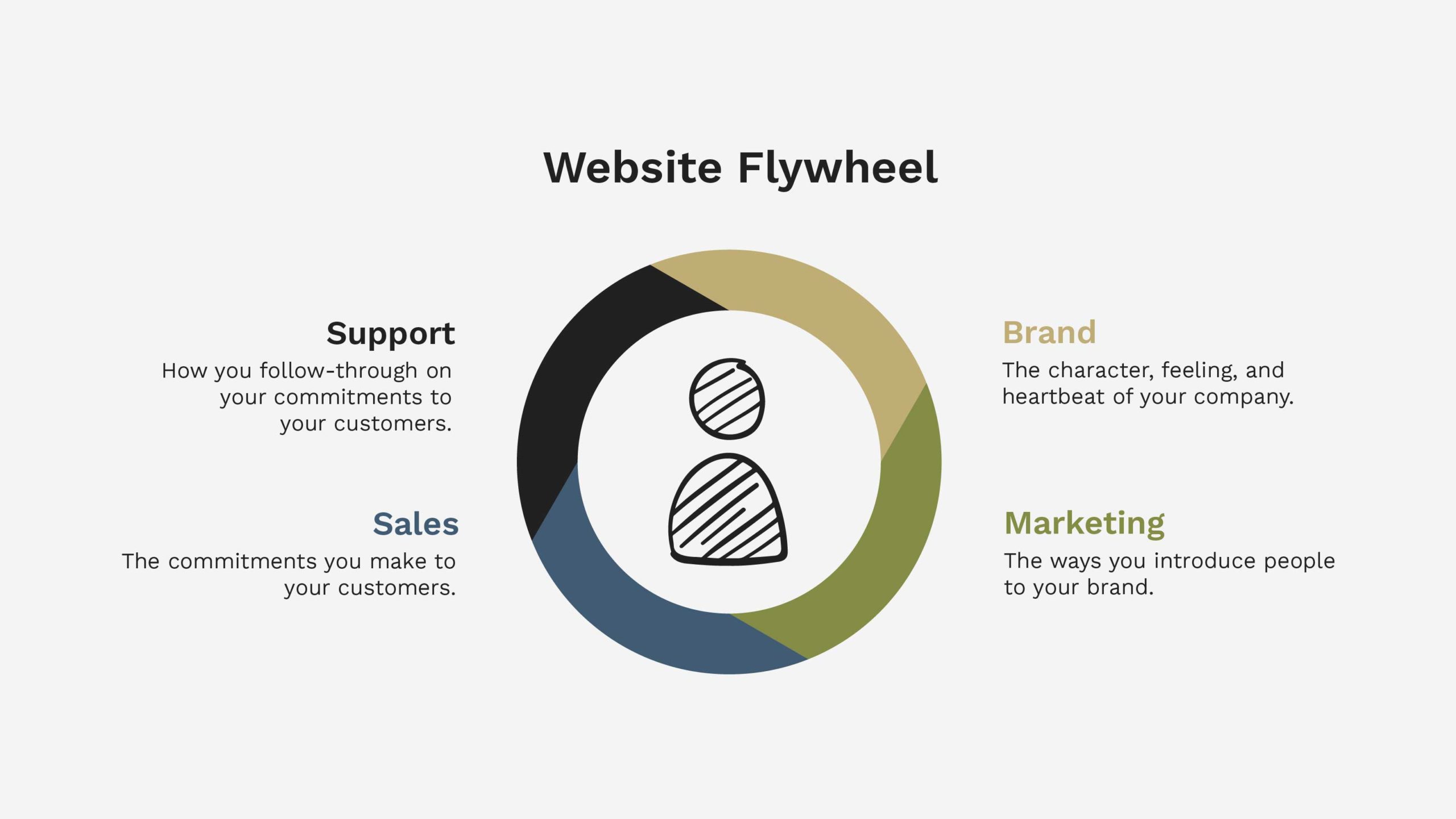
    In our free webinar How to Build an Attractive, High-Converting Website That Makes You Proud, we discuss your website as a flywheel. Let me explain.

    Website Flywheel

    A flywheel is a mechanical device that conserves angular momentum to store rotational energy. That may sound not very easy, but it’s straightforward.

    A flywheel is a circular device used on trains, tractors, trucks, and any large machine with a big job to increase horsepower and create explosive momentum.

    Your website is like a flywheel. It’s intended to create momentum and be a force multiplier for your marketing and business efforts. And when it’s designed and built to accomplish that objective, more often than not, it succeeds!

    The Glaring Problem with Website Builders, Templates, and Themes

    Need help with a Squarespace or Wix website? We can’t help you (other than help you move your website away from them).

    Those website builders (like Wix, Squarespace, Duda, GoDaddy, Weebly, etc.) don’t help you create a flywheel that multiplies force for your business.

    Instead, they help you create a clusterfuck (pardon my French) of a website. It makes you want to throw your laptop out of your office window.

    Those are not my words, by the way. They came from a recent client who desperately needed help migrating his website from Squarespace to WordPress because Squarespace drove him mad!

    Website builders do this by requiring you to start the entire process by picking a template. Then, jumping right into the building without giving the nod to your goals or unique needs as a business. They skip the entire planning process, assuming you did or will never do it.

    Skipping website planning is a fatal mistake.

    WordPress templates or themes readily available have many of the same issues. It can work if you buy a template or theme that fits your plan. It will fail if you pick a template or theme as your plan.

    WordPress Website Facts

    Here are a handful of encouraging facts.

    • WordPress is used by 42.8% of the top 10 million websites
    • There are over 455 Million WordPress websites, accounting for more than 39% of all websites
    • 62% of Inc. 5,000 websites run on WordPress
    • The New York Times, Forbes, eBay, The Walt Disney Company, and Best Buy are powered by WordPress
    • WordPress has been around since May 27, 2003
    • There are over 58,000 plugins (integrations) available for WordPress
    • WordPress is the web’s most widely used CMS (content management system)

    We all know that facts tell and stories sell. So why does Structure use WordPress, and why do we recommend you use it for your project? Here are the reasons.

    Why Structure Uses WordPress (and You Should Use Too)

    1. WordPress is widely adopted

    As you can see from the facts above, WordPress dominates the website market. This means somebody will always be available to help you with troubleshooting or customization needs.

    I frequently mention this assurance to my clients. If an unfortunate event renders Structure unable to continue working with them, they would have no difficulty locating a developer replacement who could work on their WordPress websites.

    For the record, Structure isn’t going anywhere. However, knowing you’re not choosing an obscure platform only specialists can use is peace of mind.

    We recently migrated a client’s website from a platform called Higher Logic to WordPress. The client is so much happier after the transition. I share this story because Higher Logic is one of those obscure platforms. While some use it, it’s highly specialized and requires paying a high-rate developer to make almost any update.

    2. It is easy-to-use

    There’s a myth that WordPress offers a user-friendly interface that does not require coding knowledge or experience. It does provide a user-friendly interface. But we have to be realistic with setting expectations to ensure that we know not everyone understands it.

    “WordPress does not require coding knowledge or experience” is also misleading. It may not require knowing a coding language like CSS or Javascript. But a basic understanding of HTML and development principles will take a long way.

    If you do not have a basic understanding, you will struggle. That’s precisely why folks hire Structure to help. You value the system WordPress offers, but you don’t know how to manage the technical details of the platform yourself.

    You can easily add pages and posts to your site, customize layouts, create menus and links, upload images and videos, and more. This still makes WordPress an excellent choice for small businesses and large teams.

    WordPress has the potential to provide you with a simple-to-navigate backend CMS. Alas, that doesn’t always seem to be the case. I have conversations with numerous customers apprehensive about using WordPress due to their prior negative experiences while trying cumbersome interfaces.

    WordPress Training & Support

    Our website development packages at Structure include an optional 1-hour recorded training and support video call. In this call, we train you to use your website and navigate WordPress. Furthermore, we include two additional support hours within 30 days of launch. That way, you have no reservations about contacting us for questions, big or small.

    Last but not least, our WordPress websites are designed especially for user convenience. Content can easily and quickly be edited or updated with little technical expertise. We accomplish this by using Custom Fields. You can edit copy or media in the back end without breaking your website on the front end.

    3. It is excellent with SEO

    WordPress’s most powerful benefit is its impact on your SEO (Search Engine Optimization). Some powerful plugins like YoastSEO for WordPress and LinkWhisper can significantly enhance how your website is tagged to rank for Google. It also makes it brain-dead simple to optimize your content for search.

    It’s worth noting that SEO is not automatic, and WordPress doesn’t do all the work for you. However, the data structure allows you to input and optimize data without jerry-rigging anything.

    In short, think of WordPress SEO like T-ball. The baseball is just sitting on the tee—you need to hit it. Same thing with SEO on WordPress. It tees you up, and you have a swing if you know how to hit a ball.

    4. WordPress is owned

    This might be one of the most significant selling points of WordPress. It’s what’s called an ‘open source’ platform. It is accessible worldwide, and you don’t have to pay for a license.

    With a WordPress site, you own the code base and don’t have to pay a license fee to anyone to keep your website. You also can modify and change the code as needed.

    That said, you still have to pay for infrastructure costs like domain and website hosting, which often come all-inclusive with other platforms like Squarespace, Shopify, and Wix.

    5. WordPress is secure

    Website security has always been a concern but is becoming increasingly so as time goes on. As the internet becomes more widely adopted, cybercriminals and hackers (that’s what they’re called!) are getting more innovative and savvier, while website managers are getting more relaxed and trusting.

    If you’re worried about the safety and security of your website, you should be at ease because it’s a secure platform as long as you keep it up to date.

    WordPress security vulnerabilities commonly come from outdated plugins and themes, weak passwords, and other preventable issues. So you’ll need to ensure your WordPress Core, Themes, and Plugins are current. We recommend doing this monthly at a minimum. If you’re particularly concerned, weekly updates are sufficient.

    Managing Security Vulnerabilities

    Most of Structure’s clients don’t want to manage their security, let alone update their website monthly and ensure it is still in perfect working condition. We offer WordPress Website Management packages after completing a website project. We find that most of our clients beg for help in this area!

    All Structure WordPress Website Management packages include these features:

    • Plugin and WordPress Core Updates (monthly)
    • Dedicated Account Manager
    • 24-hour Response Time (during the workweek)
    • Detailed Website Report (monthly)
    • Cloud Backups (daily)
    • Advanced Security (Malware Scans, Firewall, Bot & Login Protection)
    • Activity Log
    • Uptime Monitoring

    The benefit of hiring Structure for WordPress Website Management is ensuring your site is safe, secure, always running 24/7, and working as expected to grow your business.

    6. WordPress is scalable

    WordPress is renowned for its scalability, as it can create a single-page website or an enterprise solution with tens of thousands of pages. The scope of your imagination and budget only limits you. Structure has built websites ranging from one page to hundreds of pages.

    WordPress is incredibly versatile, and you can use it to create any website:

    • eCommerce website
    • Business website
    • Blog website
    • Portfolio website
    • Event website
    • Personal website
    • Membership website
    • Nonprofit website
    • Informational website
    • Online forum

    WordPress is widely used for eCommerce, as well as blogs, news sites, membership sites, auction sites, and more. You can also choose from thousands of plugins and themes, so you’re never limited in design or functionality. 

    Integrations

    As we mentioned in the facts above, there are over 58,000 plugins available. That means there are 58,000+ ways you can integrate your business systems—no matter what they may be—with your WordPress website.

    A few popular plugin integrations we’ve configured are:

    • LearnDash
    • Salesforce
    • HubSpot
    • MailChimp
    • Intercom
    • Zapier
    • Convert Kit
    • Slack
    • Square
    • Authorize.net
    • Stripe
    • ShipStation
    • Airtable

    WordPress is not limited by space or bandwidth. Your website can grow as large as needed without any performance issues. Particularly those that might occur if you used a platform like Squarespace or Wix.

    Website Hosting

    For example, website Hosting is highly flexible and scalable. You’re not trapped by the quality of hosting that Squarespace or Shopify has chosen.

    If you’re a small business start, you can buy cheaper hosting. It will integrate with WordPress.

    Or maybe you’re a growing business with tens or hundreds of thousands of monthly visitors. You can plug in a quality host like WP Engine (our recommendation), which will integrate well.

    The scalable nature of WordPress makes it the ideal CMS for startups and growing businesses.

    7. WordPress is stable

    There’s a big problem with content management systems. Can you tie your business to something new if it won’t be around next year?

    If you’re evaluating some of the website builders out there, you should. be concerned—mainly those created and managed in other countries.

    However, WordPress has been around since May 27, 2003. It is so widely adopted you have the comfort of knowing that, in all likelihood, it’s not going anywhere.

    The platform is continually updated and improved, keeping current with the ever-changing technology landscape. And because it’s open source, developers are constantly working on significant updates, new features, and security patches. This means your website will stay up-to-date and secure.

  • One Website, Six Budgets: What Does a 0 and Up Website Budget Look Like?

    One Website, Six Budgets: What Does a $500 and Up Website Budget Look Like?

    Structure’s mission is to deliver the most efficient yet human website design and build experience while being on budget. We ultimately improve our client’s businesses by helping them get better business results from their websites. 

    One of the ways we do this is by providing unbiased information about website design and development costs upfront. Hence, potential clients have a better idea of the budget they need for the project they envision. 

    We also go through a website project budgeting exercise with all new clients during onboarding and design their website to that budget. We have website designers and developers with many years of experience on staff. We have created countless website estimates over the years, so we share what we know from our firsthand experience around website design costs to help clients planhttps://wearestructure.com/website-budget-template/ a successful project. 

    What Do Most Websites Cost?

    Potential clients frequently ask us what different budgets will afford them: “Is $5,000 a good budget,” “What will $10,000 get me?” or “What does a $50,000 website even look like?”. 

    So, we devised a breakdown of one website with six different budgets, from $500 to $100,000. As you’ll see, a budget can be exhausted quickly in website design and development, but with smart choices and good planning, you can make the most out of any budget.

    Remember that these estimates are if the website is designed and built top-to-bottom. Most clients phase large projects so that payments (and development) are completed in manageable chunks over time.

    Any website design or budget exercise starts with the existing website. Gather all your website ideas and inspiration, then note what you’d like to keep, remove, or add. 

    Let’s assume the website we will redesign has the following five pages with no more than basic functionality. Think simple, local, small business website.

    1. Home page
    2. About page
    3. Products or Services page
    4. Blog page
    5. Contact page (with a basic contact form)

    A $500 Website Redesign: Personal

    Ultra-low budgets like a $500 website are only possible using a DIY platform, theme, or template. It’s doubtful that you’ll be able to hire anyone to help redesign the website unless they’re just starting and you’re one of their first clients.

    The best options are using WordPress with quality hosting and a premium theme. You’ll likely need to buy the theme and a few plugins to go along with it. You could start with Squarespace or Wix; however, if you’d like to grow shortly, you’ll want to migrate or replatform to WordPress—so you might as well start there if you’re able. It’ll save you time and money later!  

    • WordPress Hosting (through WP Engine): $250/yr
    • WordPress Theme: $200
    • Contact Form Plugin (through Gravity Forms): $50

    A $5,000 Website Redesign: Informational

    The $5,000 website budget stays very simple, but you no longer need to DIY and have room to find a website freelancer. Most freelancers would be thrilled to redesign a website on this budget.

    With this budget and someone helping with the work, you’ll get a website template that’s semi-customized and molded to your needs, with a few additional bells and whistles. 

    For example, the contact form might be more advanced with drop downs, radio buttons, or multi-page. The web designer might also include text animations or cleaner breakpoints for mobile devices.

    Lastly, you’ll likely be able to include some SEO and content creation or population help there. You’ll still be sourcing media and managing the project yourself.

    • WordPress Hosting (through WP Engine): $250/yr
    • WordPress Theme: $200
    • Contact Form Plugin (through Gravity Forms): $50
    • Freelance Template Customization & Build: $3,500
    • SEO & Copywriting: $1,000

    A $15,000 Website Redesign: Transformational

    The $15,000 website redesign makes a giant leap and allows you to hire help and add uniqueness to your website with a custom design. Additionally, you’re likely getting out of most freelancer territory here and will need to find and hire a professional website designer like Structure to design and build your website.

    At this budget, you’ll also get away from website themes, templates, and DIY platforms like Squarespace or Wix and will get a custom design unique to your business. 

    You’ll have the chance to consider your Website Strategy: how your company uses your website, how your customers are using your website, and how you can design and build your website to facilitate quicker purchases and simpler user flows. This is something that your website design team could facilitate with you.

    • WordPress Hosting (through WP Engine): $250/yr
    • WordPress Theme: $200
    • Contact Form Plugin (through Gravity Forms): $50
    • SEO & Copywriting: $2,500
    • Custom Design: $7,000
    • Development: $5,000

    Along with custom design will come professional copywriting and stock image sourcing. You’ll want to let someone else help clarify your message on your website.

    A $25,000 Website Redesign: Transactional

    At $25,000, your custom-designed website and professional content will get new functionality. At this price point, you’ll be able to add e-commerce functionality, payment processing, and integrations to your business systems, like your Customer Relationship Management (CRM) platform, Enterprise Resource Planning (ERP) platform, your Email Service Provider (ESP), and others.

    • WordPress Hosting (through WP Engine): $250/yr
    • WordPress Theme: $200
    • Contact Form Plugin (through Gravity Forms): $50
    • SEO & Copywriting: $3,500
    • Custom Design: $10,000
    • Development: $5,000
    • Service E-Commerce Pages & Payment: $5,000
    • Business Systems Integrations (CRM, ERP, ESP): $1,000

    Your website has turned from personal to transactional. You can now use your website for more than just information and brand recognition; it’s a business tool that can take orders, support customers, and process data.

    A $50,000 Website Redesign: Growable

    The $50,000 website is entirely custom while still on a CMS like WordPress and built for processing transactions at scale.

    With the same 5-page structure, this budget invests beyond the website infrastructure into optimizing and growing the website operations. You’re investing in content development, Search Engine Optimization (SEO), Conversion Rate Optimization (CRO), and Content Marketing and advertising for growth—plus help with website management to keep it running smoothly.

    • WordPress Hosting (through WP Engine): $250/yr
    • WordPress Theme: $200
    • Contact Form Plugin (through Gravity Forms): $50
    • SEO & Copywriting: $5,000
    • Custom Design: $10,000
    • Development: $5,000
    • Service E-Commerce Pages & Payment: $5,000
    • Business Systems Integrations (CRM, ERP, ESP): $1,000
    • Content Marketing & Ads: $17,500
    • Website Management: $6,000

    A $100,000 Website Redesign: Scalable

    A $100,000 Website Redesign further expands the content into custom photography and video, increasing SEO, CRO, Content Marketing, Advertising, and Management budgets.

    • WordPress Hosting (through WP Engine): $250/yr
    • WordPress Theme: $200
    • Contact Form Plugin (through Gravity Forms): $50
    • Copywriting: $5,000
    • Custom Design: $10,000
    • Development: $5,000
    • Service E-Commerce Pages & Payment: $5,000
    • Business Systems Integrations (CRM, ERP, ESP): $1,000
    • Custom Photography & Videography: $18,000
    • SEO & CRO: 
    • Content Marketing & Ads: $37,500
    • Website Management: $6,000

    How to Design to Your Website Budget

    At Structure, we discuss your budget at the start of the website design process to minimize surprises when it comes to build. We want to ensure our design team can personalize your website, delivering a vision that includes what’s most important for business and industry—while keeping costs within range. 

    Ready to level up your website and grow your business with a professional website design? Schedule a Free Consult Call or explore our design packages today!

    Common Questions About Website Budgets & Cost

    What should I budget for a website in 2023?

    If you’re alive in 2022, you’ll notice that costs are going up around you. Your website will likely cost more next year than it does this year. However, the cost factors are the same.

    These factors can include the complexity and size of your website, the features you require, your industry and business goals, and the level of expertise of the website designer or agency you hire. Additionally, costs may be affected by market conditions and competition.

    However, some general estimates can help to provide a starting point. For example, according to Entrepreneur magazine, the average cost of building a simple website from scratch is between $3,000 and $15,000. Factors that impact this price range include the complexity of your design requirements, the number of pages, and the level of technical expertise involved.

    The costs may be much higher if you want to develop a more complex website with interactive features or ecommerce functionality. However, there are many ways to reduce your overall web design budget by working with an experienced agency like Structure that offers custom packages and flexible pricing models. 

    Ultimately, the best way to determine the cost of your website design is to take the Website Builder Quiz or Schedule a Consult Call and discuss your goals, design requirements, and budget constraints with Structure. With this information, our team can work with you to create a custom package that meets your needs and budget.

    Can I build a website for less than $500?

    You don’t have to delay building a website because you can’t afford a professional web designer or developer. Keep in mind that you may not get a full-blown e-commerce store; there are many things you can do (including selling products) for $500 or less.

    Most people who build a website for less than $500 do so for a specific reason. You might want to test a market or your web presence and determine what kind of customer base you will have once you get off the ground. 

    Or maybe you have a successful brick-and-mortar store and need to expand online to increase sales and business. You want to do it quickly and cheaply to ensure it’s even going to work before you pay $15,000 to $50,000 for a website. 

    Whatever your reason for building a website for less than $500, research and choose the right platform or template. We recommend WordPress if you’re looking to integrate into complex business systems or Shopify if you want an all-inclusive, simple platform. 

    Ultimately, whether you can build a website for $500 or less depends on your goal and skills, but it’s possible to create an online presence at a meager cost.

    What factors go into website cost?

    Several factors can impact the cost of website design, including the complexity and size of your site, the features you require, your industry and business goals, and the level of expertise of the designer or agency you work with. Additionally, costs may be affected by market conditions and competition.

    Some common examples of website features that can affect the total cost of your project include ecommerce functionality, custom design and development, SEO optimization, and integration with business systems like CRM and ERP. Other factors that can impact costs include the quality of your content, the level of personalization you require for your site visitors, and whether you need any ongoing support or maintenance services.

    That said, here’s a standard estimate of website cost factors for most websites annually.

    • Domain ($0.95 – $12 / DOMAIN)
    • SSL certificate ($0 – $1500 / CERTIFICATE)
    • Website hosting ($24 – $24,000 PER YEAR)
    • Style or theme ($2,000 – $15,000)
    • Responsive design ($3,000 – $25,000)
    • Website pages ($1,000 – $10,000)
    • Interactive media ($250 – $10,000)
    • Content management system ($2,000 – $25,000)
    • Ecommerce functionality ($2,000 – $25,000)
    • Database integration ($2,000 – $25,000)

    Can I get financing for my website design project?

    Yes, there are many options for financing your website design project. One popular option is to work with an agency that offers flexible payment plans and custom pricing models, such as Structure. This can help you spread your project’s cost over time while getting a high-quality website that meets your needs and budget.

    Other financing options may include working with a bank or other financial institution, taking out a personal loan, or using online platforms like Kickstarter or Indiegogo. 

    In our article: Website Budgeting: What to Spend, Where to Save, and How to Finance, you can learn more about our recommendations for financing a website design, redesign, or development project.

    How much should I budget for a website builder?

    Many website builders offer low-cost plans with basic templates that allow you to quickly get online at an affordable price.

    Website builders can be free or cost up to $500 monthly, with annual maintenance fees between $0 and $5,400. The cost of a website builder will depend on several factors, including the features and functionality you require, your budget constraints, and the level of support and maintenance services included in your package.

    However, we would be remiss if we didn’t mention the opportunity cost of a website builder. What you don’t pay for in money, you will pay for in time.  Building a website yourself or with the help of an agency requires extensive time and expertise, which can sometimes be just as expensive—if not more so—than working with a website builder.

    Suppose you consider using a website builder to develop your online presence. In that case, it is crucial to carefully evaluate what you’d be losing in time or sales if you try to build your website yourself because the opportunity cost may be higher than the custom website design package cost you were considering.

    How much should I budget for website maintenance? 

    Keeping your website up and running can range from $35 to $50,000 (or more) per month, depending on several factors. However, it’s important to note that prices vary monthly, so many service providers may request upfront payment for the entire year.

    Factors that can affect your monthly website maintenance costs include the size and complexity of your site, your industry, the level of customization required, and whether you need ongoing support or updates. Other considerations may include marketing services and marketing automation tools to help increase traffic, engagement, and conversions on your site.

    To get a more accurate picture of your website’s total costs, consider the upfront and ongoing expenses of developing, maintaining, and growing your online presence. 

    How much should I budget for website marketing?

    Companies spend anywhere from $2,500 to $12,000 monthly marketing their website. Some invest even more, depending on the marketing strategies they pursue.

    Services like SEO, Content Marketing, and Digital Advertising all fall under the umbrella of digital marketing. This is just a tiny sample of what’s included in the budget for marketing. Your company can decrease costs by cutting down on how many strategies it employs.

    If a company solely decides to focus on SEO rather than adding digital advertising into its marketing strategy, it will have lower costs. Revenue and sales numbers have improved for businesses that use digital marketing as part of their plan; however, this method’s success is contingent upon your website.

    For example, marketing tactics such as SEO and Digital Advertising bring users to your website. If you want these visitors to stay on your site, it’s essential to have a user-friendly design that is easy to navigate.

  • 5 Stages of a Successful Website Redesign Process That Works Every Time

    5 Stages of a Successful Website Redesign Process That Works Every Time

    Redesigning a company website can feel intimidating, especially if you’ve never done it before or you’re already overwhelmed by the projects on your plate. It’s so much easier when you have a proven website redesign process to follow.

    In this article, we will walk you through the Structure Website Redesign Process that we’ve used for hundreds of clients over the last five years (September 20, 2023, at the time of this writing).

    To cut to the chase, we have a 5 Step Website Redesign Process that works every time (if you follow it!).

    1. Define
    2. Design
    3. Develop
    4. Manage
    5. Grow

    You can do these steps on your own or with your internal team. You could probably get a solid head start with this article and our Free Website Redesign Planning Guide.

    However, if you’re considering hiring an expert to help with your website redesign project, it’s much easier to trust someone who has a plan and has worked on it repeatedly.

    Unfortunately, you don’t get that with most local web design agencies or freelancers.

    This 5-Step Website Plan is the same process we’ve used for clients in executive coaching, manufacturing, private equity, e-commerce, cannabis, consumer packaged goods, and many more.

    If you’re in one of those industries, that’s great! But even if you’re not, this website redesign process will still work for you.

    And even if you’ve got a small website or spinning off a new one, you can use this process. While it’s perfect for a website redesign, it works great for a new website.

    Let’s build a website that keeps your customers hooked.

    Step 1: Define – Website Planning

    A website redesign isn’t art.

    It’s science.

    Unfortunately, in the many website redesign projects we’ve worked on, the primary problem with any web project that doesn’t meet goals or expectations is a failure to plan.

    Of course, at Structure, we start with planning. So that’s not an issue when you work with us.

    But in my experience as a digital marketing veteran at software companies and agencies, the same website issues have come up over the years.

    And they all come back to one thing: failure to plan.

    It’s not just my experience, either!

    Research suggests that 68% of marketers did a site redesign in the last 12 months – but 1/3 were unhappy with the results.

    Furthermore, failed website redesigns cost an average of $55,000 plus an additional $115,000 over the next 12 months to fix.

    Ralf Speth, CEO of Jaguar Land Rover, said it best:

    If you think good design is expensive, you should look at the cost of bad design.

    Likewise, if you think a good website is expensive, you should see the cost of a bad website.

    That is why we start every website redesign process with a website plan. And you should, too.

    Get Our Free Website Redesign Planning Guide

    Download the Structure Website Design Planner to plan a website launch that makes your project successful!

    How does the “define” stage of the Structure website redesign process work?

    All website projects start with a free 30-minute Consult Call where we’ll gain an understanding of what you’re hoping to create.

    We’ll ask questions like…

    • Why do you need a new website?
    • What do you need your website to do for your business?
    • How did your last website perform? What worked/didn’t work?
    • Which platforms are you using, and do you like them?

    During this call, we’ll also be able to recommend a website design package that fits your goals. Once you decide on a package, we’ll start with a virtual or in-person Website Workshop.

    During this workshop, we’ll help you define and document the following information:

    1. Basic company information
    2. Who is on your team
    3. The vision for your website
    4. A competitive analysis
    5. Brand documentation
    6. Your buyer’s journey
    7. A sitemap of your pages
    8. Content plans for each page
    9. Technology requirements
    10. Website build budget

    The final answers comprise your Website Plan.

    Step 2: Design – Website Layout

    Website design is more than mocking up a pretty version of your brand for a webpage; it’s designing a home for your customers to visit to engage with your business and buy from you!

    Whether you’re starting by looking for a fresh look for your website or you already know you want to add new functionality, the website redesign process hinges on understanding what makes an outstanding strategic design.

    Website Redesign Process: Define

    What is a strategic design, you might ask?

    A strategic design is these things:

    • Visually appealing and on-brand
    • Well-organized and easy to navigate
    • Engaging with compelling content
    • Designed for your target audience
    • Optimized for search engines
    • Responsive, so it looks good on all devices

    Creating a strategic website design that meets all these criteria can seem daunting, but it’s important to remember that your website is a vital part of your business and should reflect your brand and meet your business goals.

    In short, your website design should focus on how it works, not just how it looks.

    How does the “design” stage of the Structure website redesign process work?

    The Structure Website Design Package you choose will determine what you receive from the process. However, here are some of the deliverables you can expect:

    • Wireframes
    • Desktop Designs
    • Mobile Designs
    • Tablet Designs
    • Content & Media
    • Functional Specification

    If you’re unsure what this means, that’s okay! Our team of website design experts can help. We’ll coach and consult with you to clearly understand the goals and needs of your website, and then we’ll create a custom website design that’s right for you.

    Step 3: Develop – Build

    During the website development process, the aim is to create a site that aligns with the design concepts established in the prior phase.

    Moreover, this is the stage where you guarantee that your website operates smoothly, catering to the objectives, technology, and user requirements outlined in the Website Plan.

    This is another reason the website plan is so critical. It is a guiding source of truth throughout the website redesign process.

    Achieving these objectives will create a website that accomplishes your plan and sets you up to crush your business goals.

    Website Redesign Process: Development

    How does the “development” stage of the Structure website redesign process work?

    Upon your approval of the Functional Specification (the final design deliverable), our development team will begin building your website on a separate development site so your live website isn’t affected. 

    We’ll optimize your website for all devices and browsers and essential SEO, accessibility, and load speed as standard practice.

    Then, we’ll break your website. But don’t worry, it won’t stay broken!

    We’ll fix any issues and put checks in place to ensure it’s bulletproof for your team and users.

    Testing is completed with a Training Call so you know exactly how everything works. Then, you’ll get to review and approve your website.

    When you approve, we’ll launch your website and push it live onto your domain for customers to use and love. 

    If you’re lost by now, here’s a quick recap:

    1. Structure Builds Your Website
    2. Structure Completes Quality Assurance (testing)
    3. Structure Provides Website Training
    4. Your Review
    5. Structure Launches Your Website

    Ultimately, by the end of this step, you’ll have a new website to delight every visitor.

    Your website will be easy to manage and set up to work for your business.

    And we have a Work For Free Warranty to cover you in case of any unexpected flaws.

    Step 4: Manage – Updates & Monitoring

    All websites must be updated and optimized, especially after being redesigned.

    It’s a common practice for local agencies to “lock” you into a management plan with them. Often, this subscription is part of the deal. Or, they might hold the key to your hosting.

    Either way, we’re not fans of locking you into anywhere you don’t want to be.

    That includes a management or hosting plan you don’t know why you’re paying for. That’s not our style.

    Website Redesign Process: Support

    We want to hand off your website to your team with training and support to ensure it’s working and meeting your business goals.

    You’ll have every tool and resource if you want to manage it yourself.

    However, managing your website takes time. It can easily take a few hours a week.

    Most clients don’t have a team to hand their website to, so we continue working with an active WordPress Website Management package.

    We love managing websites we’ve built, and it’s honestly one of our favorite partnerships for long-term growth.

    The reason is that we’re “in your corner” to support any ongoing initiatives, optimizations, and projects.

    We’re here for whatever you need, as long as you need it.

    How does the “manage” stage of the Structure website redesign process work?

    Website management with Structure is more hands-off for you than most other steps in the website redesign process.

    This means you may not see much of what’s happening in the background.

    But as soon as you hand off your website for management, we immediately do the following:

    • Setup daily site backups
    • Test forms and conversion funnels
    • Make monthly plugin and software updates
    • Report on website performance monthly
    • Audit website performance & SEO annually
    • Make ourselves readily available to answer any questions you have

    That’s it! If you want to learn more, you can download our free PDF Overview (no email required).

    Step 5: Grow – Increase Results

    In the end, the effectiveness of your website launch hinges on its capacity to generate traffic, capture leads, and drive sales.

    However, achieving these objectives becomes impossible if your website isn’t functioning correctly. In this final phase, you will execute marketing campaigns tailored to your target audience.

    Subsequently, you will consistently fine-tune your strategies in response to the distinctive challenges and opportunities you encounter. The growth phase is where your website truly reaches its full potential.

    How does the “grow” stage of the Structure website redesign process work?

    Often, we work with our clients to develop a sales funnel to drive sign-ups and sales.

    For most clients, this means focusing on three initiatives, in order:

    1. Acquire Traffic
    2. Generate Leads
    3. Increase Sales

    Website Redesign Process Common Questions

    [gs_faq id=”2091″]

    [gs_faq id=”2093″]

    [gs_faq id=”903″]

    [gs_faq id=”892″]

    [gs_faq id=”895″]

    [gs_faq id=”897″]

    [gs_faq id=”2095″]

    [gs_faq id=”2097″]

    [gs_faq id=”2099″]

    [gs_faq id=”2102″]